Two Critical EIPs Designated as Essential Deliverables for Ethereum's Hegotá Network Upgrade
In preparation for Hegotá, the Ethereum Foundation has assessed and categorized 62 different proposals, clarifying which modifications are likely to be implemented and which ones are still being evaluated for inclusion.
Two proposals have been singled out by the Ethereum Foundation as essential deliverables for the upcoming Hegotá upgrade, with the organization placing emphasis on strengthening censorship resistance and enabling more adaptable account authentication mechanisms as it defines the parameters of this network fork.
This comprehensive evaluation process examined 62 different Ethereum Improvement Proposals (EIPs), incorporating feedback from approximately 60 researchers and engineers who are part of the Foundation's Protocol cluster. This represents the inaugural instance where the Foundation's Protocol cluster has released a consolidated perspective on proposed EIPs instead of presenting disparate viewpoints from individual development teams.
EIP-7805, commonly referred to as FOCIL, and EIP-8141, also known as Frame Transactions, comprise the two essential proposals, with the Foundation identifying them as the primary consensus and execution-layer features for the Hegotá upgrade.
The purpose of FOCIL is to establish a mechanism allowing users to ensure their eligible transactions are included in blocks without depending on centralized block builders, thereby enhancing Ethereum's ability to resist transaction censorship.
The implementation of Frame Transactions would bring native account abstraction to the network and establish a foundation for authentication methods that are resistant to quantum computing attacks. When combined with two associated proposals, this modification could additionally offer protocol-level infrastructure components for applications focused on privacy.
By designating these two proposals as "must ship," the Foundation has essentially made them the defining features of the upgrade. Should either proposal face developmental challenges, the Foundation has indicated that Hegotá's timeline should be modified rather than removing the proposal from the upgrade altogether.
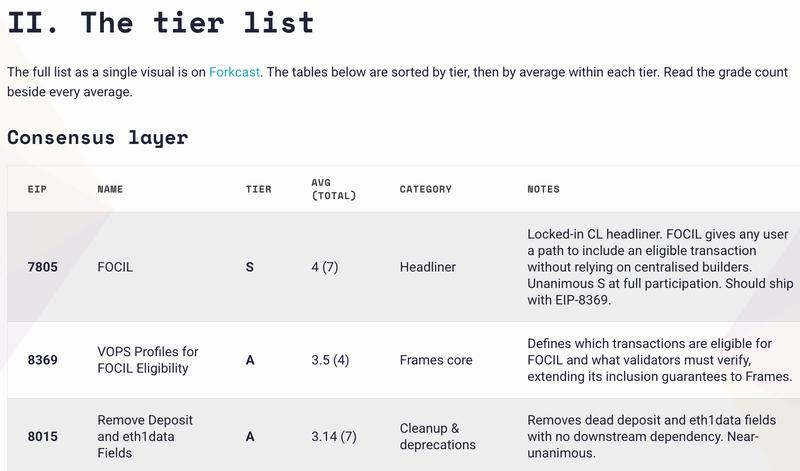
Hegotá scope still being finalized
In addition to these two priority proposals, the Foundation has categorized 15 proposals within its A-tier classification, indicating these are anticipated to be delivered unless developmental challenges or testing limitations necessitate their removal. An additional eight proposals continue to be evaluated as potential candidates for inclusion, seven have been positioned below the cutoff line while remaining under consideration, and 28 proposals have been rejected.
Two proposals have not yet received rankings as the Foundation awaits mainnet performance data from Glamsterdam, the Ethereum upgrade that will precede Hegotá and focuses on enhancing scalability while reinforcing the network's foundational layer. Based on the Foundation's projections, client development teams may commence Hegotá implementation activities in late 2026 after Glamsterdam has been deployed.
The most recent significant upgrade to Ethereum, known as Fusaka, was deployed on Dec. 3, 2025, delivering multiple enhancements related to scaling and usability to the blockchain network. The primary innovation included in Fusaka, called PeerDAS, modified the way nodes process rollup data, decreasing the volume of information that each node must download and upload while simultaneously expanding data availability capacity for layer-2 networks operating on Ethereum.