Trust Wallet rolls out instant scam detection for cryptocurrency transactions
The non-custodial wallet provider has deployed protection against address poisoning across 32 EVM-compatible networks as security threats against digital asset holders continue to escalate.
A new defense mechanism against address-poisoning schemes has been unveiled by Trust Wallet, incorporating a screening capability that aims to protect users from inadvertently transferring digital assets to fraudulent wallets designed to replicate authentic addresses.
According to an announcement made on Tuesday by the noncustodial wallet service provider, this newly implemented feature will conduct automatic verification of recipient addresses by cross-referencing them with a repository of identified scam and copycat addresses, thereby blocking potentially harmful transactions. The initial deployment encompasses 32 blockchains that are compatible with the Ethereum Virtual Machine, such as Ethereum, BNB Smart Chain, Polygon, Optimism, Arbitrum, Avalanche and Base.
The wallet provider characterized address poisoning schemes as among the "fastest-growing threats in crypto," further asserting that these attacks have exceeded 225 million instances and generated confirmed financial damages totaling $500 million up to the present day.
The technique known as address poisoning represents a phishing variant wherein fraudsters manipulate victims into transferring cryptocurrency to illegitimate wallets through an initial step of transmitting nominal amounts to them, with the expectation that unwary investors will subsequently copy and paste the fraudster's address directly from their transaction records.
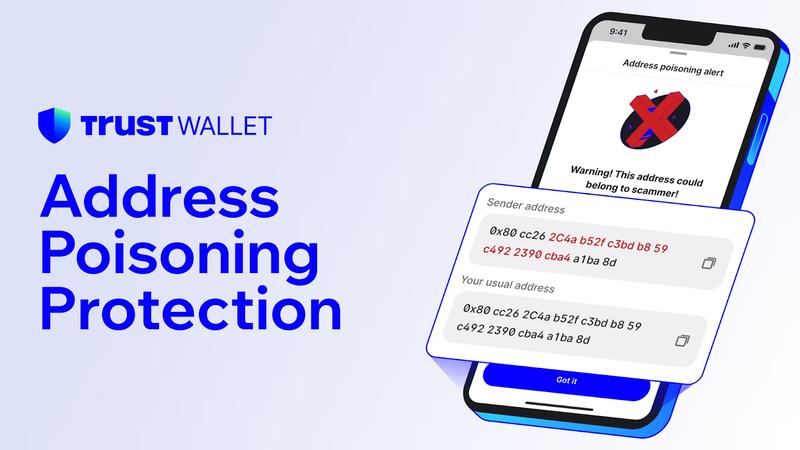
Address poisoning losses keep rising
Recent address poisoning schemes have resulted in two cryptocurrency investors collectively losing $62 million in digital assets. Among these victims, one individual suffered a devastating loss of $50 million in USDt (USDT) during December 2025, a catastrophic event that prompted prominent figures within the industry to advocate for wallet providers to deploy enhanced security protocols.
"All wallets should simply check if a receiving address is a poison address,' and block the user. This is a blockchain query,"
former Binance CEO Changpeng Zhao wrote in a Binance Square blog post on Dec. 24, 2025, adding that wallets shouldn't display similar spam transactions in the first place.
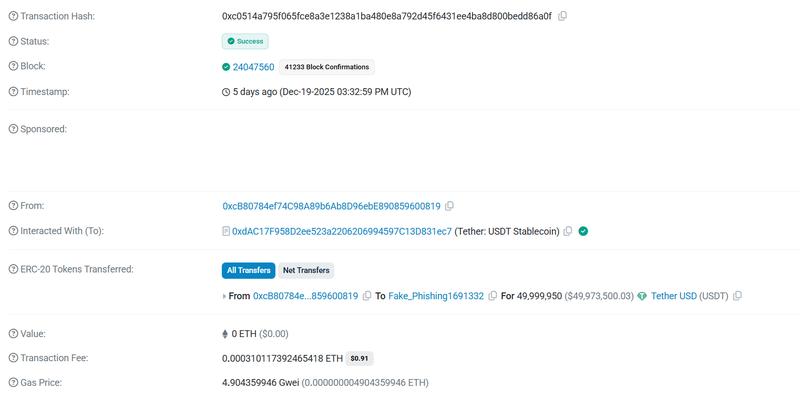
In addition to implementing spam transaction filters, cryptocurrency holders must discontinue the practice of extracting wallet addresses directly from their transaction histories, according to guidance recently provided to Cointelegraph by the Extractor team at cybersecurity company Hacken.
Additional wallet solutions that provide preventative transaction screening capabilities designed to identify and block malicious transactions include the Rabby Wallet, Zengo Wallet and Phantom Wallet.
A security breach affecting Trust Wallet's Chrome browser extension occurred on Dec. 24, 2025, leading to approximately $7 million in financial losses sustained by users. Trust Wallet subsequently deployed an updated version of its wallet application, which eliminated the malicious code, and announced that affected user losses will be covered.