Treasury Inflation-Protected Securities Contradict Inflation Story as US Bond Yields Climb
While nominal yields on Treasuries continue their upward trajectory, five-year breakevens have declined to 2.2%. Analysis of TIPS suggests the culprit is rising real yields rather than inflation — creating obstacles for Bitcoin.

Key points:
- Since the commencement of the Iran conflict, bond yields have climbed higher, with many market observers pointing to inflation concerns stemming from energy market disruptions
- Yet, Treasury Inflation-Protected Securities reveal that five-year inflation expectations stand at 2.2% and have been declining since May
- Evidence points to increasing real yields as the primary force, presenting negative implications for non-yielding assets such as Bitcoin
Q2 bond selling trend persists
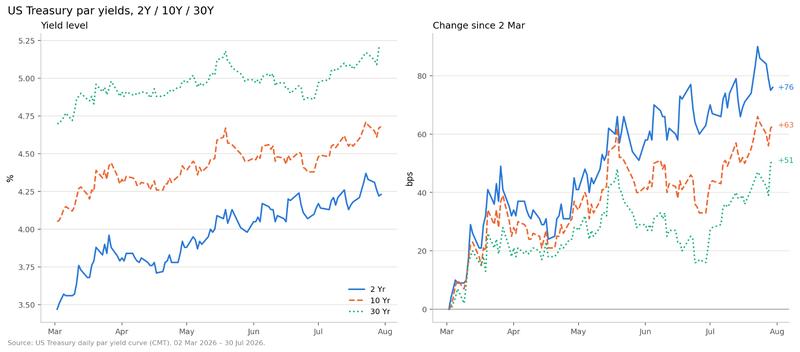
Following yields hitting local bottoms in early March, a multi-month liquidation of US government debt has been underway. During this week's latest Federal Open Market Committee (FOMC) gathering, 30-year Treasury yields captured market attention by climbing to levels not witnessed since 2007.
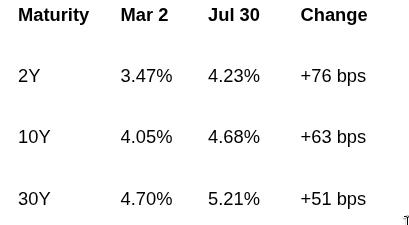
Consistent with the two-year yield climbing 76 basis points (bps) during this period, market pricing now reflects a 63% probability of a Federal Reserve rate increase in September, based on CME FedWatch data.
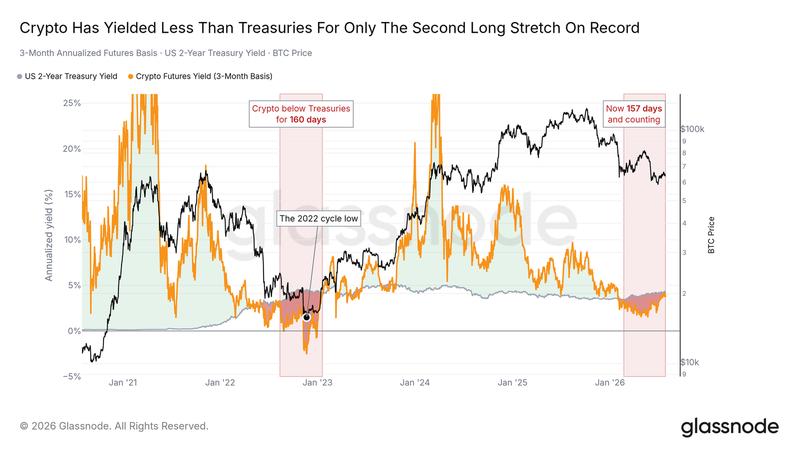
At these heightened yield levels, investments in government bonds have become, for the first time since 2019, more lucrative than cash-and-carry strategies within crypto markets, according to the most recent analysis from Glassnode.
Prevailing inflation interpretation
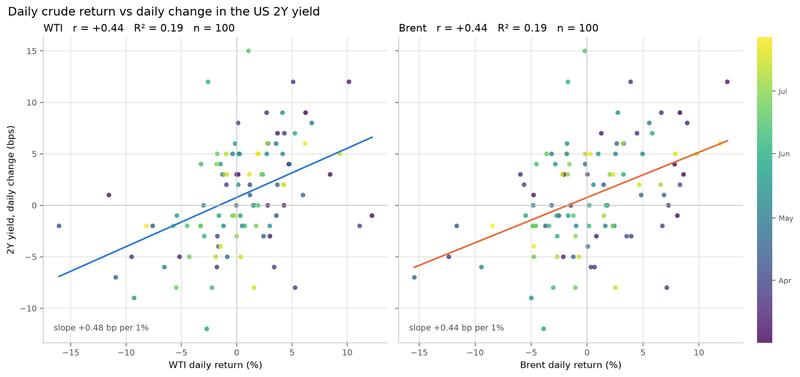
Conventional wisdom attributes the bond liquidation to inflationary forces emerging from elevated commodity and energy costs. The extended bond sell-off aligns temporally with the Iran war's commencement and subsequent closure of the Strait of Hormuz. Additionally, since March, the daily closing prices of the two-year US government bond yield, West Texas Intermediate (WTI) and Brent Crude have exhibited a correlation coefficient of r=0.44:
On Thursday, WTI momentarily climbed back above the $85 per barrel threshold following President Donald Trump's threats directed at Iran, while bonds experienced selling pressure in advance of the FOMC meeting. With no indicators suggesting imminent conflict resolution, certain observers have posited that elevated rates stem from inflation expectations.
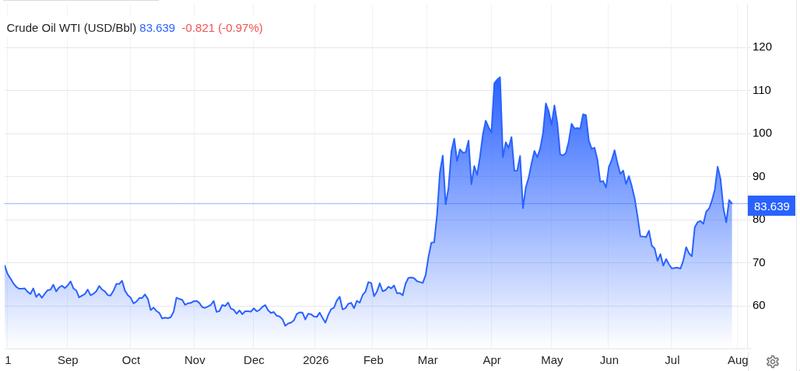
These developments have sparked prominent inflation concerns throughout mainstream financial media, with Bloomberg publishing recent headlines including "Global Bonds Are Reeling as Oil Surge Rekindles Inflation Threat", "US Yields Hit Two-Month High as Oil Sparks Inflation Risk" and "Global Bond Selloff Worsens as Rising Oil Prices Spook Investors". This interpretation has also gained traction among the crypto and precious metals communities, which remain perpetually vigilant regarding inflation.
Nevertheless, the trading behavior of other Treasury instruments contradicts the inflation-focused explanation for rising bond yields.
TIPS indicate rate increases are 'real'
Despite most analysts and market observers concentrating on conventional Treasury yields for their assessments, Treasury Inflation-Protected Securities, commonly known as TIPS, have provided unmistakable evidence challenging the inflation explanation.
Treasury Inflation-Protected Securities (TIPS) function as standard treasury bonds where the principal repayment adjusts upward according to the Consumer Price Index for All Urban Consumers (CPI-U). Beyond the inflation-adjusted principal, every TIPS instrument pays a fixed coupon rate. Consequently, in contrast to conventional bonds, both the principal and interest distributions receive inflation adjustments.
Through comparison of TIPS yields with regular, maturity-matched Treasuries, market participants can derive future CPI inflation expectations via the so-called breakeven rate. Despite rising Treasury yields overall, the five-year breakeven rate has experienced a pronounced decline since May.
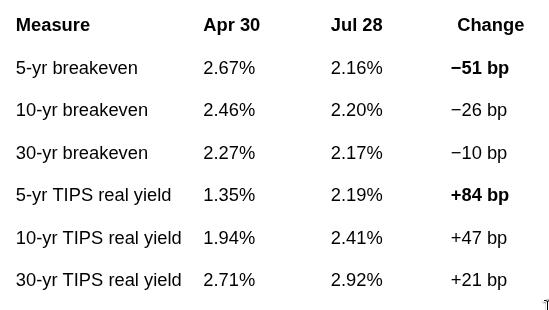
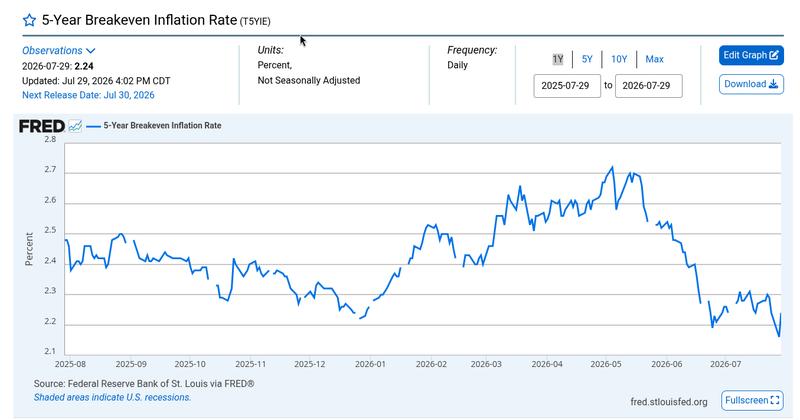
Currently around 2.2%, the five-year breakeven projects the Fed will successfully reach its 2% inflation objective over the intermediate timeframe. More significantly, however, the breakeven rate has trended in the opposite direction relative to nominal treasury yields.
During the period when five-year nominal yields increased 33 bps, TIPS analysis reveals this resulted from an 84 bps increase in the real yield, which was partially counterbalanced by a 51 bps decrease in inflation expectations. Though the inflation explanation remains narratively appealing, marketplace dynamics tell a different story. The authentic narrative centers on ascending real yields.
Potential implications for cryptocurrency markets
As a general principle, increasing "real" investment returns on bonds and equities measured in CPI terms diminish the relative attractiveness of non-yielding assets like Bitcoin for particular investor segments. Beyond this baseline effect, the cryptocurrency market impact hinges on which explanation for elevated real rates proves accurate, with multiple theories currently circulating.
Reserve liquidation — No clear impact on Crypto. Elevated oil prices expand trade deficits for energy-importing Asian nations. Given that oil transactions are predominantly denominated and settled in US dollars, shortages have emerged in local eurodollar markets throughout Asia, creating downward pressure on their currencies. The Japanese yen (JPY), Philippine peso (PHP) and Indian rupee (RBI) have all necessitated central bank intervention for exchange rate defense. These defensive measures, financed through US Treasury reserve sales, apply upward pressure to bond yields. HSBC's Frederic Neumann has publicly attributed the bond liquidation to foreign exchange pressure rather than a judgment on dollar strength.
Demand destruction — Bearish for Crypto. An oil price shock of sufficient duration transitions from being inflationary to becoming recessionary. In its second-quarter market outlook, Neuberger Berman contended that investors are underestimating the economic output damage from persistent elevated energy costs. The credit market contraction accompanying recession would prove detrimental to both equities and Bitcoin through severe liquidity constraints. As genuine indicators of recessionary credit stress, credit spreads should be expected to widen. Cointelegraph documented potential initial signals of this phenomenon on Wednesday.
Investment demand — Likely bearish for Crypto. Real rates may have additionally reacted to anticipated economic growth and capital requirements from the artificial intelligence sector. Government bond offerings are increasingly facing competition from record-breaking corporate bond issuance by AI hyperscalers. Goldman Sachs Research forecasts approximately $755 billion in AI capital expenditures for 2026 and roughly $920 billion in 2027. UBS has elevated its 2026 investment-grade issuance projection to $1.8 trillion, with technology sector supply increased to $360 billion based on hyperscaler forecasts. Given that cryptocurrency competes for similar capital pools and investor demographics, this dynamic will likely constrain the sector.