Treasury Chief Confirms $500M Confiscation of Iranian Digital Currency Holdings
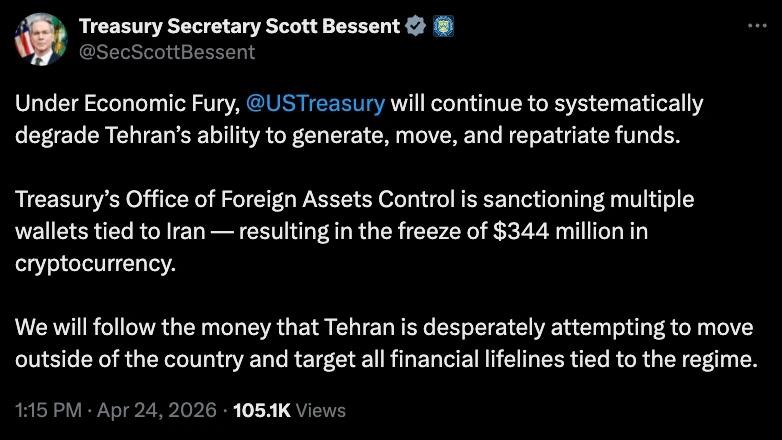
Scott Bessent, serving as Treasury Secretary, confirmed that American authorities have confiscated close to $500 million worth of cryptocurrency holdings linked to Iran, a figure that exceeds the $344 million freezing action disclosed earlier.

American authorities have confiscated approximately $500 million worth of cryptocurrency holdings connected to Iran as a component of an extensive economic pressure initiative targeting Tehran, according to statements made Wednesday by Treasury Secretary Scott Bessent.
The Treasury chief delivered these remarks while appearing on the Fox Business program "Kudlow," during which he detailed the breadth of Operation Economic Fury, an initiative commissioned by President Donald Trump in March 2025 designed to eliminate Iran's access to financial resources through the confiscation of assets, the freezing of banking accounts, and the implementation of secondary sanctions against nations continuing to purchase Iranian petroleum.
"Bank accounts are being frozen by us across the globe. What's more significant is that we're reducing the willingness of people to engage with the regime," Bessent stated, noting that Iranian officials' retirement accounts and property holdings abroad are among the targets being pursued.
The disclosed amount of $500 million represents a significant increase from the earlier announcement of $344 million in confiscated cryptocurrency holdings. During the previous week, Bessent revealed that the Office of Foreign Assets Control within the Treasury had imposed sanctions on multiple cryptocurrency wallets connected to Iran, with Tether, the stablecoin issuing company, acknowledging it had frozen in excess of $344 million worth of USDt (USDT) following requests from American authorities.
An inquiry was submitted by Cointelegraph to both the US Treasury and Tether seeking clarification regarding the discrepancy between these two amounts, though no response had been obtained prior to this publication.
Iran's economy under pressure
According to Bessent's assessment, Operation Economic Fury has inflicted significant damage on Iran's economic stability. The nation experienced the failure of one of its most prominent banking institutions in December, while its national currency has depreciated by 60 to 70% relative to the US dollar. "A currency crisis is currently unfolding in their country," he remarked.
The Treasury has further escalated enforcement measures by increasing sanctions across numerous areas. This past Tuesday, OFAC imposed sanctions on 35 organizations and individuals connected to Iran's covert banking infrastructure. In a separate action, sanctions were directed at a Chinese petroleum refining facility along with approximately 40 maritime shipping companies functioning as components of Iran's shadow fleet, which transports Iranian petroleum to purchasers in China and other locations in defiance of existing sanctions.
The enforcement measures have also impacted Iran's weapons production and unmanned aerial vehicle supply networks, with 14 people and organizations facing sanctions for obtaining components necessary for Shahed-series attack drones and fuels for ballistic missiles. Beginning in February 2025, OFAC has imposed sanctions on more than 1,000 Iran-connected individuals, maritime vessels, and aircraft under the framework of Operation Economic Fury.
Iran weighs crypto tolls for Hormuz passage
Reports surfaced earlier this month indicating that Iran was exploring the possibility of requiring vessels to pay Bitcoin-based fees for transit through the Strait of Hormuz, with unloaded tankers potentially granted complimentary passage while loaded vessels would face charges of approximately $1 per barrel of petroleum. According to Forbes reporting, Iran had already begun collecting income from such fee arrangements, although Tehran has refrained from publicly verifying these assertions.
In a related development, Marisks, a company specializing in maritime risk assessment, issued a warning that fraudulent parties were posing as Iranian security authorities and making contact with owners of detained ships, requesting payment in Bitcoin or USDt as compensation for authorization to pass through the strait.