The term 'stablecoins' no longer fits the technology's evolution, says a16z Crypto
According to Robert Hackett, head of special projects at a16z crypto, the stablecoin terminology has become obsolete as these digital assets transform into fundamental financial infrastructure that extends far beyond their initial function.
Robert Hackett, head of special projects at a16z crypto, argues that cryptocurrencies pegged to stable assets like the US dollar or gold—commonly known as stablecoins—have evolved beyond their original designation as they integrate into the worldwide financial infrastructure.
In a Friday report, Hackett explained that the terminology "stablecoins" emerged during cryptocurrency's formative period, a time characterized by extreme price fluctuations, and these digital tokens were developed to preserve consistent value and promote their adoption in routine financial transactions.
"The name was straightforward, if slightly defensive: not a volatile coin, but a stable one. It described the problem it solved perfectly. But the technology has since outgrown the label," he said.
"Stability is now table stakes. It's a prerequisite, and not the point. The question is no longer 'will it hold its value?' But 'what else can we build with it?'" Hackett added.
"That's why the name stablecoin is outdated now: It still points to the original problem it was designed to solve, not the platform it has become. The term frames the category as a patch rather than a new primitive."
The technology behind stablecoins has proven to be among the most compelling applications in the cryptocurrency sector. Data from DefiLlama shows the worldwide market capitalization has surpassed $321 billion. Usage continues to broaden across various economies as financial institutions and banks look to leverage the technology for accelerated payment systems and additional advantages.
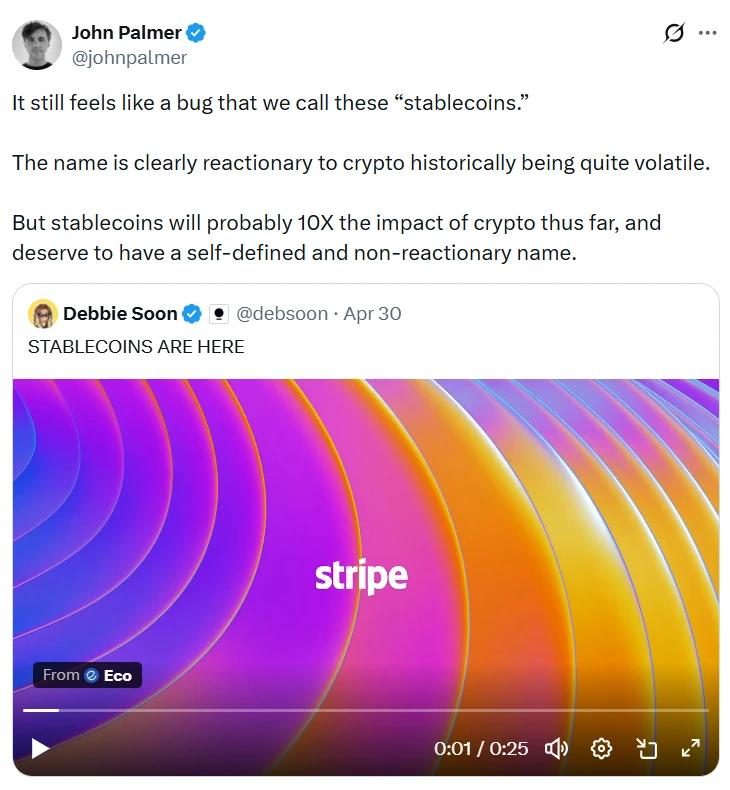
On Thursday, John Palmer, who works as a developer and brand adviser, presented a comparable perspective and stated it "feels like a bug" to call them stablecoins because "stablecoins will probably 10x the impact of crypto thus far and deserve to have a self-defined and non-reactionary name."
The stablecoin name will likely linger
According to Hackett, rebranding to terminology that more accurately represents the technology's true nature, like "digital cash" or "programmable money," proves too awkward for practical usage.
Simultaneously, he contended that the initial terminology that catches on with emerging technology typically persists, citing examples such as email, which no longer functions similarly to conventional mail, or horsepower as a measure of automotive engine performance.
"Stablecoins will probably follow the same quirky etymological path. The skeuomorphic name may linger long after it stops being descriptive. Or it may gradually fade as we simply speak of digital dollars, digital euros and other onchain assets," Hackett said.
"Most likely though, the technology will disappear into the background entirely and become just how money works, the same way we stopped saying electric lighting once that newfangled gadgetry became the default. Now they're just lights."