The Evolution of Prediction Market Arbitrage Through AI Agent Technology
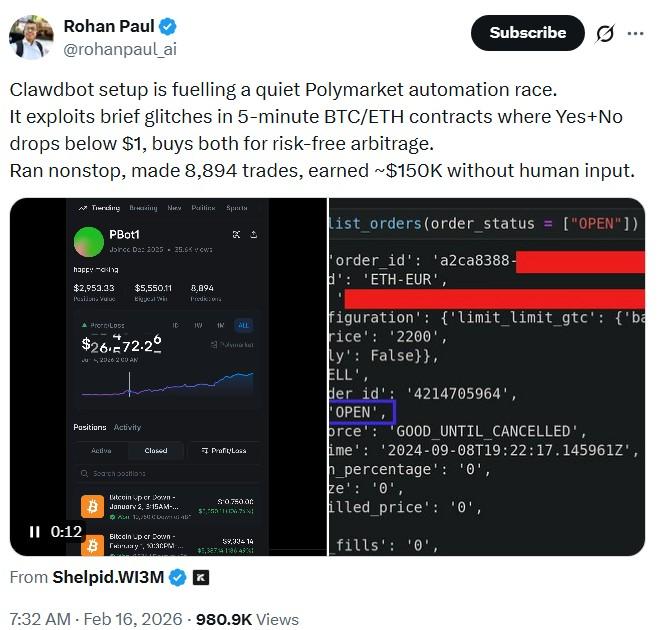
AI-powered bots are transforming prediction markets into laboratories for automated arbitrage, capitalizing on price discrepancies with unprecedented speed that outpaces human capabilities.

While prediction markets are designed to pool collective human intelligence in principle, the persistent trading opportunities within them are increasingly being seized by automated systems capable of operating at speeds no individual can match.
These arbitrage windows manifest as fleeting price inefficiencies, ranging from probability totals that momentarily deviate from 100% to lag times in how swiftly markets adjust to breaking news.
According to Rodrigo Coelho, CEO of Edge & Node, automated bots are currently monitoring hundreds of markets every second, a function that increasingly converges with more sophisticated AI-powered agents.
"Capturing those opportunities requires monitoring thousands of markets and executing trades almost instantly, which is why they're largely dominated by automated systems," Coelho told Cointelegraph.
This dynamic positions prediction markets as an organic evolution point for AI-powered systems designed to capitalize on fleeting pricing inefficiencies without requiring human intervention.
Arbitrage Mechanics in Prediction Markets
The performance of Bitcoin and cryptocurrency markets has been disappointing lately, with BitMine's Tom Lee characterizing the prevailing market mood as a "mini-crypto winter." Simultaneously, prediction markets have become platforms where participants can wager and potentially profit regardless of wider economic trends.
The expansion of prediction markets has also revealed opportunities like what Coelho describes as "latency arbitrage," which depend on brief time intervals too limited for manual human exploitation. He told Cointelegraph:
If there's even a few-second delay between an event happening and the market updating, bots scan for that and place bets on the correct outcome. For that window, they have a 100% guaranteed win.
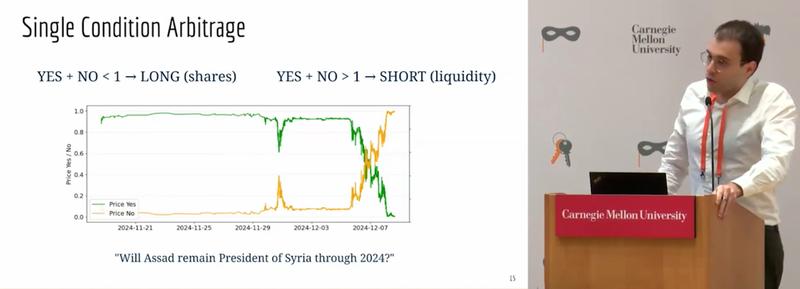
According to a recent academic investigation, Polymarket demonstrates regular pricing anomalies, enabling traders to establish arbitrage positions. These inefficiencies emerge both inside single markets, where outcome probabilities fail to total 100%, and between connected markets displaying inconsistent valuations. The research team calculated that approximately $40 million has been captured through exploiting these market imperfections.
While prediction markets remain in their early stages, their underlying technology continues to advance. As an illustration, Polymarket recently implemented taker fees to elevate transaction costs. Results aren't settled instantly, rendering these approaches less dependable and not consistently lucrative.
AI Agents Could Amplify Market Manipulation Risks
Beyond arbitrage opportunities, AI agents may progressively dominate participation in prediction markets, sparking worries that automated systems might reproduce the same problematic behaviors observed in human traders. After all, these systems learn from human patterns.
Coelho noted that well-funded participants can shape outcomes through substantial wagers on one outcome, and that more advanced autonomous agents might leverage comparable tactics on a larger scale.
"If you have a large pool of money and the market is thin, you can bet on one side and sway the market, like we saw in the election when some French guy put in like [$45 million] on Donald Trump winning," he said.
Pranav Maheshwari, engineer at Edge & Node, emphasized that the accelerating advancement of AI agents in tandem with prediction markets elevates these concerns and necessitates protective measures.
"Up until now, AI agents have medium capability and we give them a lot of permissions. With this medium capability, they have already started acting autonomously," Maheshwari told Cointelegraph.
But in the future, AI agents will have really high capabilities. When it has really high capabilities as humans, you have to restrict their permissions.
From Execution Bots to AI-Driven Systems
The landscape of trading is experiencing a transformation, as automation transitions from basic execution bots toward more sophisticated, AI-enhanced systems that can recognize and capitalize on opportunities instantaneously.
The platforms currently deployed to take advantage of market inefficiencies are predominantly rule-based, though the technologies powering them continue to develop.
Archie Chaudhury, CEO of LayerLens, explained that the majority of retail market participants aren't directly utilizing AI agents, depending instead on chatbot platforms like ChatGPT or Gemini for analysis, while more technically proficient users are starting to explore automation possibilities.
"Some of us simply use coding agents such as Claude Code to create automated bots or algorithms for executing trades, while others take it a step further, using autonomous tools such as OpenClaw to enable the automatic execution of trades and other policies," he told Cointelegraph.
With growing AI knowledge among retail traders, agents might democratize access to techniques that were formerly restricted to institutional players, according to Chaudhury. Nevertheless, this doesn't remove competitive pressures, and major institutions are already employing AI, albeit not always transparently.
He further noted that current large language model frameworks are particularly effective at processing structured financial information, which may reduce the technical obstacles for developing trading platforms that would have previously demanded specialized quantitative knowledge.
These same patterns are already apparent throughout cryptocurrency markets, where arbitrage opportunities increasingly hinge on automation instead of human decision-making. As these technologies continue to mature, the competitive advantage is migrating toward execution velocity. Market participants leveraging AI and automation possess a distinct advantage over those operating without such tools.