Thailand's SEC considers expanding crypto derivatives access through licensing reforms
The Securities and Exchange Commission of Thailand has launched a public consultation on regulatory amendments that would enable digital asset companies to provide derivatives products through their current corporate structures, reducing market access hurdles.
The Securities and Exchange Commission (SEC) of Thailand has opened a public consultation period on regulatory amendments that would permit currently licensed digital asset companies to pursue derivatives licensing directly, eliminating the existing mandate to create standalone corporate entities for such operations.
These proposed regulatory updates would expand upon previous amendments that formally recognized digital assets as permissible underlying instruments for futures trading agreements, thereby broadening Thailand's derivatives marketplace while simultaneously implementing enhanced requirements designed to address conflicts of interest and bolster regulatory supervision.
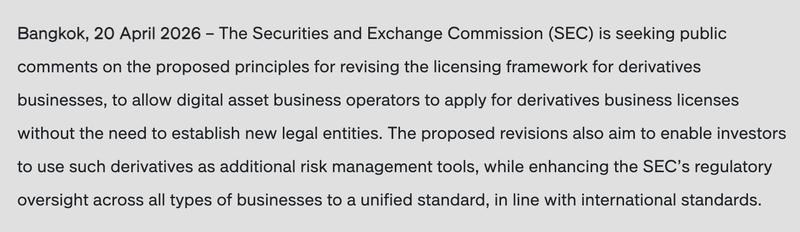
The regulatory proposal has the potential to reduce market entry obstacles for cryptocurrency businesses seeking to participate in derivatives trading by permitting them to submit licensing applications through their current operational entities, eliminating the need to create separate corporate structures, while simultaneously subjecting these operations to enhanced regulatory monitoring and compliance requirements.
According to the regulatory authority, these amendments aim to equip investors with enhanced instruments for risk hedging and investment portfolio diversification, while also ensuring that operational standards governing derivatives trading platforms and clearing facilities align with globally recognized best practices and international regulatory frameworks.
The regulatory amendments under consideration remain available for public review and industry feedback through May 20, with contributions from market participants and stakeholders anticipated to play a significant role in shaping the ultimate regulatory framework that will be implemented.
Crypto derivatives expand as US moves toward approval
The regulatory initiative from Thailand emerges at a time when cryptocurrency derivatives products are experiencing worldwide expansion and regulatory momentum continues building toward formal approval processes in the United States marketplace.
This past Tuesday, Blockchain.com unveiled perpetual futures trading capabilities integrated directly into its self-custody wallet infrastructure, enabling users to establish leveraged trading positions utilizing Bitcoin (BTC) as the underlying collateral without requiring fund transfers to centralized exchange platforms. Powered by the Hyperliquid protocol, this functionality provides trading access to an extensive selection of more than 190 different markets with leverage options extending up to 40x.
Additional cryptocurrency exchanges have pursued comparable strategic directions. During the earlier months of this year, both Kraken and Coinbase introduced perpetual futures products linked to traditional equity securities specifically for their international user base, representing part of an industry-wide expansion toward continuous 24/7 trading capabilities spanning multiple asset categories.
Although the majority of these derivative products currently remain largely inaccessible to customers located within the United States, that regulatory landscape may be approaching a significant transformation. During March, Michael Selig indicated the Commodity Futures Trading Commission is actively developing frameworks to facilitate crypto perpetual futures products, noting the regulatory agency could potentially advance these products "within the next month or so."
During this transitional regulatory period, major exchanges appear to be strategically positioning their operations in anticipation of potential regulatory approval. This past week, Payward, the parent company operating Kraken, announced its agreement to acquire Bitnomial, a derivatives trading platform operating under US regulatory oversight, in a strategic transaction designed to facilitate expanded product availability including perpetual futures offerings for customers based in the United States.