Tether Fires Back at S&P with Big Short Reference Over USDt Reserve Assessment
Tether's USDt maintains its rating of 5 (weak) from S&P Global Ratings, with concerns over increased high-risk reserve components and transparency issues despite KPMG's audit completion.
Tether's USDt has remained at the bottom tier of S&P Global Ratings' stablecoin stability scale, as the rating agency points to an increasing proportion of higher-risk assets within the token's reserve holdings.
According to a Nov. 18 report from S&P, the ability of USDt to maintain its peg to the US dollar received a score of 5 (weak). This rating remains identical to the evaluation conducted in November 2025.
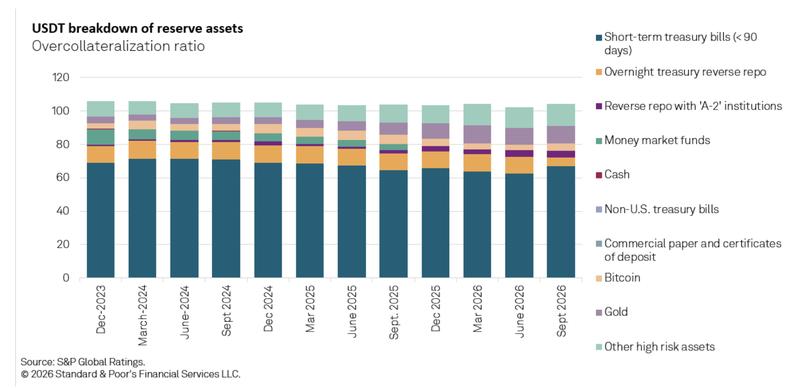
Assets classified as higher-risk, such as gold, Bitcoin (BTC), publicly traded equities, secured lending products and corporate bonds, represented 28% of circulating USDt (USDT) as of the end of September 30, an increase from the 24% recorded one year prior. S&P warned in its report that "A significant drop in the value of these assets could lead to USDT being undercollateralized."
Responding to Cointelegraph, Tether stated: "The problem is S&P's framework, not our reserves." The company continued by pointing to "Their own history shows the underlying problem," making a reference to The Big Short, the motion picture chronicling the 2008 financial crisis.
According to Tether's reserve report dated Sept. 30 and attested by BDO, the company maintained approximately $191.5 billion in total assets compared to $183.5 billion in total liabilities, resulting in roughly $7.95 billion worth of excess assets. S&P noted it identified additional weaknesses but chose not to implement a downward revision "because our assessment cannot be lower than 5."
S&P questions reserve oversight safeguards
S&P's report highlighted several additional areas of concern, including the regulatory oversight framework in El Salvador, the jurisdiction to which Tether relocated operations in January 2025.
The report notes that CNAD (the National Commission of Digital Assets of El Salvador), which serves as Tether's regulatory authority in the country, mandates that 70% of reserves must be maintained in assets capable of being liquidated within a 30-day timeframe. S&P characterized this framework as "broad," noting it permits the inclusion of assets carrying relatively elevated risk profiles, including gold, BTC and various loan products.
S&P further highlighted the absence of requirements for reserve asset segregation, a practice typically mandated by regulatory authorities in both the United States and Europe. Without publicly accessible information regarding segregation practices, the report indicates, there exists no transparency into how these assets are protected from wider corporate-level risks.
Audit disclosure remains a concern
KPMG announced in August 2026 that it had provided an unqualified opinion regarding Tether's 2025 financial accounts, marking the company's inaugural "full independent audit." Tether emphasized that this audit validated the accuracy of the financial statements the company has published.
Nevertheless, S&P noted that neither the audited financial statements nor the auditor's formal report have been made publicly available, which restricts the agency's capacity to verify the underlying data. Additionally, S&P pointed out that reserve reports fail to disclose the specific custodians and counterparties responsible for holding Tether's assets, and attestations continue to be released on a quarterly basis, whereas competing stablecoins typically provide monthly reporting.
When S&P initially implemented its downgrade in 2025, Tether challenged the assessment. CEO Paolo Ardoino posted on X, stating "we wear your loathing with pride," and cited historical financial collapses as "proof" demonstrating that conventional financial systems are fundamentally flawed.
While the stability rating stayed at 5, S&P concluded its Nov. 18 report by acknowledging that Tether has demonstrated a strong track record of maintaining price stability, especially throughout the most recent 12-month period.