Tech Giants Agree to Self-Regulation Framework for Advanced AI Under Trump Initiative
A new voluntary agreement shifts primary accountability for controlling advanced AI system risks to the companies building them.
A voluntary agreement has been executed between US President Donald Trump and leading technology company executives, designed to guarantee that their artificial intelligence models "behave as intended."
This agreement emerges as worries intensify regarding the security of progressively advanced frontier AI technologies. Trump has opposed any deceleration in development, pointing to competitive pressures from China. The framework assigns the bulk of AI risk management obligations to the corporations creating these technologies.
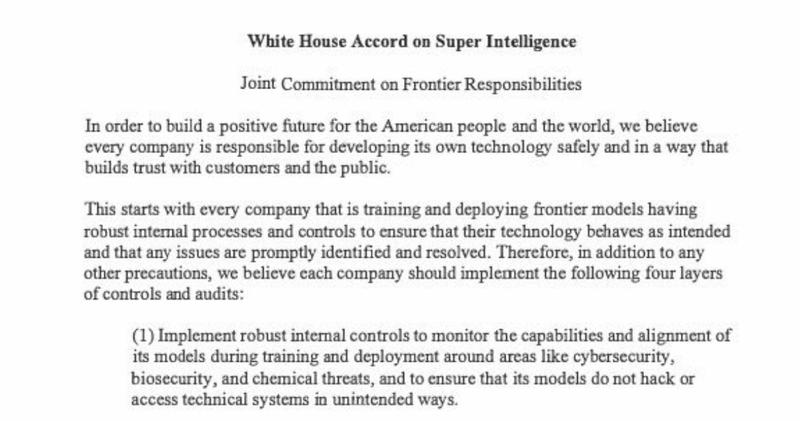
The White House initiative, titled "Joint Commitment on Frontier Responsibilities," mandates internal regulatory mechanisms, independent third-party audits and oversight at the board level "to ensure its models do not hack or access technical systems in unintended ways." The framework also maintains flexibility for potentially converting these commitments into legislative requirements or regulatory mandates, acknowledging this may become appropriate as time progresses.
"I think I'm seeing tremendous self-policing. And they understand that they have to self-police," Trump told reporters at the White House.
The framework received signatures at the White House from Google CEO Sundar Pichai, Anthropic CEO Dario Amodei, Meta CEO Mark Zuckerberg, OpenAI President Greg Brockman, Nvidia CEO Jensen Huang and xAI CEO Elon Musk.
The gathering covered topics including AI safety protocols, the sector's expansion trajectory and infrastructure development for data centers, while Trump dismissed the possibility of a US-China joint venture to develop AI.
It also came on the same day Trump signed an executive order directing the executive branch to use "Super Intelligence" instead of "Artificial Intelligence," arguing the term "more appropriately captures the promise, potential, and rapidly advancing capabilities of these technologies."