Survey reveals 77% of US citizens consider cryptocurrency in retirement accounts a risky proposition
Recent polling data reveals widespread doubt about cryptocurrency inclusion in employer-sponsored retirement accounts, even as federal officials work to increase availability of alternative investment options.

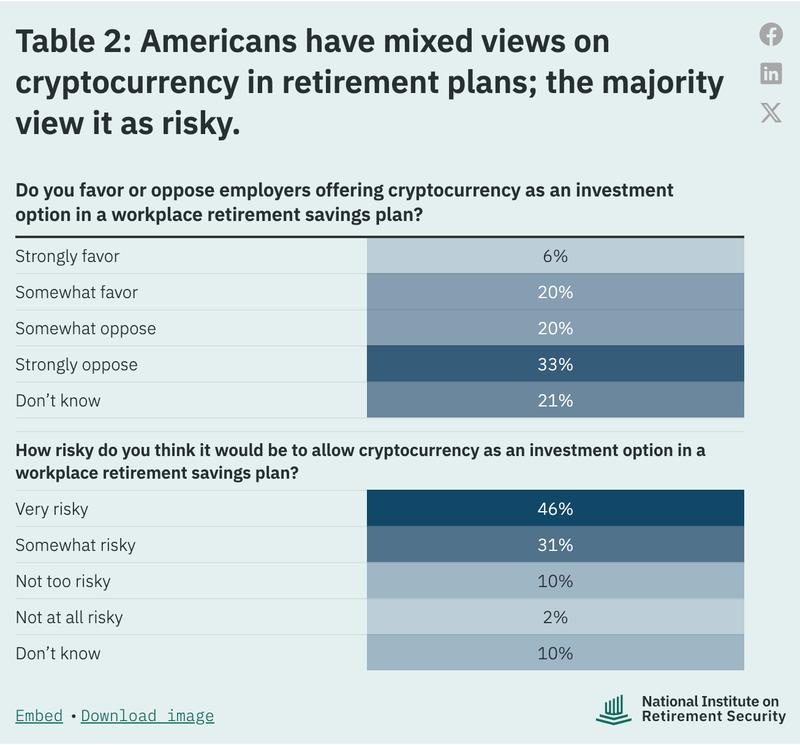
Over three out of four Americans perceive the inclusion of cryptocurrency in employer-sponsored retirement accounts as a dangerous proposition, according to fresh polling data from The National Institute on Retirement Security, released amid growing anxiety about retirement preparedness throughout the nation.
Results from the survey revealed that 77% of American respondents believe crypto represents a risky addition to workplace retirement plans, with 46% characterizing it as extremely risky, and 53% expressing opposition to employers providing cryptocurrency as a potential investment choice.
This widespread doubt emerges at a time when 80% of survey participants indicated the United States is experiencing a retirement crisis, representing an increase from 67% recorded in 2020, and 61% voiced anxiety regarding their ability to attain financial stability during retirement.
Economic pressures related to affordability are additionally impacting retirement preparation efforts, as 68% of respondents indicated that planning for retirement is becoming increasingly difficult and 77% reported that debt obligations are preventing them from saving sufficient amounts.
Greenwald Research administered the survey from Oct. 24 through Nov. 14, 2025, gathering responses from 1,203 American participants who were 25 years of age or older, with the final data weighted according to age, gender and income demographics.
US policymakers move to broaden alternative assets in 401(k)s
Despite the survey results showing that Americans generally perceive cryptocurrency as a hazardous choice for retirement investing, both the Trump administration and federal oversight agencies have taken steps to expand the availability of alternative assets within retirement accounts, thereby introducing cryptocurrency and other unconventional investments more prominently into discussions surrounding retirement savings.
In May 2025, the US Department of Labor withdrew previous guidance that had encouraged fiduciaries of 401(k) plans to use "extreme care" when evaluating cryptocurrency investment options, opting instead for a neutral stance that neither promotes nor discourages the inclusion of crypto in retirement plan investment offerings.
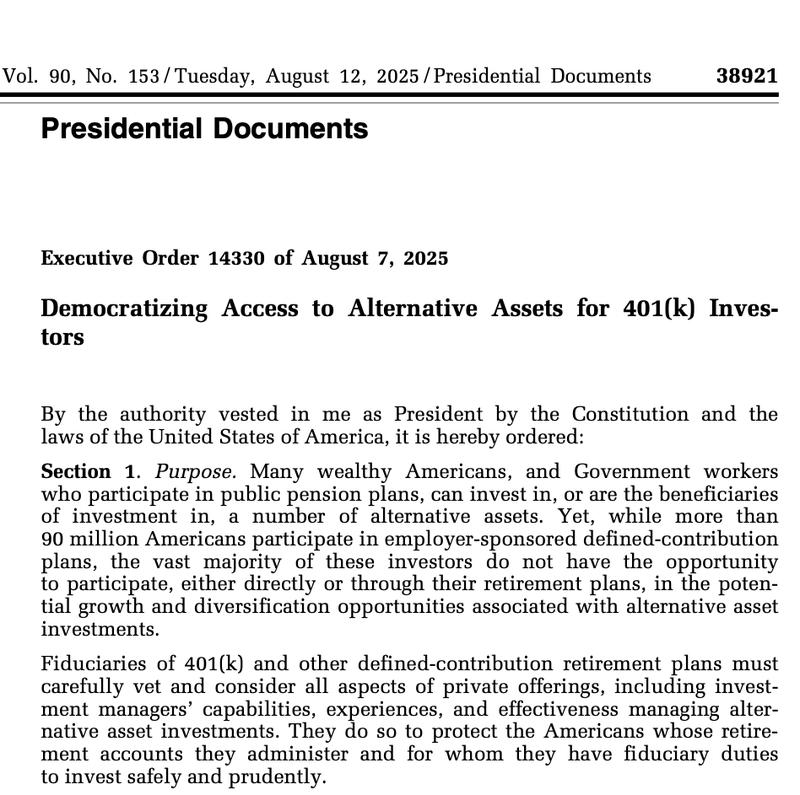
President Donald Trump issued an executive order on Aug. 7, 2025, designed to enhance access to alternative assets within defined-contribution retirement accounts, including investment products containing digital assets, while simultaneously instructing the Labor Department and US Securities and Exchange Commission to explore regulatory modifications that would enable greater access.
Several days following that action, the Labor Department withdrew 2021 guidance that had previously dissuaded 401(k) fiduciaries from incorporating alternative assets, stating that investment choices should be assessed using a neutral, principles-based framework instead.
Most recently, during March 2026, the Labor Department put forward proposed regulations describing how fiduciaries of 401(k) plans could incorporate alternative assets into their investment offerings, featuring safe harbor provisions designed to minimize litigation exposure while mandating evaluation of elements including fees, liquidity, valuation methodologies and performance metrics.
The regulatory proposal has encountered resistance from members of Congress, as Sens. Bernie Sanders and Elizabeth Warren along with Rep. Bobby Scott called upon the Labor Department in June to retract the proposal, pointing to cryptocurrency's price volatility and what they characterized as inadequate protections for investors.