Sui blockchain faces second consecutive day of network disruption
The disruption stemmed from an identical software bug in the network update that caused Thursday's protocol malfunction, leading to approximately six hours of service interruption.
On Friday, the Sui layer-1 blockchain suffered yet another service interruption, resulting in a "network stall" that brought block production to a temporary standstill before operations returned to normal, the Sui team confirmed.
The Sui team announced that network activity "may be paused." According to the Sui network's uptime dashboard, the service disruption persisted for more than three hours and 30 minutes as of publication time.

Data from the Suiscan block explorer indicates that the final block prior to the interruption was generated at approximately 11:51 UTC on Friday. Operations on the Sui mainnet were restored around 3:30 UTC. In an update, the Sui team stated:
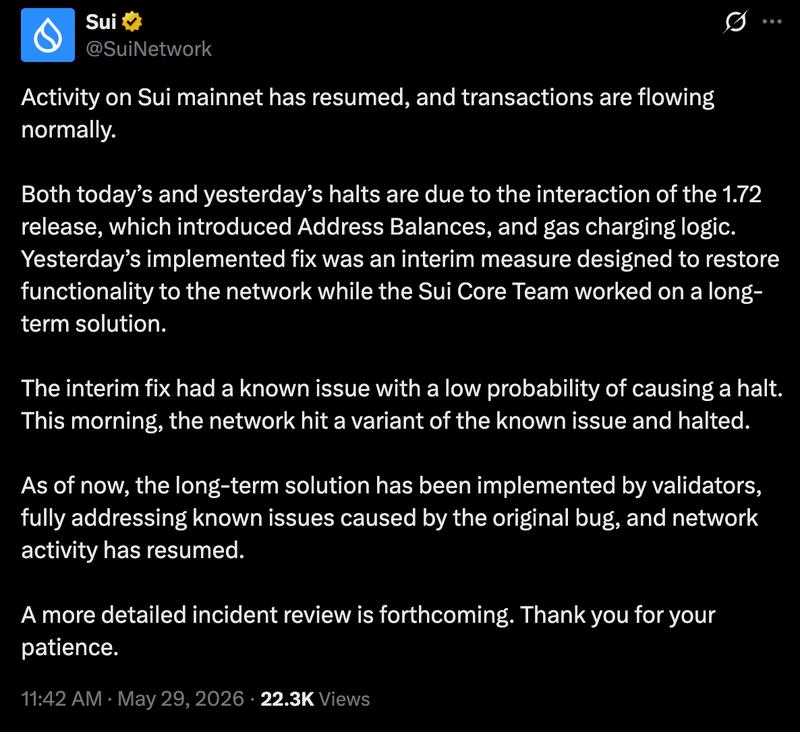
"Both today's and yesterday's halts are due to the interaction of the 1.72 release, which introduced address balances and gas charging logic. Yesterday's implemented fix was an interim measure designed to restore functionality to the network."
According to the team, the interim solution carried a "low probability" of triggering a network interruption, while the permanent software patch has now been deployed by the majority of Sui validators.
This incident comes on the heels of multiple significant disruptions and network failures, including the Thursday outage that resulted in nearly six hours of downtime attributed to a "crash bug in the gas charging logic," the team reported. This crash marked the second significant network disruption in 2026.
The Sui network went down in January due to a consensus bug
During January, the network experienced more than six hours of offline status, bringing block production to a halt because of a consensus bug. The protocol's checkpoint mechanism received conflicting transactions submitted by validators, preventing the network from achieving the required consensus threshold, the post-mortem report explained.
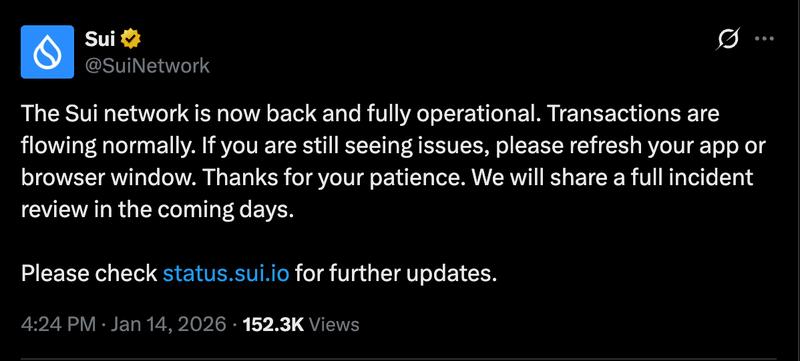
The Sui team emphasized at the time that the January disruption did not result from network congestion, user funds were "never at risk," and no "certified transactions" experienced rollbacks.
"The issue was detected and contained by Sui's checkpoint certification and quarantine mechanisms, which prevented any user-visible fork at the cost of halting progress," according to the post-mortem report.
Smart contract blockchain networks with high throughput capabilities incorporate multiple layers, such as data availability, transaction execution and validator consensus, each of which creates additional potential failure points.
That said, network outages in the cryptocurrency sector also affect centralized service providers, such as exchanges, despite facing fewer coordination challenges compared to decentralized blockchain networks.
During May, cryptocurrency exchange Coinbase experienced a brief service interruption stemming from an Amazon Web Services (AWS) outage, which compelled the platform to transition markets into an "auction" mode prior to restoring complete service.