Stratum V2 Working Group Welcomes 7 Leading Bitcoin Mining Pools
A coalition of prominent Bitcoin mining pools has become part of the Stratum V2 working group, collaborating on the creation of a vendor-neutral mining pool communication protocol solution.

A coalition of seven prominent Bitcoin mining pools has become part of the Stratum V2 working group with the goal of creating an industry-wide open standard protocol that mining pool operators utilize for communication with individual miners participating in their pools.
The working group now includes AntPool, Block Inc, F2Pool, Foundry, MARA Foundation, SpiderPool, and DMND, all of whom are working together on the mining pool communication standard. This collaborative effort has the potential to decrease the amount of time pools require to successfully mine blocks, as stated in a Stratum V2 announcement.
"Bitcoin mining is competitive and fragmented by design. It is a race for efficiency where a millisecond can determine whether a miner wins a block or loses to a competitor," the announcement said.
Among the participants, Foundry and AntPool represent the two most dominant Bitcoin mining pools when measured by hashrate, which represents the aggregate computing power that miners deploy for securing the Bitcoin network.
According to data sourced from Hashrate Index, Foundry commands approximately 30% of the worldwide mining pool hashrate, while AntPool maintains control of roughly 17.7%.
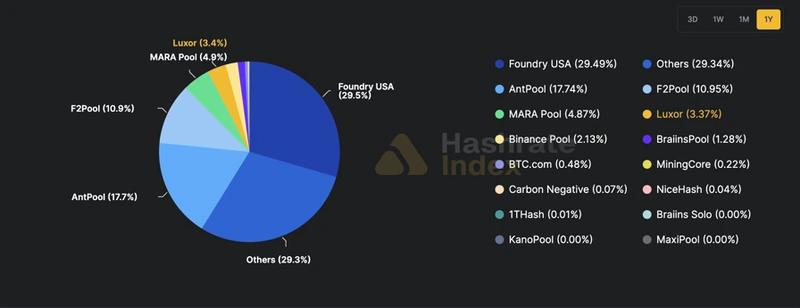
Creating an open standard for Bitcoin mining pools that remains independent of control by any single mining pool operator contributes to decentralizing the mining industry, which has experienced growing centralization, while simultaneously providing miners with enhanced flexibility when selecting block templates.
Bitcoin mining difficulty is set to rise in the next difficulty adjustment, while energy costs soar
The Bitcoin mining difficulty, representing the relative challenge associated with adding new blocks to the blockchain ledger, is anticipated to increase once more during the upcoming difficulty adjustment scheduled for May.
"The next Bitcoin difficulty adjustment is estimated to take place on May 15, 2026, 5:58 PM UTC, increasing the Bitcoin mining difficulty from 132.47 T to 135.64 T," according to CoinWarz.
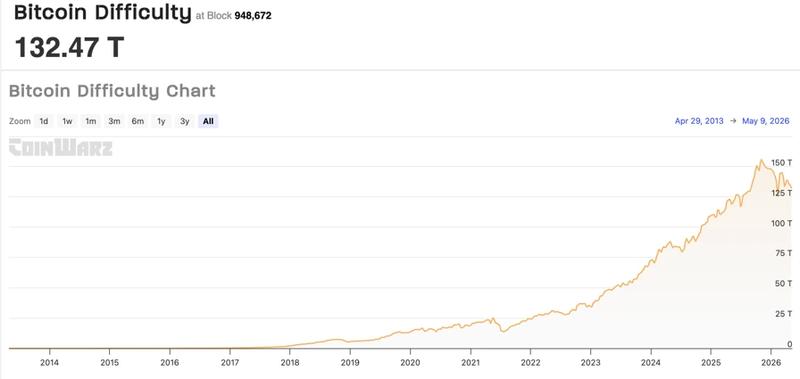
The combination of increasing network difficulty and escalating energy costs is creating additional pressure on the Bitcoin mining industry, which was already highly competitive.
According to asset manager CoinShares, as many as 20% of Bitcoin miners are currently operating at a loss given the present crypto market and prevailing economic conditions.
Hashprice, which serves as a critical metric for determining miner profitability, has declined to levels ranging between $36 and $38/Petahash-seconds per day, representing near or at breakeven profit levels for certain miners, CoinShares said.