Stellar blockchain payment system advances to full deployment phase at UN agency
After testing blockchain payment systems in five nations, the UN Development Programme reports reduced costs and enhanced resilience, paving the way for broader implementation in development and humanitarian operations.

Following successful pilot testing across five nations, the United Nations Development Programme (UNDP) has entered into a fresh partnership with the Stellar Development Foundation to broaden its deployment of blockchain-enabled payment systems, marking an expanded role for public blockchain technology within its international development initiatives.
The partnership comes after 16 months of pilot testing and research conducted in Haiti, Syria, Kenya, Guatemala and The Gambia, along with supplementary initiatives in Colombia and Papua New Guinea, the organization announced Monday. The UNDP stated that the upcoming phase will create frameworks enabling country offices to implement blockchain-based payments throughout a more extensive array of programs.
According to UNDP, the pilot programs delivered quantifiable outcomes. Within Syria, a Cash for Work initiative that documented payments on the blockchain decreased distribution expenses from 10% down to 2%, while testing in Haiti demonstrated continued payment processing capabilities even during cellular network disruptions.
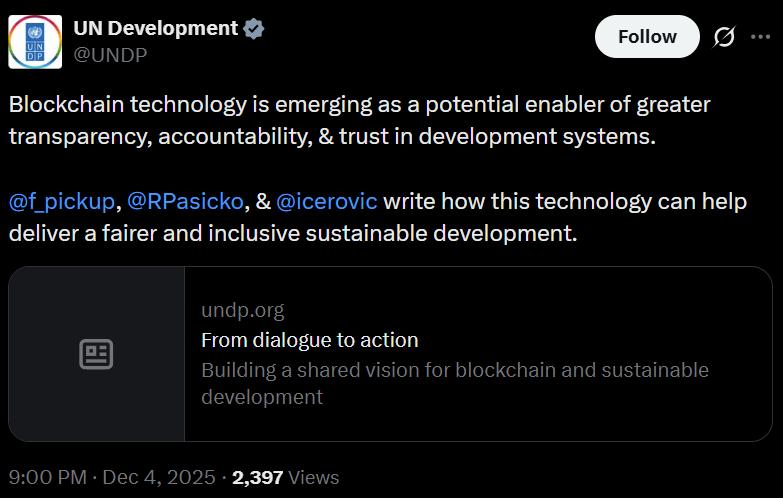
During last month's Proof of Talk conference held in Paris, France, UNDP introduced a Blockchain Advisory Group designed to provide guidance on blockchain technology implementation throughout its development initiatives. The group's scope extends beyond digital payments to examine blockchain's potential in supporting digital public infrastructure and enhancing governmental systems.
Stablecoins gain ground in remittance markets
The UNDP's expansion of blockchain-based payment systems mirrors a wider movement toward modernizing international payment transfers in developing markets, where restricted access to conventional banking services and elevated remittance fees have positioned stablecoins as a progressively more appealing option.
In a recent move, Ripple acquired an ownership position in Flutterwave, an African fintech company, as part of a comprehensive strategy to broaden adoption of its RLUSD stablecoin and the XRP Ledger throughout Africa, a region where remittance payments represent a significant portion of household earnings.
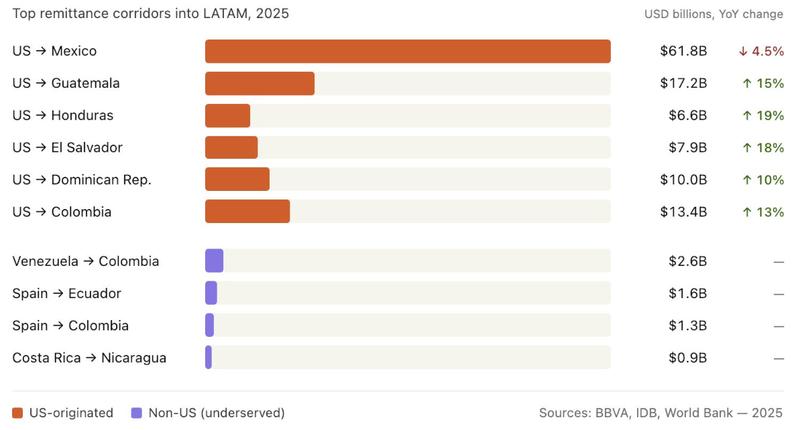
The Latin American region is similarly becoming a critical marketplace for stablecoin-enabled remittance services, with cryptocurrency issuers focusing on payment corridors spanning Argentina, Bolivia, Colombia and Venezuela.
Vera Songwe, former UN under-secretary-general, emphasized that the increasing significance of digital payment systems reaches beyond simple remittance transfers. During her remarks at the World Economic Forum's annual gathering in January, Songwe stated that stablecoins are emerging as "more important than aid" within certain developing nations due to their ability to deliver access to digital financial tools in regions where conventional banking infrastructure remains unavailable.
650 million people don't have access to a bank account in Africa. With a smartphone, you have access to stablecoins, so you can save in a currency that is not exposed to fluctuations of inflation and making you poor.
Vera Songwe, former UN under-secretary-general, at the World Economic Forum