State Attorneys General Challenge CLARITY Act Despite Trump Ethics Compromise
While Trump's ethics amendments remove one obstacle for cryptocurrency legislation, a coalition of 18 state attorneys general warns the updated bill could undermine state regulatory powers.
Following President Donald Trump's acceptance of most provisions in a bipartisan ethics proposal designed to strengthen restrictions on public officials' cryptocurrency holdings, the CLARITY Act is approaching a pivotal US Senate procedural vote scheduled for Tuesday, multiple sources have reported.
Despite this latest negotiated agreement, opposition to the bill persists. A bipartisan coalition of state attorneys general is now pressing senators to vote against the legislation, expressing alarm that it could diminish state-level regulatory authority over the cryptocurrency sector.
In a formal letter addressed to the leadership of the Senate Banking committee, a group of 18 state attorneys general spearheaded by New York Attorney General Letitia James contended that the CLARITY Act would create obstacles for states seeking to pursue legal action against cryptocurrency firms facing allegations of fraud or other forms of wrongdoing.
While the current draft of the CLARITY Act reserves certain powers for states to prosecute fraud, the language is often ambiguous, unclear, or confined in ways that either create the opportunity to challenge state police powers or outright deprive the states of their ability to continue to combat the scam epidemic.
This resistance from state officials introduces an additional layer of complexity to the legislative process. Although the amended version of the bill would grant state attorneys general enforcement authority over new ethics requirements, the coalition maintains that separate sections of the legislation would diminish their power to regulate cryptocurrency companies.
Widely regarded as groundbreaking US cryptocurrency legislation, the CLARITY Act aims to create a comprehensive federal framework for digital asset markets, provide definitive guidance on whether crypto assets should be classified under securities or commodities regulations, and clearly define the respective oversight roles of the Securities and Exchange Commission (SEC) and the Commodity Futures Trading Commission (CFTC).
According to Cointelegraph's previous reporting, Senate Majority Leader John Thune submitted the cloture motion for CLARITY during the previous month following lawmakers' inability to move the legislation forward prior to their departure from Washington for the August recess. The procedural vote scheduled for Tuesday will decide whether the bill proceeds to full Senate debate.
Trump agrees to tougher crypto ethics rules
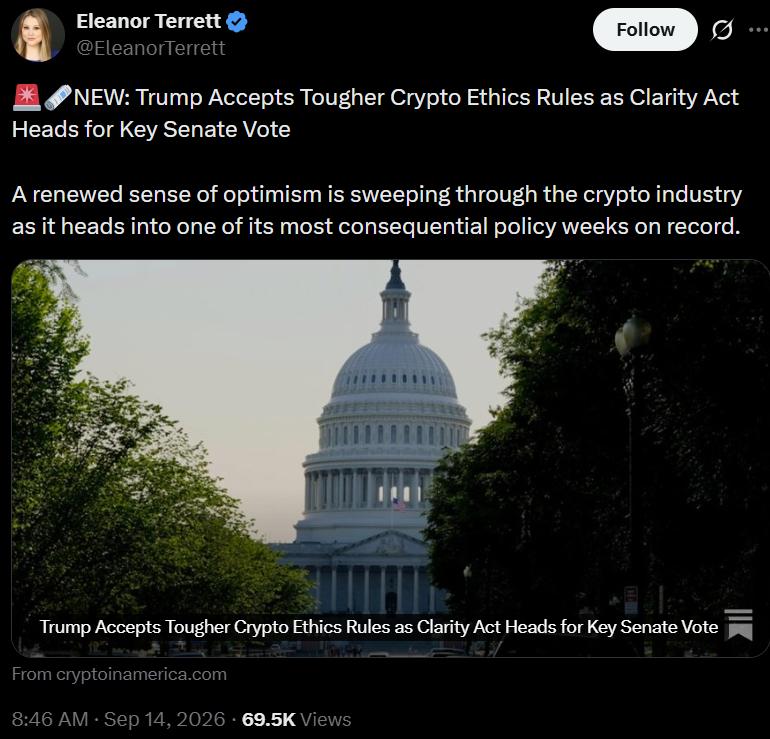
The intervention by state attorneys general came at the same time that legislators appeared to be achieving headway on another significant obstacle confronting the CLARITY Act. According to a Sunday report from the Associated Press, Trump had accepted "about 80%" of a compromise package put forth by Republican Senator Thom Tillis and Democratic Senator Ruben Gallego, as confirmed by a senior GOP aide.
While the legislation already prohibited federally elected officials, their spouses and federal judges from creating digital assets, the most recent compromise extends these restrictions considerably. Officials possessing a "significant" financial stake in a cryptocurrency issuer would face requirements to either divest their holdings or transfer the interest into a blind trust. Additionally, state attorneys general would receive enforcement authority over these restrictions.
These amendments respond to various concerns previously voiced by Democrats and Tillis, who had maintained that the earlier ethics language was insufficient to adequately address potential conflicts of interest related to Trump's cryptocurrency assets and commercial ventures.
Crypto in America, a publication co-hosted by Eleanor Terrett, reported that the weekend's political developments generated a "renewed sense of optimism" throughout the digital asset sector. Republicans characterized the modified legislation as their "last, best and final offer" to Democrats in advance of Tuesday's critical vote.
Advocates within the cryptocurrency industry have been championing the CLARITY Act to establish a comprehensive federal market structure framework for digital assets, which would include more precise delineation of regulatory responsibilities shared between the SEC and the CFTC.