SpaceX IPO Showcases Crypto's Price Discovery Success While Exposing Token Access Failures
The landmark SpaceX initial public offering demonstrated the effectiveness of cryptocurrency-based pre-IPO price discovery mechanisms while simultaneously revealing significant limitations in tokenized IPO access, leaving retail investors on prominent exchanges without any share allocations.
The highly anticipated June 12 public market debut of SpaceX generated $75 billion in capital at a price point of $135 per share, establishing a company valuation exceeding $2 trillion and elevating founder Elon Musk to the status of the planet's first trillionaire.
Musk wasn't the only beneficiary of the wealth creation. Investors who secured shares at the initial offering price realized approximately 20% returns in less than 24 hours, while those who invested during earlier private funding rounds experienced substantially larger gains.
Cryptocurrency traders, on the other hand, found themselves suddenly excluded from the opportunity, holding pre-IPO subscription tokens on exchanges including Binance, Bybit and Bitget that yielded zero SpaceX share allocations.
While SPCX stock prices climbed, critical tokenized equity distribution channels experienced breakdowns. Third-party intermediaries proved unable to obtain share allocations, promotional campaigns faced sudden cancellations, and trading platforms rushed to process refunds and manage the fallout.
Essentially, the situation functioned as a real-world examination of the "tokenized IPO access" concept; the price discovery mechanism performed as expected, but the actual access to underlying equity securities failed completely.
Pre-IPO perpetual contracts functioning as alternative pricing indicators
Data from Talos Research provided to Cointelegraph on June 15 revealed that during the half-hour period preceding the Nasdaq market opening, SPCX perpetual contracts achieved a volume-weighted average price (VWAP) of $159.89 across Hyperliquid, Binance and OKX, approximately 6.6% higher than the opening price, while Cerebras (CBRS) perpetual contracts on Hyperliquid came within 1.3% of the Nasdaq opening price.
Additionally noteworthy is that SPCX perpetual contracts reached levels exceeding $220 during mid-May before progressively declining toward the IPO date as market participants adjusted their valuation expectations to more realistic levels, according to Talos Research.
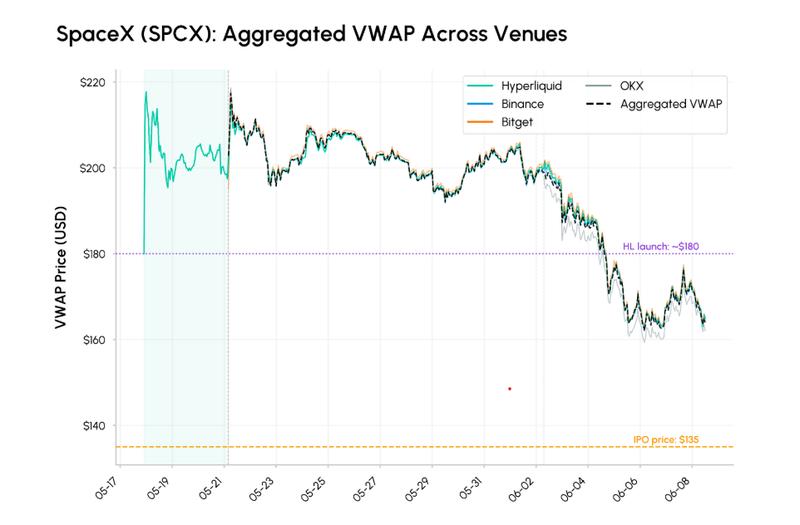
Pre-IPO perpetual contracts available on derivatives trading platforms demonstrated that blockchain-based traders possessed the capability to establish reliable price discovery mechanisms and substantial liquidity for a highly sought-after technology unicorn prior to any actual share transactions. These instruments provided live indicators of where market speculators anticipated the stock would be valued at market opening.
"These signals will become increasingly difficult for underwriters and retail-facing platforms to ignore," Samar Sen, head of international markets at Talos, told Cointelegraph, "particularly for high-profile listings where there is already active global demand before the IPO."
He said these markets could "become a useful supplementary input alongside institutional orders, private market marks and comparable-company analysis."
The collapse of tokenized SpaceX "IPO access" during final execution
The issue, therefore, wasn't related to synthetic, futures-based exposure to SpaceX's market valuation. Pre-IPO perpetual contracts "functioned as intended," Sen said, demonstrating themselves to be "a venue for continuous trading and price discovery ahead of the listing."
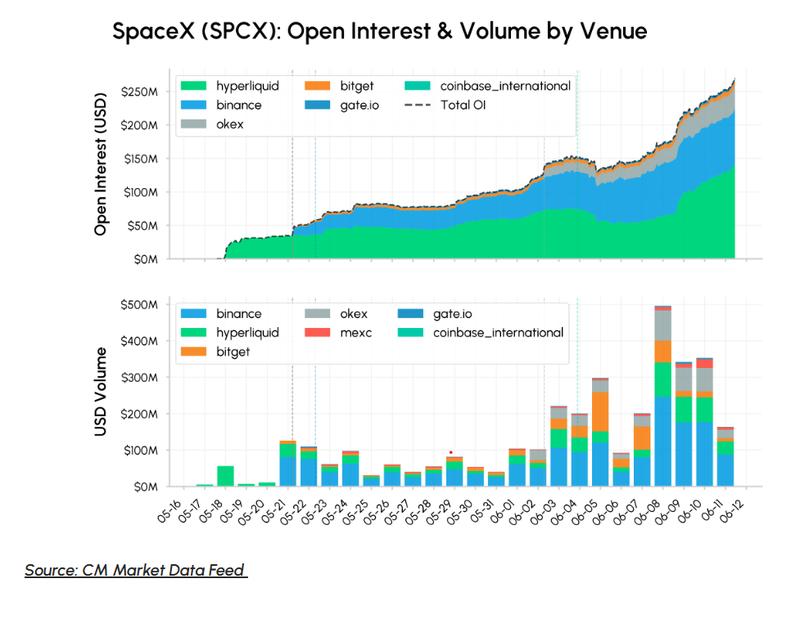
Data from Talos Research indicated that SPCX perpetual contract markets generated approximately $4.6 billion in trading volume on the IPO date, with aggregate open interest reaching peaks near $500 million across eight trading venues, including Hyperliquid, Binance, OKX and Kraken, while Cerebras (CBRS) on Hyperliquid recorded $281 million in IPO day volume.
Traders in perpetual contracts successfully capitalized on both the pre-IPO price volatility and the post-listing price convergence. However, participants who purchased tokenized claims representing SpaceX IPO shares completely missed out on any gains.
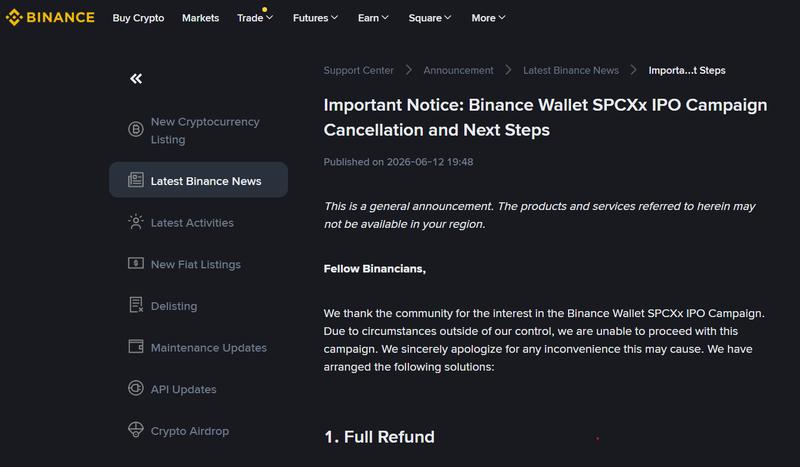
SpaceX-related tokenized equity products on major cryptocurrency exchanges failed during the final stage of execution, with exchanges including Binance, Bybit and Bitget Wallet all terminating their promotional campaigns and processing user refunds after xStocks proved unable to deliver the promised underlying share allocations.
The anticipated tokens never materialized. Kraken found itself unable to meet demand from its own customer base, much less function as a distribution center for third-party exchanges, as the constraint stemmed from the scarcity of underlying IPO share allocations, not from any deficiencies in the blockchain infrastructure itself.
Exchange responses following the allocation pipeline failure
Binance founder and former chief executive Changpeng Zhao published the announcement on X with the accompanying statement, "Protect users when things don't go as planned," which generated numerous angry responses from retail investors.
One platform user declared, "last in the queue, again," and highlighted the $557 million in cryptocurrency capital accumulated across "three of the world's biggest exchanges" for the purchase of tokenized SpaceX equity.
"All cancelled. Zero shares delivered… Turns out you still need the underlying asset. Blockchain doesn't magic shares into existence when Wall Street decides who gets the allocation."
A Binance Wallet representative told Cointelegraph its role in the campaign was limited to technical and support services. Binance Wallet was not responsible for "pricing, issuance, backing or redemption," they said, and user-facing materials stated allocation was not guaranteed.
Despite encountering similar obstacles with the xStocks allocation bottleneck, Bitget, following the cancellation of its pre-market subscription program and user refund processing, pivoted to Reality, a real-world asset tokenization platform supported by the exchange.
Bitget chief executive Gracy Chen told Cointelegraph that Reality provides 1:1 tokenized SpaceX shares (rSPCX) on the spot market, held with a broker, replacing the exchange's third-party initiative with xStocks.
She said that for users, that means access to "properly backed" US equities, rather than short-term structures chasing a single hot IPO.
The disconnect between blockchain-based exposure and actual share allocations
At the core of the SpaceX situation lies a straightforward structural disconnect. Cryptocurrency trading venues possess the capability to generate synthetic or tokenized exposure to equity securities, but they lack control over the primary market share allocations that remain exclusively within the purview of underwriters possessing established broker-dealer networks.
Pre-IPO perpetual contracts delivered a robust real-time indication of where market participants believed SPCX would be valued, but the tokenized IPO promotional campaigns relied upon a single upstream allocation channel that ultimately proved insufficient.
Sen argued this is exactly why pre-IPO derivatives should be treated as "signals" not substitutes for the IPO machinery itself, and the SpaceX episode reinforces the "need for greater caution around how different forms of pre-IPO exposure are structured, marketed and understood."
Kan said the episode points to a "broader reality facing the tokenized RWA space," adding that onchain infrastructure for distribution and settlement is ready, but the mechanisms for crypto-native channels to access primary market allocation are still developing.
Retail demand, he said, is growing faster than the supply-side infrastructure, and closing that gap will require "closer collaboration between crypto platforms, traditional intermediaries and regulators."
Blockchain tokenization enhances accessibility, but cannot manufacture equity shares
The regulatory and legal restrictions also clarify why the SpaceX IPO was never a realistic candidate for blockchain-native execution from the outset.
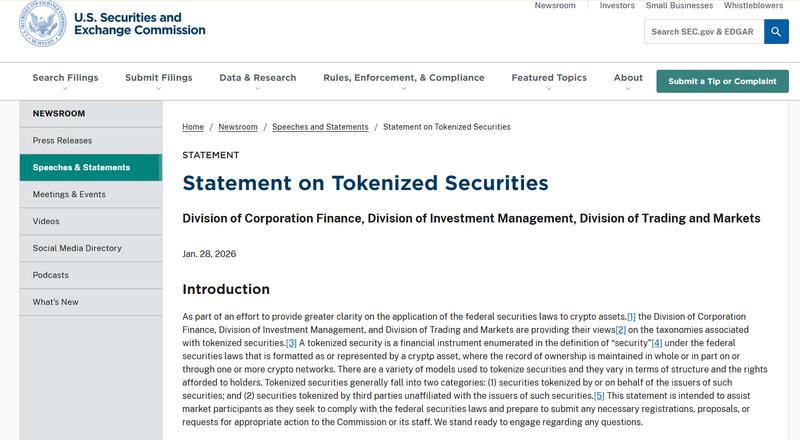
Brogan Law's Aaron Brogan noted that a token sold to raise $75 billion for SpaceX and marketed on the company's future performance would fall squarely on the securities side of the Securities and Exchange Commission's (SEC) recent token guidance line.
Between securities law, tax uncertainty and the scrutiny a mega-deal would invite, he argued, "there is no path to do so reliably," making a full-blown token sale an unrealistic substitute for a traditional IPO for a company of SpaceX's size.
A spokesperson from the SEC declined to comment on whether the regulator had concerns around crypto platforms' promotion of IPO access or whether securities regulations adequately address tokenized equity offerings.
What lies ahead for tokenized IPO accessibility
Despite all the controversy surrounding the SpaceX public offering, none of the principal market participants believe the event has destroyed the tokenized equity narrative, but rather clarified the specific conditions under which such mechanisms can function effectively.
Dinari, a tokenized equities platform whose tokenized $SPCX maintained continuous uptime as the allocation pipe ran dry, chief executive Gabriel Otte told Cointelegraph the long-term opportunity is to "extend the reach of public markets, not reinvent them."
He said that was achievable by starting with real underlying securities, regulated custody and clear legal rights, then using tokenization to improve access and settlement rather than to sidestep the rules.
Chen, for her part, said the exchange has learned to avoid short-term, third-party structures and instead build 1:1, broker-backed tokens it can stand behind.
For Brogan, the SpaceX IPO exposed the difference between pricing a stock and allocating one. Crypto markets were able to generate liquidity and price discovery ahead of the listing, but access to actual IPO shares remained firmly in the hands of traditional market participants.
Sen concluded that, while investors may be more cautious about products promising exposure to underlying private company shares, the scale of activity surrounding SpaceX shows these markets are "becoming increasingly difficult to ignore."