South Korean Markets Suspended After 10% Plunge Amid Middle Eastern Tensions
Trading halted on South Korea's major stock exchanges as escalating Middle East tensions sparked widespread selling across global markets.

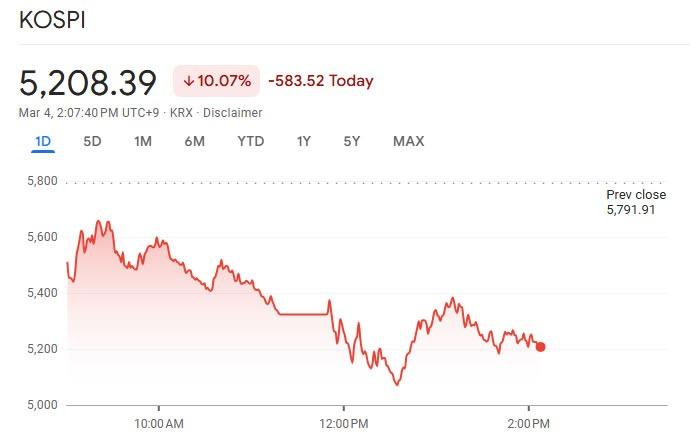
Trading operations at the Korean Stock Exchange came to an abrupt standstill following a dramatic sell-off triggered by intensifying tensions in the Middle East on Wednesday.
Both major South Korean indices, the Kospi and Kosdaq, experienced declines exceeding 10% during the morning trading session in Seoul, activating automatic circuit breakers in what marked the most severe trading day since August 2024, according to Channel News Asia's Wednesday report.
Stock markets across Japan experienced significant downward pressure on Wednesday as well, with both the Nikkei and Topix indices falling nearly 4%. At the same time, the Hang Seng Index in Hong Kong declined by 3%, while the Shanghai Composite in China recorded a 1.3% decrease, based on data from Google Finance.
"Investors sold down risk assets, and in particular, the Nikkei as well as the Kospi, which outperform other major indexes, have become a target of the heavier selloff as they try to book profits," Kazuaki Shimada, chief strategist at IwaiCosmo Securities, told CNA.
"South Korea imports 94% of its oil, with 75% coming from the Middle East. So, it is easy to see why its 'degens' are panicking," said Bianco Research CEO Jim Bianco.
In Thailand, another country heavily dependent on Middle Eastern oil imports, the national stock exchange experienced a 7.8% decline on Wednesday.
Wars can be fought forever, says Trump
According to the Trump administration, military operations against Iran are escalating, with American forces targeting a gathering of the country's senior leadership during their deliberations on selecting new leadership, Fox News reported on Wednesday.
This development comes after the Strait of Hormuz was shut down following Iranian warnings to attack oil tankers and cargo vessels navigating through the strategically important passage.
"If necessary, the United States Navy will begin escorting tankers through the Strait of Hormuz, as soon as possible," said Donald Trump on Truth Social.
During a Tuesday statement, he remarked that the US possesses a "virtually unlimited supply" of weapons and conflicts can be "fought forever."
Consequently, global crude oil markets have experienced dramatic price increases, with Brent crude surging 14% to reach $82 per barrel and WTI crude climbing 12% to hit $75 per barrel from the time airstrikes commenced on Feb. 28, data from OilPrice shows.
Black swan event unfolding, says crypto researcher
Cryptocurrency analyst SungHoon Lee characterized the situation as a black swan event, clarifying that Korean markets were suspended "because the crash was too fast for the system to handle," while highlighting that global equity markets have shed $3.2 trillion in value over the last four days.
"This isn't just a war. This is the WORST geopolitical shock since 1973," referring to an oil crisis that crashed markets for two years in the 70s.
Digital asset markets, which have already experienced a 21% decline year-to-date, haven't demonstrated as dramatic a response, with overall market capitalization declining only 0.5% during the day to reach $2.39 trillion, data from CoinGecko indicates.