South Carolina enacts legislation safeguarding crypto mining operations while prohibiting CBDCs
The newly enacted Senate Bill 163 prohibits state entities from utilizing CBDCs and provides legal protection for Bitcoin mining operations against discriminatory municipal regulations.

On Tuesday, South Carolina's Governor Henry McMaster put his signature on Senate Bill 163, establishing it as law and pushing forward one of the nation's most welcoming state-level regulatory environments for cryptocurrency operations.
The legislation, which received overwhelming bipartisan support by passing the Senate with a 38-1 vote and the House with a 110-1 margin, prohibits government agencies at the state level from utilizing central bank digital currencies (CBDCs), safeguards the legal rights of individuals and businesses engaging in cryptocurrency mining and usage, and eliminates regulatory obstacles for enterprises active in the digital asset sector.
Regarding CBDCs, the legislation prohibits any governmental agency or political subdivision at the state level from accepting, mandating payments using, or engaging in digital currency experimental programs led by the Federal Reserve, which includes participation in any pilot initiatives conducted by federal government bodies.
The law further safeguards the right to self-custody of cryptocurrency assets, stopping governmental entities from limiting the utilization of hardware wallets and self-hosted storage solutions while simultaneously prohibiting tax rates on cryptocurrency transactions that exceed those applied to equivalent payments conducted using US dollars.
South Carolina protects Bitcoin miners
The legislation provides Bitcoin mining operations functioning within industrial districts with particular legal safeguards. Municipal authorities are prohibited from enforcing restrictions on mining enterprises that are not equally applied to other industrial businesses operating within the same geographical area, and they cannot establish noise limitations specifically targeting mining activities beyond those already mandated by existing general pollution regulations.
A political subdivision shall not change the zoning of a digital asset mining business without going through the proper notice and comment. A digital asset mining business may appeal a change in zoning to the proper court of jurisdiction.
Senate Bill 163
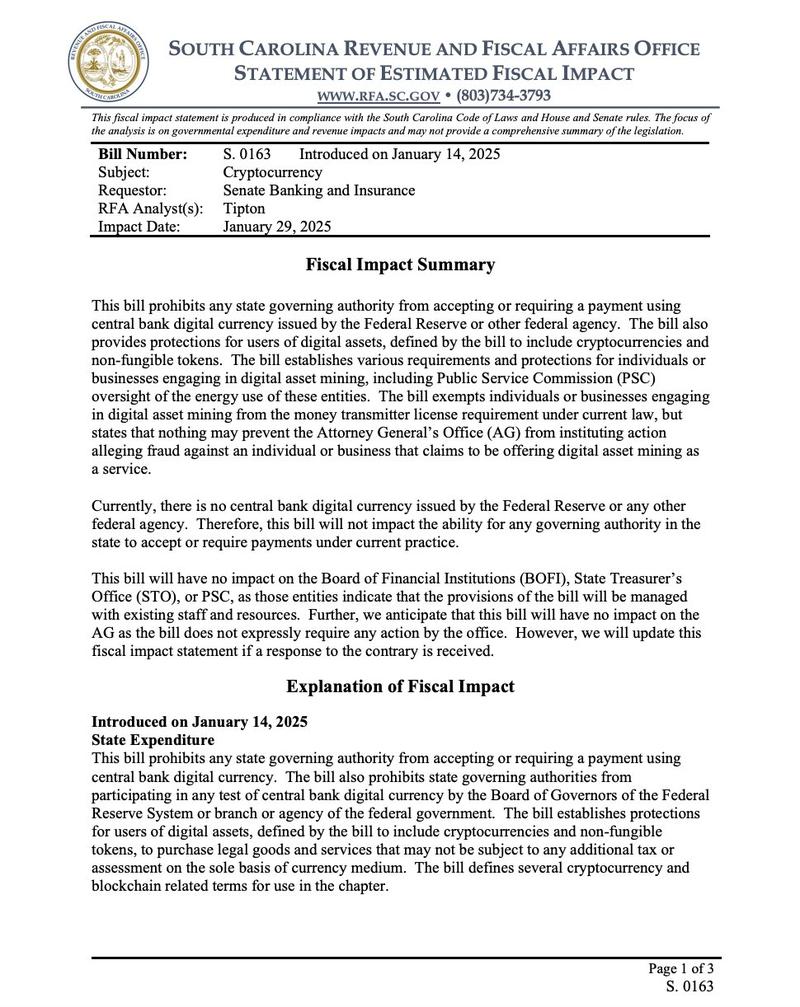
The legislation additionally provides exemptions for multiple categories of activities from requirements related to money transmitter licensing, which encompasses mining operations, running network nodes, developing blockchain-based software applications and facilitating cryptocurrency-to-cryptocurrency exchange services. Businesses offering mining-as-a-service and staking-as-a-service solutions are specifically exempted from being categorized as securities.
More states pass crypto-friendly bills
South Carolina has become part of an expanding group of states that are establishing pro-cryptocurrency regulatory positions. The Bitcoin Rights bill was enacted by Kentucky in March of last year, ensuring self-custody rights for residents and protecting mining businesses from discriminatory regulations imposed by local authorities.
States including Oklahoma, Arkansas, Florida, Mississippi, Montana, North Dakota, Louisiana and Arizona are among those that have enacted comparable cryptocurrency-friendly legislative measures over the course of recent years.