Singapore Gulf Bank launches direct stablecoin minting for continuous settlement operations
Institutional clients of the Bahrain-headquartered financial institution can now directly transform fiat currencies into dollar-backed stablecoins through their existing accounts.

Singapore Gulf Bank (SGB) has rolled out a new offering that enables its institutional client base to directly mint and redeem stablecoins from their banking accounts, leveraging the Solana layer-1 blockchain infrastructure to facilitate continuous settlement operations between traditional fiat currencies and digital assets around the clock.
The offering will begin by supporting Circle USDC (USDC) transfers exceeding $100,000 and features temporary waivers on fees for both minting and redemption activities conducted on the Solana network, based on SGB's public announcement.
Further digital assets including Tether's USDT (USDT), Ethena's USDe (USDe) and Global Dollar (USDG) are anticipated to be added subsequently, according to the company's statement.
The newly launched capability has been embedded into the bank's proprietary clearing infrastructure, enabling capital to transfer between onchain positions and conventional balances without dependence on third-party banking networks, SGB stated.
The rollout arrives at a time when payment platforms, regulatory bodies and banking institutions globally are actively working to incorporate stablecoin settlement capabilities and blockchain technology into conventional financial infrastructure to minimize expenses and accelerate settlement timeframes.
Banks, payment networks and regulators push stablecoin integration
During March, Mastercard announced its agreement to purchase stablecoin infrastructure provider BVNK through a transaction with a potential value reaching $1.8 billion.
Jorn Lambert, Mastercard's chief product officer, said "most financial institutions and fintechs" are moving toward services built around stablecoins and tokenized deposits.
In a separate development, Visa commenced operating validator nodes on the Tempo network on Tuesday. Validators operating on the network have the opportunity to receive stablecoin-based rewards in exchange for processing transactions.
A Visa spokesperson told Cointelegraph the company is focused on the technical and strategic aspects of operating a validator, rather than generating revenue.
Regulatory structures across the globe are also starting to advance. During April, Pakistan's central bank granted authorization for banks to provide services to licensed crypto firms, bringing an end to multiple years of legal prohibitions.
Earlier this year, the country signed an exploratory agreement to assess World Liberty Financial's USD1 (USD1) stablecoin and its potential use for cross-border payments.
Meanwhile in Europe, where euro-denominated stablecoins still lag far behind dollar-backed tokens, a consortium of banks including ING, UniCredit and BBVA is developing a euro-pegged stablecoin.
The banks plan to distribute the stablecoin across crypto exchanges and banking channels, with a launch targeted for the second half of 2026.
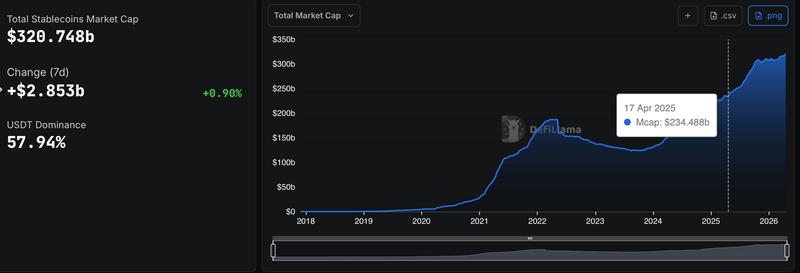
The moves come as the stablecoin market cap, which exceeds $320 billion at the time of publication, according to data from DeFiLlama, continues to grow.