Short Sellers Face $2.5B Wipeout Risk as Bitcoin Eyes $72K Target
A surge to $72,000 could trigger massive short liquidations as Bitcoin positions itself for a potential comeback driven by renewed ETF interest or geopolitical de-escalation.

Main highlights:
- A move to $72,000 in Bitcoin would trigger $2.5 billion worth of short position liquidations, delivering a severe blow to overleveraged bearish traders.
- Ongoing conflict in Iran and elevated oil prices are currently weighing on BTC, though a peace agreement or renewed ETF capital flows could catalyze a swift rebound.
Massive $2.5 billion short position exposure at $72,000 BTC price point
Bitcoin (BTC) has repeatedly struggled to establish new peak values since its effort to regain the $75,000 threshold that began on March 17.
Pessimistic wagers on Bitcoin futures contracts have accumulated as the Iranian conflict drove oil valuations to their most elevated points since June 2022. Nevertheless, a pair of potential catalysts could drive Bitcoin toward $72,000 within the next several weeks and establish the foundation for a sustained upward trajectory.
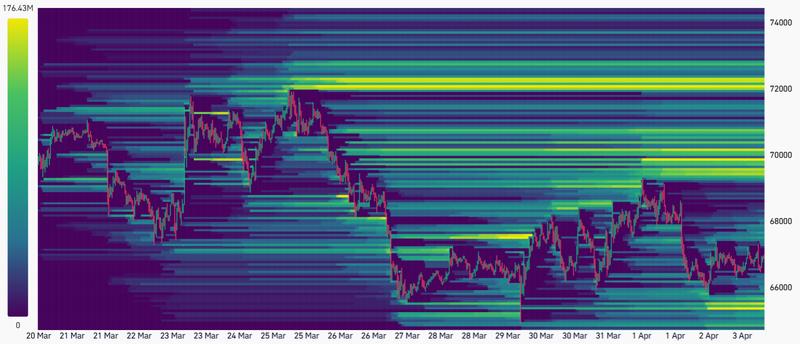
Data from Coinglass projections indicates that approximately $2.5 billion worth of bearish positions in Bitcoin futures contracts would face liquidation should Bitcoin experience a modest 7.5% climb to $72,000 from its present $67,100 price point.
Bearish traders gain advantage from mining company selloffs, declining S&P 500
Short sellers have been building their positions since March 25, coinciding with reports that Iran declined to participate in ceasefire discussions. Further downward pressure materialized when MARA Holdings (MARA US) disclosed the sale of 15,133 BTC on March 26. The publicly traded Bitcoin mining operation pivoted its strategy toward AI computing infrastructure and elected to decrease its cryptocurrency reserves to address outstanding debt obligations.
Following a January 28 peak near the 7,000-point mark, the S&P 500 experienced a 10% decline through March 30. Market participants are growing concerned about potential recession scenarios given that central banking authorities possess diminished capacity for interest rate reductions amid persistent inflation.
Crude oil valuations have surged more than 70% since the commencement of Iranian hostilities in late February, creating increased transportation expenses and diminishing consumer purchasing power.
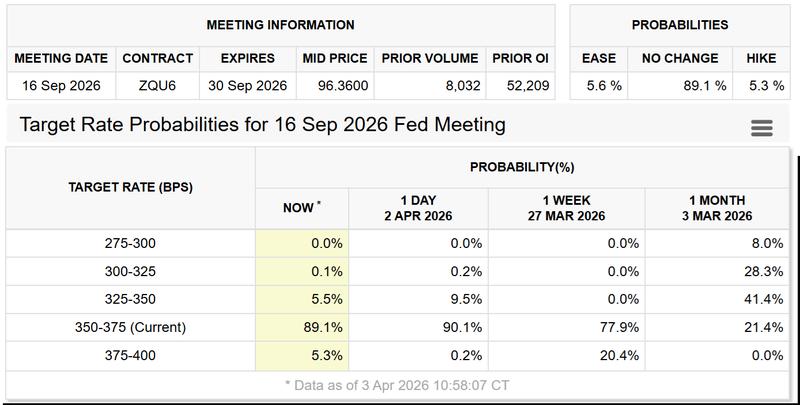
Market participants are assigning 89% probability that the Federal Reserve will maintain current interest rate levels through September, alongside 5% odds of an increase to 4%.
During early March, fixed-income futures indicated the contrary, showing 79% probability of rate reductions. Yields on fixed-income securities appear positioned to remain competitive for an extended period.
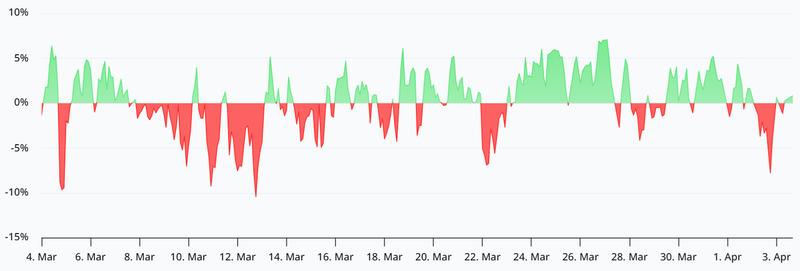
Simultaneously, growing conviction among pessimistic Bitcoin traders is evident through the negative funding rate observed in perpetual futures contracts.
Under typical market circumstances, bullish positions generally incur costs to maintain open positions, resulting in this metric typically fluctuating between 5% and 10% to account for opportunity costs of capital.
When funding rates turn negative, this demonstrates insufficient appetite for leveraged bullish positions and suggests possible excessive confidence among bearish traders.
Peace agreement or economic deterioration could catalyze Bitcoin rally
Although forecasting the resolution of the Iranian conflict remains speculative, any ceasefire deal could ignite optimistic market sentiment and blindside bearish position holders.
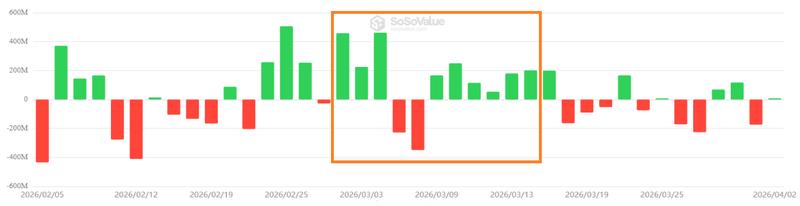
Bitcoin rallied from $69,150 to $74,900 throughout the five-day period concluding March 16 following $1.5 billion in aggregate net capital inflows into US-domiciled Bitcoin exchange-traded funds across a two-week span. Should ETF capital flows return to positive territory, Bitcoin may successfully recapture the $72,000 price level.
US President Donald Trump has requested congressional approval to increase defense expenditures to $1.5 trillion, as outlined in a 2027 fiscal budget proposal made public Friday. These initiatives encompass a 10% reduction across other governmental sectors to balance military spending increases.
Trump purportedly stated during a closed-door White House gathering on Wednesday: "We're fighting wars. We can't take care of day care," as reported by CNBC.
Should the US economy demonstrate weakening momentum, or if private credit withdrawal pressures persist in affecting the marketplace, investors will probably seek alternative protective assets.
As a result, Bitcoin's attractiveness would increase given that it currently trades 47% beneath its historical peak valuation. Therefore, an upward movement toward $72,000 could materialize independent of the duration of Iranian military operations.
This article is produced in accordance with Cointelegraph's Editorial Policy and is intended for informational purposes only. It does not constitute investment advice or recommendations. All investments and trades carry risk; readers are encouraged to conduct independent research before making any decisions. Cointelegraph makes no guarantees regarding the accuracy or completeness of the information presented, including forward-looking statements, and will not be liable for any loss or damage arising from reliance on this content.