Shift in trader positioning emerges as Bitcoin futures long-to-short metrics reveal caution
Data from the Bitcoin futures marketplace reveals that professional traders continue to exercise caution while BTC encounters difficulty pushing beyond the $77,000 to $79,000 trading range.

Key takeaways:
- Bitcoin funding rates entering negative territory suggest bearish sentiment, though whale traders continue to hold consistent long-to-short positioning across leading trading platforms.
- Rising inflation pressures and technology sector corporate performance continue to serve as the primary factors influencing Bitcoin market participants' outlook.
On Wednesday, Bitcoin (BTC) encountered resistance at the $77,800 price point before pulling back to retest support at $76,000. The price action occurred alongside a pullback in the S&P 500 Index, as ongoing conflict in Iran entered its 60th day, pushing crude oil valuations toward the $118 threshold. Despite growing interest in leveraged short positions within Bitcoin futures markets, whale long-to-short positioning at leading exchanges reveals an alternative narrative.
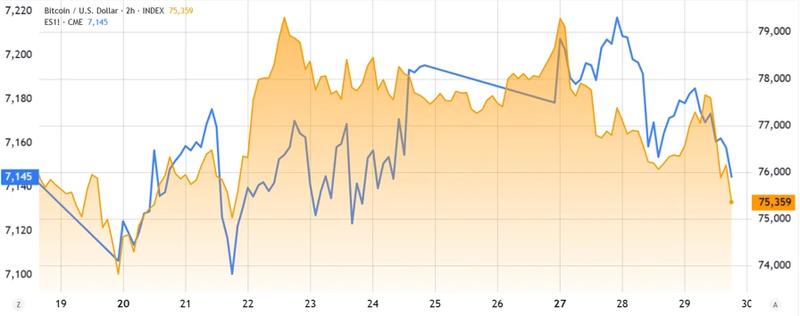
The inability of Bitcoin to sustain upward momentum beyond $78,000 parallels the challenges faced by the S&P 500 Index in breaking past the 7,200 level. Market participant skepticism partially originates from inflationary pressures associated with elevated energy costs, which erode consumer purchasing power and impact corporate profitability through increased transportation and logistics expenses. Furthermore, market observers continue to scrutinize whether technology sector investments in artificial intelligence will deliver sustainable returns, as reported by Yahoo Finance.
Bitcoin futures show bulls lacking confidence
Regardless of the particular factors driving investor hesitancy, Bitcoin perpetual futures funding rates shifted into negative territory on Wednesday. This transition followed a short-lived period of neutral-to-positive rates observed on Tuesday. Under normal market conditions, this metric typically ranges from 6% to 12% annually to account for cost of capital, meaning long position holders generally compensate short sellers. When the rate becomes negative, it indicates market momentum favoring sellers.
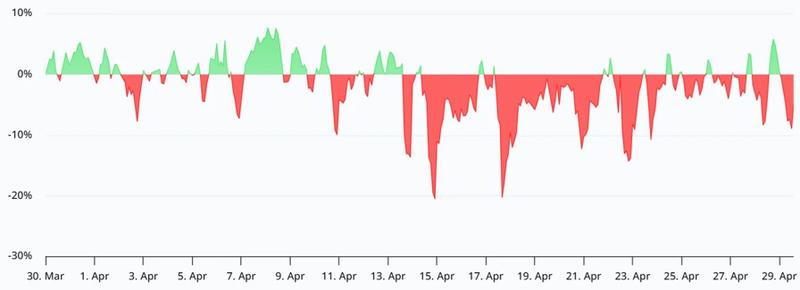
Throughout the previous two weeks, the Bitcoin perpetual futures funding rate has predominantly remained in negative territory, pointing to elevated interest in leveraged bearish positions. Although this metric at first glance appears to demonstrate weakening buyer confidence, examining the positioning of major market participants provides essential context. The long-to-short positioning ratio of leading traders at various exchanges encompasses data from spot markets, margin trading, and futures contracts, delivering a more holistic view of market dynamics.
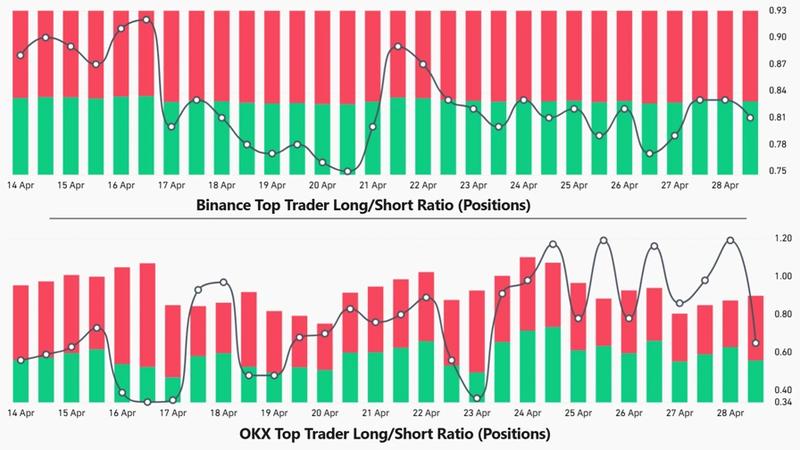
Professional trader positioning on Binance registered a long-to-short ratio of 0.80, demonstrating modest gains from Tuesday's reading of 0.75, while continuing to exhibit slight bearish bias. On the OKX platform, elite traders have momentarily displayed bullish positioning on multiple occasions since Friday, though these changes have not persisted. Despite this, data shows no indication that whale traders are adopting increasingly pessimistic stances, with the long-to-short ratio maintaining stability across the preceding seven days.
In its most recent statement released following Wednesday's policy meeting, the US Federal Reserve acknowledged that "inflation is elevated, in part reflecting the recent increase in global energy prices." The Federal Open Market Committee decided to maintain interest rates at the levels established in late 2025, despite four committee members advocating for a 0.25% reduction. As reported by CNBC, this represents the first instance of four FOMC members expressing dissent since October 1992.
The hesitation displayed by Bitcoin bulls should not be interpreted as outright pessimism, especially considering that Strategy (MSTR US) maintains its aggressive acquisition strategy. During the past four weeks, Strategy purchased 56,235 BTC, financing the expansion through the offering of its perpetual preferred security, STRC. The firm's total holdings now reach 818,334 BTC, surpassing the Bitcoin position held by BlackRock's IBIT exchange-traded fund (ETF).
Elite traders demonstrated resilience in response to Bitcoin's Wednesday decline to $75,000, as evidenced by stable exchange long-to-short positioning metrics. Nonetheless, the continuing negative trajectory of Bitcoin futures funding rates indicates that market sentiment maintains a cautious posture. Broader economic conditions and technology sector corporate earnings continue to serve as the primary catalyst for Bitcoin market participants' sentiment.