Scalable Ethereum Layer-2s Require Dynamic Pricing Models, Offchain Labs Argues
Offchain Labs' Edward Felten advocates for responsive pricing mechanisms on Ethereum L2s to enable scaling, while Arbitrum pioneers an approach diverging from EIP-1559's volatile fee structure.
According to Offchain Labs co-founder Edward Felten, Ethereum's layer-2 solutions must implement "responsive pricing" mechanisms if they are to accommodate billions of users while mitigating the fee volatility that currently occurs during network congestion. Felten delivered these remarks during his keynote address at EthCC 2026.
The Ethereum network introduced EIP-1559 as part of the London hard fork in August 2021. This upgrade fundamentally restructured Ethereum's fee marketplace by adjusting the gas fee ceiling and implementing a mechanism that burns a portion of transaction fees, effectively removing those tokens from circulation permanently.
According to Felten, fluctuations in gas prices remain the primary defense mechanism preventing networks from becoming overwhelmed during peak usage periods, despite the fact that this creates the type of fee unpredictability that mainstream users typically find unacceptable.
"[With responsive pricing], you can see more traffic at lower gas prices without overrunning the infrastructure."
The unpredictability of gas prices has consistently presented a significant obstacle to widespread adoption, especially among users who are familiar with stable or predictable transaction fees in conventional financial infrastructure.
This concern carries significant weight because Ethereum's scalability narrative has evolved beyond simply increasing transaction throughput. The critical question now centers on whether layer-2 solutions can deliver sufficiently predictable transaction costs to support mainstream applications while maintaining an honest pricing structure for congestion that adequately safeguards infrastructure during periods of intense demand. The dynamic pricing implementation on Arbitrum now represents one of the earliest live experiments examining this balance.
Arbitrum One becomes inaugural L2 to implement responsive pricing
In January, Arbitrum One implemented its dynamic pricing mechanism. The network characterized this approach as an "Arbitrum platform direction to make fees more predictable under demand by aligning prices with real network bottlenecks."
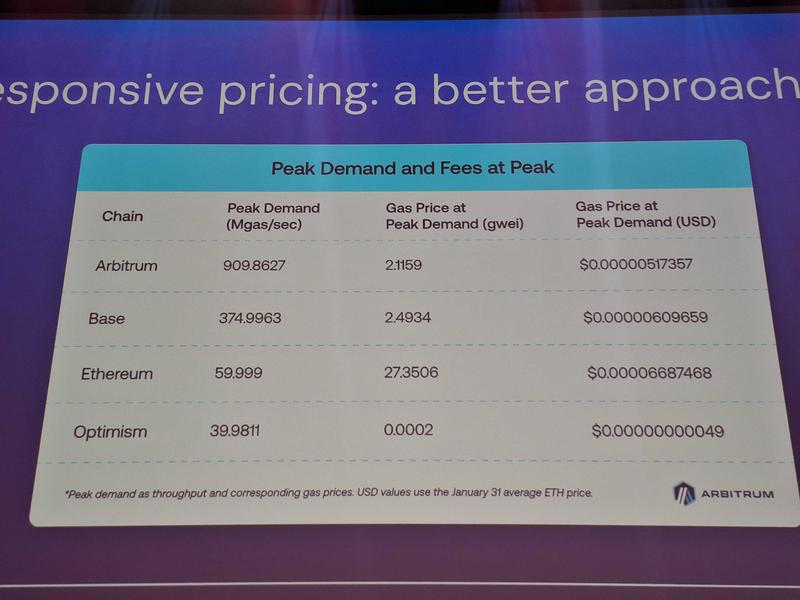
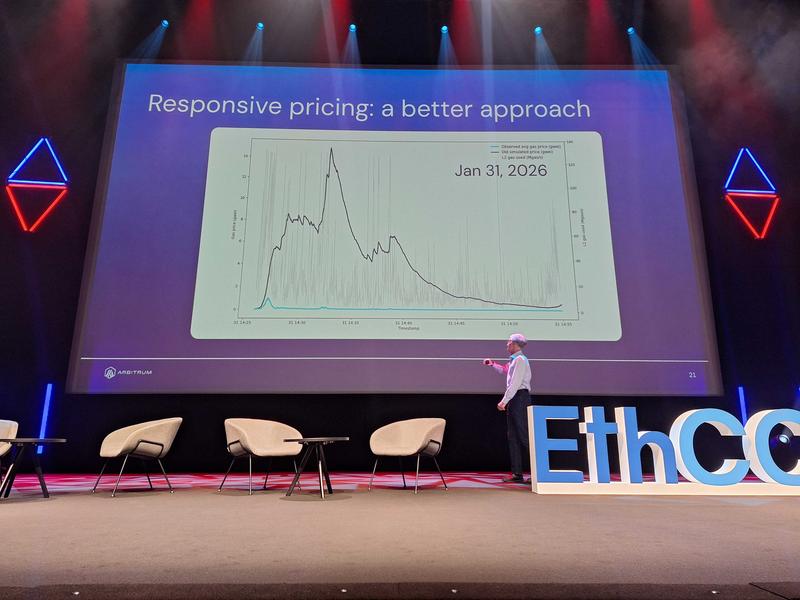
During his presentation, Felten displayed several charts demonstrating that Arbitrum maintained lower gas fees during periods of maximum network activity compared to the Base network and other L2 solutions that continue to utilize EIP-1559.
According to L2beat data, Arbitrum One maintains its position as the dominant L2 network with $15.2 billion in TVL, whereas Coinbase's Base Chain holds the second position with $10.9 billion. Layer-2 solutions collectively secure more than $39.7 billion in cumulative TVL, representing a 4.6% increase over the previous year.
Julian Kors, a senior developer and founder of execution workspace startup Pulsar Spaces, notes that while responsive pricing may offer superior scalability and greater transparency regarding underlying infrastructure costs, its primary weakness compared to EIP-1559 is reduced predictability.
The discussion isn't centered on determining which model is objectively superior, but rather on whether networks should prioritize "predictability and mechanism design purity or for efficiency and real-time cost alignment. EIP-1559 does the first very well. Responsive pricing leans into the second," he explained to Cointelegraph.
Responsive pricing represents progress, but the gas model requires replacement
Jerome de Tychey, who serves as president of Ethereum France and EthCC, informed Cointelegraph that responsive pricing mechanisms have the potential to enhance user experience by ensuring fees more accurately mirror genuine network demand.
Cyprien Grau, who leads the gasless Ethereum L2 Status Network project, expressed agreement, characterizing the innovative pricing model as a "real improvement in fee accuracy." Nevertheless, the system remains dependent on a "fee market," which indicates that users could still encounter variable costs and gas price surges during periods of congestion, he explained to Cointelegraph.
"It doesn't solve the structural problem: L2 gas fees trend toward zero as scaling on L1 and L2s improves and competition intensifies. Responsive pricing makes the decline smoother, but you're still building a revenue model on a depreciating asset."
Grau further stated that responsive pricing represents the "most advanced version of the gas model," while emphasizing that the gas model itself requires replacement. "L2s that scale to billions of users will be the ones where users never think about gas at all, and where networks' economics don't depend on charging them for it," he continued.
This debate surrounding fee models emerges as segments of the Ethereum ecosystem have begun reconsidering the original rollup-centric scaling approach. During February, Vitalik Buterin presented arguments suggesting that certain layer-2 assumptions no longer remain valid and that future scalability efforts should place greater emphasis on the mainnet and native rollups.
Layer-2 networks were originally developed to enhance Ethereum's scalability and reduce the transaction burden on the mainnet. Nevertheless, Ethereum is currently reevaluating its L2-focused strategy, given that these networks have diverted substantial economic value away from the mainnet.