Revised cryptocurrency legislation gains approval from Polish parliament following multiple presidential rejections
In a 241–200 decision, Poland's Sejm approves government-sponsored cryptocurrency regulatory legislation designed to align with EU's MiCA regulations, following two prior vetoes by the president.

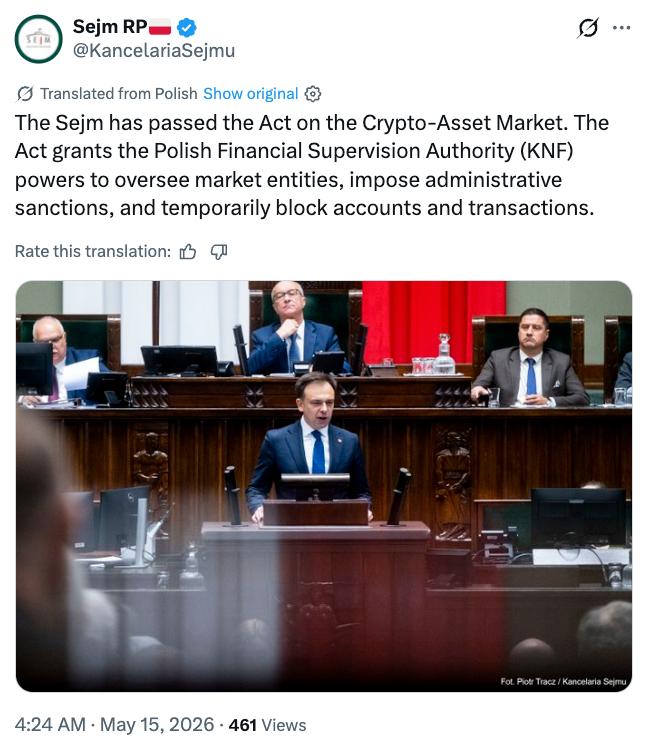
On Friday, Polish legislators gave their approval to a government-sponsored legislative proposal intended to align Poland's cryptocurrency sector with the European Union's Markets in Crypto-Assets Regulation (MiCA) framework, following two instances where President Karol Nawrocki rejected previous iterations of the legislation.
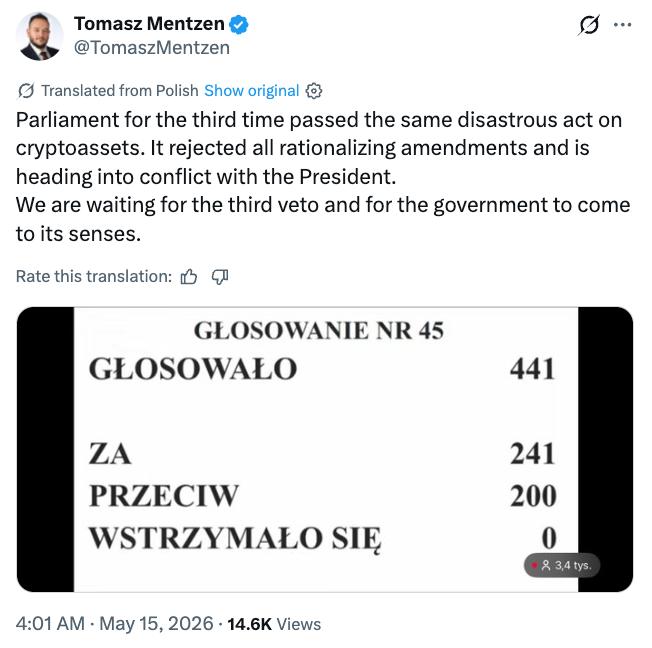
During the 57th session of the Sejm held in Warsaw on Friday, legislators endorsed the legislation through a 241–200 vote, as documented in official parliamentary records.
The legislation that received approval (No. 2529), which has the support of the Ministry of Finance, grants the Polish Financial Supervision Authority (KNF) the authority to supervise market participants, apply administrative penalties, and temporarily freeze accounts and transactions.
This voting outcome represents the government's third endeavor to secure passage of cryptocurrency legislation after facing two presidential vetoes previously, with legislators choosing the state-supported version over three alternative draft bills that were in competition.
Poland's crypto regulation split: Four competing bills amid rising tensions
Following Nawrocki's rejection of two previous government-supported cryptocurrency bills, legislators reconvened this week to deliberate on four different competing legislative proposals.
The most recent parliamentary vote was conducted based on a consolidated committee document that merged government bill 2529 with rival proposals from the president (No. 2528), Confederation (No. 2530), and a parliamentary draft (No. 2363), as indicated in official parliamentary records.
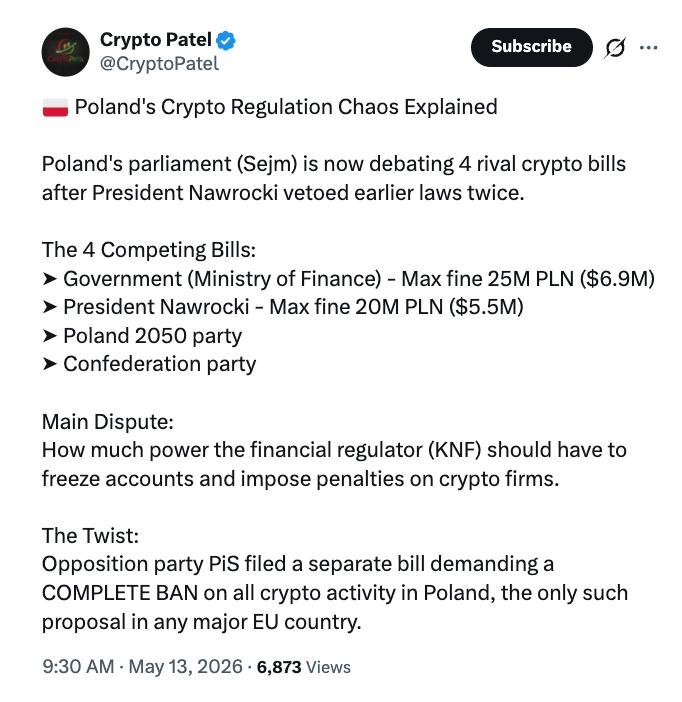
Additionally, the opposition Law and Justice party (PiS) put forward a distinct draft bill that advocates for a comprehensive prohibition on all crypto-asset activities within Poland, as reported by local media sources.
Community expects another veto despite Zonda controversy
Crypto market participants and industry commentators responded with criticism to the most recent Sejm vote, with several anticipating that the president will exercise his veto power once more, given that repeated parliamentary endorsements have failed to address fundamental disagreements regarding supervisory authority and enforcement mechanisms under KNF.
Critics drew attention to persistent concerns regarding provisions for account and domain blocking, which they maintain have remained essentially unmodified despite previous presidential concerns, while recommended protections such as enhanced judicial oversight were excluded from the final legislative text.
They cautioned that persistent political impasse could extend regulatory ambiguity as Poland works to harmonize with the EU's MiCA framework in advance of forthcoming implementation deadlines scheduled for July.
The most recent legislative debate has also been influenced by an escalating controversy surrounding Zondacrypto, following the initiation of a fraud investigation by prosecutors and widespread reports that thousands of users have been prevented from withdrawing their funds.
This matter has become part of Poland's political discourse, with Prime Minister Donald Tusk making allegations regarding connections between Zondacrypto and Russian capital and influence, referencing its initial history and subsequent evolution under different ownership. Tusk further contended that the absence of a comprehensive investor protection framework impeded regulatory intervention, highlighting Poland's recurring postponements in achieving compliance with the EU's MiCA regulations.