Record Bitcoin Supply Among Long-Term Holders Points to Earlier Cycle Bottom, Says Swan's Klippsten
Cory Klippsten from Swan Bitcoin believes the unprecedented levels of Bitcoin supply held by long-term investors could indicate an earlier-than-expected crypto market bottom.

Long-term Bitcoin investors have accumulated a record-breaking 14.7 million Bitcoin, a milestone that may indicate an earlier arrival of the crypto market's cycle bottom, says Cory Klippsten, who serves as CEO of Swan Bitcoin.
"We're at an all-time high of BTC held in addresses of long-term holders," Klippsten stated during an interview with Cointelegraph, noting that this metric has historically "marked cycle lows" in previous market cycles.
The amount of Bitcoin (BTC) in the possession of long-term holders hit 14.7 million BTC this past Wednesday, representing an unprecedented peak that "signals continued conviction" from experienced market participants, as reported by Glassnode, a crypto analytics platform.
According to Klippsten, these numbers indicate that Bitcoin could potentially reach its cycle bottom sooner than it has in past market cycles. This perspective differs from various other market analyses, such as the one from Jiang Zhuoer, the founder of Lebit Mining Pool, who forecast that Bitcoin's bottom wouldn't arrive until somewhere between October and December 2026, or roughly six months following the cycle low of Strategy's Multiple to Net Asset Value (mNAV).
"MSTR's mNAV has already dropped to 0.72," nearing the historical low of 0.7 recorded on May 11, 2022, Zhuoer explained, suggesting that Bitcoin might reach its bottom approximately six months after Strategy's mNAV hits its low point, potentially resulting in a cycle bottom in the range of $42,000 to $44,000.
The mNAV represents the ratio between a company's market capitalization and the actual value of assets held in its treasury. These two predictions both indicate that Bitcoin's valuation could decline further, creating more affordable opportunities for prospective investors.

BTC long-term holder supply up 14% since November
Bitcoin accumulation by long-term holders resumed toward the end of 2025, following a roughly two-month period after the historic $19 billion liquidation event that occurred in early October.
As of publication time, the total Bitcoin supply controlled by long-term holders stood at 16.65 million BTC, representing a 14% increase from the 14.6 million BTC recorded on Nov. 26, according to information from data provider Coinglass.
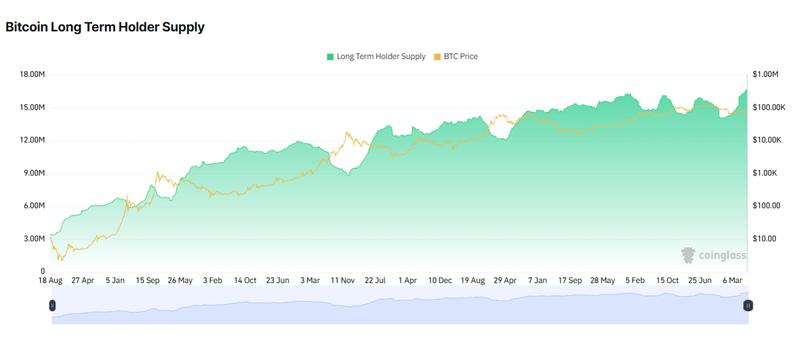
The definition of long-term holders used by Coinglass refers to Bitcoin addresses that have maintained their BTC holdings for a minimum of 155 days. Growth within this investor group is frequently interpreted as an indicator of optimism regarding Bitcoin's long-term prospects, demonstrating unwillingness to liquidate positions at prevailing market prices.
CLARITY Act uncertainty weighs on Bitcoin demand
Additional regulatory factors could also play a role in shaping Bitcoin's price movements, particularly the ongoing uncertainty surrounding whether the CLARITY Act will be enacted, according to Grayscale, an asset manager specializing in cryptocurrency investments.
Should the CLARITY Act fail to pass into law this year, Strategy along with other corporate treasury holders might proceed with additional "deleverage" actions, which could cause Bitcoin prices to "fall moderately further," according to a Friday report authored by Zach Pandl, Grayscale's head of research.
This past Monday, Galaxy Digital reduced its probability estimate for the CLARITY Act becoming law in 2026 down to 50%, cautioning that the US Senate has limited time remaining to advance the crypto market structure legislation prior to its August recess.
A committee hearing in the House of Representatives has been scheduled for July 17 to consider the legislation. The proposed bill seeks to create the United States' first comprehensive regulatory framework governing digital assets, though it has encountered opposition from the banking sector concerning provisions that would permit yield generation on stablecoin holdings.