Prediction Markets Face State-Level Crackdown as Federal Oversight Questions Mount
State regulators across the United States are challenging Kalshi and other prediction market platforms, arguing these services constitute gambling operations that could generate substantial tax revenues for state coffers.

A growing wave of regulatory activity is sweeping through US states as authorities move to either regulate or curtail prediction market operations, with numerous legal challenges focused on platforms like Kalshi.
Judge Jason Woodbury of the Carson City District Court in Nevada issued an order on March 20, making Nevada the first state in the nation to implement a temporary prohibition on Kalshi's operations. State gaming authorities argued that the platform was in violation of Nevada's gambling statutes.
Close to a dozen additional states have initiated various forms of legal action as well. The majority have sent cease-and-desist notifications, though Arizona has escalated matters by filing criminal charges against Kalshi. Meanwhile, several other states are weighing legislative options for prediction market oversight.
This fragmented approach to enforcement across different jurisdictions has attracted nationwide scrutiny, with federal-level regulatory intervention appearing increasingly likely.
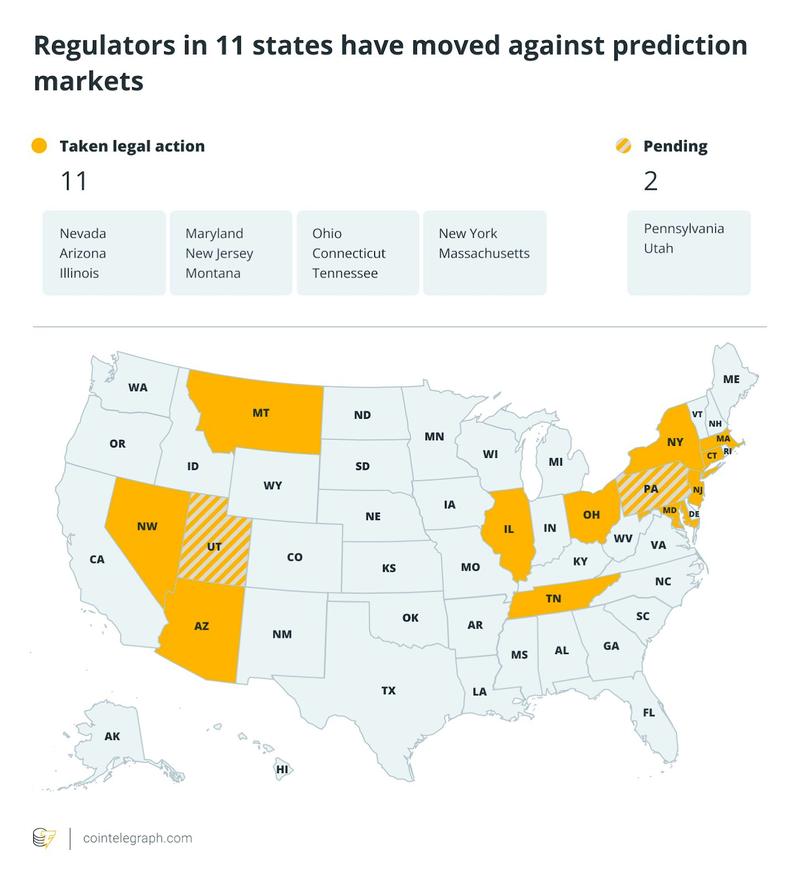
Nevada bans Kalshi while Arizona opens criminal charges
Across 11 states throughout the United States, state and local regulators have pursued legal measures against prediction market platforms including Kalshi and Polymarket.
Nevada authorities succeeded in implementing a temporary prohibition that barred Kalshi from conducting business within state borders for a 14-day period. The Nevada Gaming Control Board originally filed the motion seeking this restriction.
Board chair Mike Dreitzer characterized prediction markets as facilitating "unlicensed gambling" and declared them illegal under state law. "We have a statutory duty to protect the public," he stated.
Legal expert Daniel Wallach, who specializes in sports betting and gaming law, explained that the order bars Kalshi from providing "event-based contracts relating to sports, politics and entertainment to people within Nevada without first obtaining all required licenses."
Only days before Nevada's action, Arizona, which shares a border with Nevada, filed criminal charges against the companies operating Kalshi. The office of Arizona Attorney General Kris Mayes submitted a complaint asserting that Kalshiex LLC and Kalshi Trading LLC were "running an illegal gambling operation and taking bets on Arizona elections, both of which violate Arizona law."
According to the announcement, Kalshi "accepted bets from Arizona residents on a wide range of events in violation of Arizona law. These events included professional and college sporting contests, proposition bets on individual player performance, and whether the SAVE Act would become law."
Under Arizona law, sports betting operations must hold a gaming license, and the state has an absolute prohibition on election-related wagering.
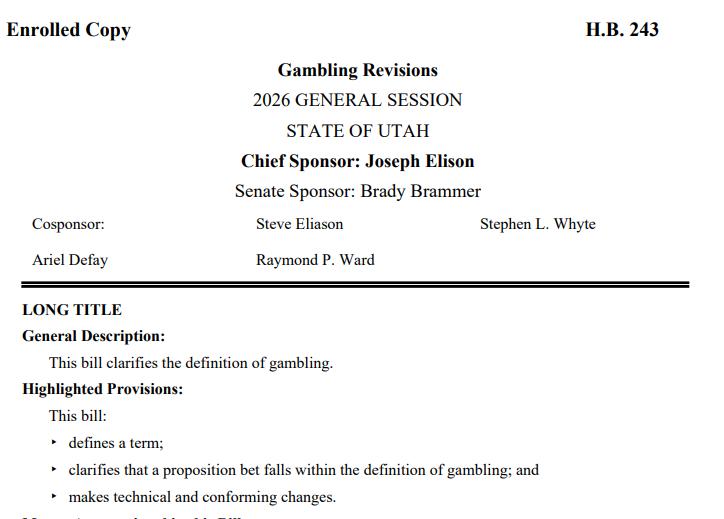
Several other states have either introduced or are contemplating new regulatory frameworks. Utah State Representative Joseph Elison introduced HB243, legislation that would establish a definition for proposition betting as "a gambling bet on an individual action, statistic, occurrence, or non-occurrence."
Pennsylvania Representative Danilo Burgos revealed intentions to bring forward legislation establishing a regulatory framework for prediction markets, placing them under the authority of the Pennsylvania Gaming Control Board. The proposed bill would establish:
- a 34% state tax and 2% local share assessment on gross revenue,
- to ban underage users,
- to include self-exclusion lists for user protection, and
- strict Anti-Money Laundering (AML) and Know Your Customer (KYC) protocols.
Many additional states have sent cease-and-desist notices to prediction market operators and sought to halt their operations through judicial channels. However, not every attempt has proven successful. Judge Aleta Trauger of the US District Court for the Middle District of Tennessee prevented a state injunction that would have stopped Kalshi from conducting business in that jurisdiction. The court determined that the event contracts qualified as "swaps" under the Commodity Exchange Act (CEA), which grants the US Commodity Futures Trading Commission (CFTC) exclusive jurisdiction.
Kalshi did not respond to Cointelegraph's request for comment at publishing time.
Who should regulate prediction markets?
The fragmented landscape of differing enforcement strategies — and the varied judicial responses to these actions across different courts — has raised fundamental questions about proper regulatory authority over prediction markets and appropriate oversight mechanisms. Prediction market operators and their supporters contend that regulatory power should rest with federal authorities, specifically the CFTC.
Elison, who sponsored the Utah legislation, explained to local news outlets, "It's a huge gray area and there's lots of lawsuits all over the country right now [...] debating this very thing, trying to find out what are the actual definitions."
"They're flying under what's called prediction markets, and prediction markets are regulated by the Federal Commodities Exchange [sic]. That's why they're able to do it," he explained.
A Kalshi spokesperson stated previously to Cointelegraph, "States like Arizona want to individually regulate a nationwide financial exchange, and are trying every trick in the book to do it. As other courts have recognized and the CFTC affirms, Kalshi is subject to federal jurisdiction."
"It's different from what sportsbooks and casinos offer their customers, and it should not be overseen by a patchwork of inconsistent state laws," they declared.
Aaron Brogan, who founded crypto-focused legal practice Brogan Law, observed, "Prediction markets' 'crime,' the reason that so many states have pursued and will continue to pursue action against them until they win or are stopped, has nothing to do with the merits of these markets."

Because prediction markets currently fall under the CEA and thus within the CFTC's regulatory purview, "states will not be able to control them, and more importantly, may not be able to tax them," Brogan noted. The American Gaming Association reports that billions of dollars in potential tax revenue are at stake across the 40 states that have legalized online sports betting.
Certain state legislators have been quite candid regarding these financial considerations. Burgos wrote that the "regulatory arbitrage" employed by prediction markets to circumvent state regulations "leaves our constituents vulnerable and deprives the commonwealth of significant tax revenue."
In comments to local news organizations, he argued that states should possess the authority to tax activities, especially those with potential to harm residents. "It's another opportunity to expand the tax base. [...] And like everything else that has a potential harm for our community, for our communities. It can create bad habits or worse habits in our communities. That's one of the dangers that I see."
Federal-level pressure on prediction markets is also intensifying. Utah Senator John Curtis put forward legislation titled the Prediction Markets Are Gambling Act. This measure would modify the CEA to prohibit "event contracts involving sports and casino-style games."
Curtis explained to Utah state media that the legislation would restore authority to state governments. "Our bipartisan legislation clarifies regulatory jurisdiction, ensuring that states can maintain their authority over sports betting and casino gaming. The Prediction Markets Are Gambling Act is about respecting states' authority, protecting families and keeping speculative financial products out of spaces where they don't belong."
Meanwhile, the CFTC is actively soliciting public comment regarding its rulemaking process for prediction markets. Currently, the CFTC has only one sitting commissioner, Chair Michael Selig. He has indicated previously that the agency would defend prediction markets.
According to Brogan, should the CFTC move toward further liberalization of prediction markets, and the preemption question reaches the Supreme Court, "all that counts, through all the sound and fury, is counting to five."