Physical Attacks on Cryptocurrency Holders Net Over $30M in First Half of 2026: Report
Latest data from Chainalysis reveals 46 incidents of violent cryptocurrency-related crimes through the end of June, with attacks proliferating across the globe and France continuing to serve as a primary location for such crimes.

Through violent attacks targeting cryptocurrency owners during the initial six months of the year, criminals have successfully stolen in excess of $30 million, establishing a trajectory that could potentially exceed the unprecedented $58 million taken throughout 2025.
Blockchain intelligence company Chainalysis published findings on Thursday revealing that 46 incidents involving violence related to cryptocurrency had been recorded around the world by the conclusion of June, representing an increase compared to 40 such incidents during the equivalent timeframe in 2025. These criminal activities encompass abductions, residential break-ins and situations involving hostages, commonly referred to within the industry as "wrench attacks."
The data indicates that such physical attacks targeting crypto holders are on the rise, broadening the spectrum of dangers that digital asset owners face from mere custody concerns and portfolio management to encompass direct threats to their personal wellbeing, residential properties and family members.
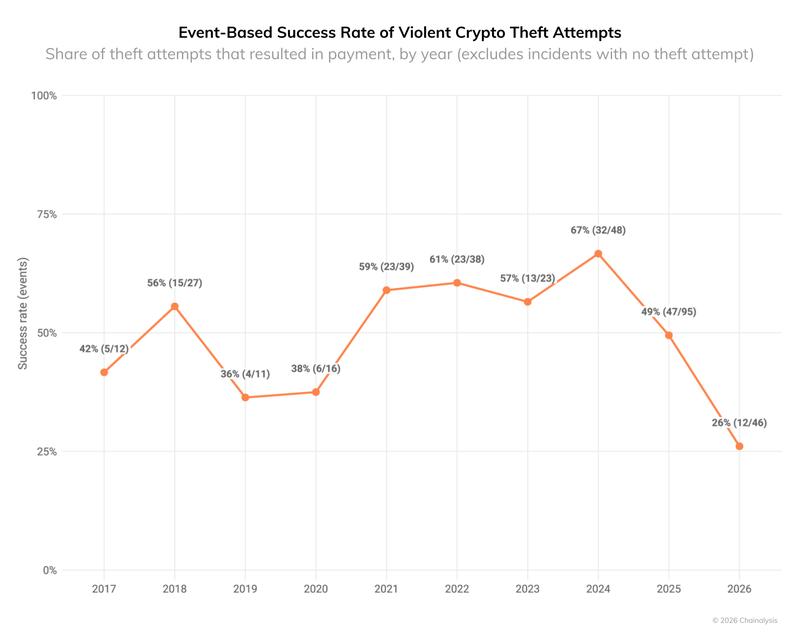
The report reveals that merely 12 among the 46 documented attempts culminated in actual payment to the perpetrators, translating to a success rate of 26% for criminals, which represents a decline from the 49% success rate observed in 2025. That said, the analysis acknowledges that documented incidents probably represent an undercount of the true magnitude of this criminal phenomenon, given that numerous attacks remain unreported to authorities.
The blockchain analytics firm stated that the "tradecraft tends to be amateur at the point of violence, but professional at both ends," explaining that targets are frequently identified through compromised databases, public social media profiles or information from insiders prior to less-sophisticated criminal teams executing the actual physical attacks.
France remains wrench attack hotspot
The Chainalysis analysis indicates that France documented 30 publicly disclosed incidents by the middle of the year, a significant jump from the 19 cases recorded across the entirety of 2025. The research highlights that French law enforcement agencies have tallied upward of 70 such incidents, suggesting the true figure could be considerably higher than publicly reported cases.
During July, Laurent Nuñez, serving as Interior Minister, reported the first-half tally stood at 77 cases of kidnappings, extortions or extortion attempts, marking a sharp rise from the 45 incidents throughout the full year of 2025. As a countermeasure, French authorities have implemented a rapid-response alert and victim protection program while pledging enhanced intelligence exchange and collaborative efforts with cryptocurrency industry participants.
In Thursday's report, Chainalysis identified the purported unauthorized exploitation of French taxation records as the most probable catalyst behind this dramatic increase. Allegations have emerged that a tax authority employee in France inappropriately obtained and subsequently sold sensitive information regarding cryptocurrency investors to criminal organizations, while an independent security breach at Waltio, a company providing cryptocurrency tax-reporting services, allegedly resulted in the exposure of personal data for approximately 50,000 users.
Blockchain transaction analysis further revealed differing degrees of criminal expertise among attackers. Certain perpetrators transferred stolen digital assets directly to centralized cryptocurrency exchanges, whereas others employed more complex methods including cross-chain bridges, decentralized trading platforms and specialized money laundering services. The analytics firm noted that the most sophisticated operations demonstrated connections to established criminal networks operating at a broader scale.