Paris LONGITUDE Highlights: Adam Back Addresses Satoshi Speculation, European Crypto Rules Under Scrutiny
At the recent LONGITUDE conference in Paris, Blockstream's Adam Back addressed speculation about his identity as Satoshi Nakamoto, as OKX Europe's CEO praised MiCA regulation while highlighting concerns about its impact on innovation.

The creator of Hashcash and CEO of Blockstream, Adam Back, a British cryptographer, acknowledged that speculation linking him to Satoshi Nakamoto is "flattering," attributing it to his particularly active participation on the cypherpunk mailing list during the early days of cryptocurrency development.
During a fireside conversation with Cointelegraph at the LONGITUDE conference held recently in Paris, which was co-hosted by the cryptocurrency exchange OKX, Back made these remarks. The event's discussions revolved around regulatory frameworks for digital assets, market infrastructure, and the expansion of stablecoin usage.
Adam Back pushes back against fresh claims linking him to Bitcoin's invention
"There's something flattering about people believing you had the capability to accomplish it," Back explained to Cointelegraph, responding to the high-profile New York Times piece published on April 8 that proposed he could be Satoshi, an assertion he has consistently rejected.
According to Back, there's a rational explanation for why many believe he created Bitcoin. "My challenge is that I was extremely active on the mailing list," he explained, referencing the 1992 Cryptography Mailing List, the platform where Satoshi would eventually unveil the Bitcoin white paper in October 2008.
"Whenever someone brought up electronic cash, I'd jump in immediately, becoming the person who always had commentary on it," he remarked.

According to Back, the enigma surrounding Satoshi's true identity represents an "interesting question" that both he and other professionals in the cryptocurrency space have contemplated without reaching a definitive conclusion.
Before the fireside discussion featuring Back, the conference included three separate panel discussions examining traditional financial institutions' involvement in Web3, the necessity for more transparent regulatory guidelines, and the rate at which stablecoins are being adopted. The event also included a distinct fireside conversation with Erald Ghoos, CEO of OKX Europe.
MiCA regulation deemed "extremely beneficial," though innovation risks emerge
Leaders within the cryptocurrency sector indicated that recent regulatory initiatives have provided welcome clarity, though they cautioned that regulatory fragmentation and excessive regulation might stifle innovation.
During his onstage conversation, Ghoos offered insights into the Markets in Crypto-Assets (MiCA) regulation, the regulatory framework under which OKX Europe achieved full compliance status in January 2025.
"MiCA represents an extremely beneficial development for our industry," Ghoos stated, noting that the framework has contributed to establishing greater trust in cryptocurrency markets.

"This has transformed crypto into a fully regulated asset class, which represents a crucial milestone," Ghoos explained, emphasizing that market participants will now be "thoroughly vetted and required to meet the most stringent standards."
Nevertheless, he cautioned that the "regulatory burden" introduced by the framework might decelerate innovation throughout the European region.
"At this moment, given the substantial and demanding regulatory requirements imposed on startups, I'm increasingly concerned that the innovative spirit and exceptional entrepreneurial talent we possess in Europe may begin migrating to alternative jurisdictions globally," he commented.
Ronghui Gu, CEO of CertiK, identified the absence of a harmonized global regulatory framework as a significant challenge for the cryptocurrency industry.
"Developers and crypto businesses operating in various regions continue to navigate different compliance frameworks," Gu noted.
Addressing the proposed US CLARITY Act, which has experienced delays primarily due to unresolved questions regarding how stablecoin yields affect the banking sector, Gu observed that although the legislation seeks to establish structure, "numerous terms remain unclear, to be honest, and somewhat vague."
"Various firms interpret these provisions differently," he noted.

"However, I believe it certainly creates a considerably more welcoming environment for cryptocurrency companies and developers," he continued.
Frederik Gregaard, CEO of the Cardano Foundation, expressed strong confidence that the CLARITY Act will gain approval in the near future, stating: "You can sense the enthusiasm from policymakers indicating their intention to pass this legislation," he said.
"They're incredibly enthusiastic about it," Gregaard emphasized.
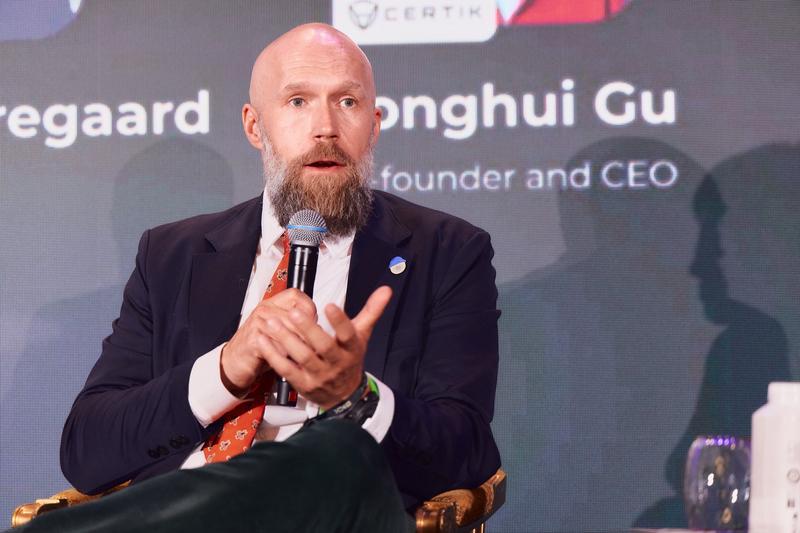
"Once this legislation is enacted, regarding non-TradFi adoption, we'll witness a 100X increase," Gregaard projected, contending that "traditional industries" have been holding back, waiting for regulatory certainty before fully adopting the technology.
North Carolina US Senator Thom Tillis indicated on Monday that he anticipates the Senate Banking Committee will not proceed with marking up the legislation, referred to as the CLARITY Act, during April and has suggested that Senate Banking Chair Tim Scott should calendar it for the following month.
Traditional payments industry excels at "almost faking" instant payment capabilities
Christian Rau, who serves as Mastercard's senior vice president for blockchain and digital assets, commented that stablecoins are "very well suited for payment purposes" while participating on a panel alongside Raja Chakravorti, chief business officer at Stella Development Foundation, and Matthew Dawson, enterprise lead at the Ethereum Foundation.
"Stablecoins avoid the price volatility associated with other digital assets, particularly given that they benefit from regulatory clarity across much of the globe," Rau observed.
According to Rau, the conventional payments industry performs admirably at "almost faking real-time payments."
"When I make a card payment by tapping, the system displays transaction approved or payment completed...but this represents authorization, clearing, and settlement processes," he explained.
"Many aspects of the system that function reasonably well today still involve time delays, expenses, and similar friction points," he added.
Meanwhile, Chakravorti from the Stella Foundation referenced the approximately $317 billion currently in stablecoin circulation, representing roughly a 50% increase from the previous year, while noting that he's observing some near-term deceleration.
"Though it's worth noting that over the past two quarters, growth has begun decelerating somewhat," he characterized this as an encouraging indicator as it implies portions of the foundational infrastructure are beginning to reach maturity.
"The next evolution I envision involves local stablecoins, as stakeholders are increasingly concentrating on developing these opportunities within their own economies as critically important," he stated.
Chakravorti highlighted the "last mile" as among the most significant obstacles to widespread adoption, describing the difficulty of converting digital assets into something "workable" within domestic financial infrastructures.
"This represents the absolutely critical element, as that's ultimately where all the friction exists within the system," he concluded.