New Method Enables Zcash-Like Privacy for Bitcoin Transactions Without Protocol Changes
The Shielded Bitcoin system would leverage zero-knowledge proofs alongside encrypted notes to obscure transaction information while avoiding modifications to Bitcoin's consensus rules, though experts have voiced concerns regarding quantum computing resistance and anonymity guarantees.

A team of researchers from cryptography research firm Alloc Init has unveiled a new framework designed to enable Zcash-style privacy features on Bitcoin while avoiding the need for a soft fork implementation.
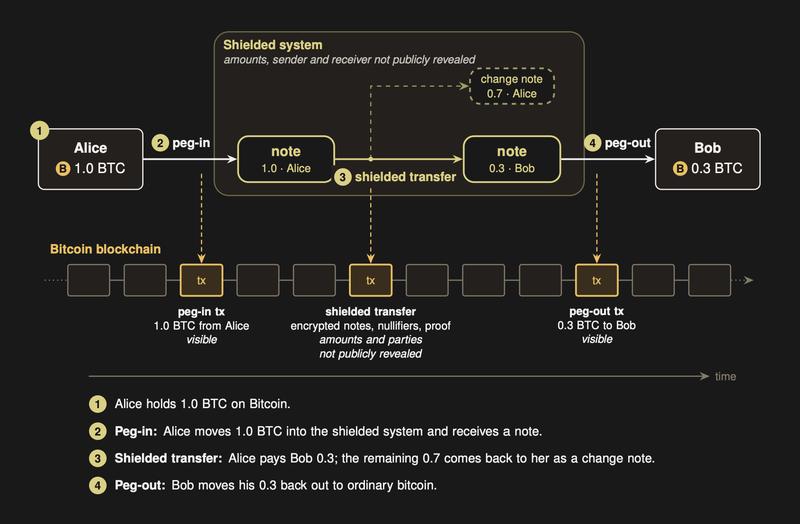
Dubbed Shielded Bitcoin, the system would mask transaction values, sender identities, recipient addresses and connections to prior expenditures through the utilization of encrypted notes combined with zero-knowledge proofs. The research paper was made public on Thursday, authored by Clara Shikhelman, Mikhail Komarov and Aleksei Moskvin.
This framework represents a promising avenue toward enhanced privacy capabilities for Bitcoin participants while circumventing the necessity for consensus-level modifications to the underlying protocol.
Rather than relying on miners to enforce privacy mechanisms, Shielded Bitcoin would utilize Bitcoin as "a neutral publication and ordering layer," according to the research team. Specialized software components known as indexers would then validate zero-knowledge proofs, confirm that assets have not been subject to double-spending, and reassemble the complete state of the shielded infrastructure.
The architectural design of Shielded Bitcoin takes direct inspiration from Zcash's foundational structure. According to the researchers, it employs comparable elements including encrypted notes, publicly visible nullifiers that designate notes as consumed, and zero-knowledge proofs that demonstrate transaction validity. The key distinction from Zcash is that Shielded Bitcoin would not maintain its own independent blockchain or consensus framework.
Shielded Bitcoin draws mixed reactions
Software developer Vadim Zavodil offered criticism of the framework on X, contending that a significant portion of its privacy infrastructure had previously been deployed by Zcash. He raised doubts about the degree of privacy protection a freshly launched system could deliver from the outset, asserting that a newly created shielded pool would begin operation without the established anonymity set that Zcash has developed through years of active deployment.
Privacy is a function of the crowd. Zcash has a real shielded pool built over years. A brand new metaprotocol starts at zero, so your first private transfer hides in a crowd of one.
In an accompanying post that elaborated on the framework, the Shielded Bitcoin research team conceded to a comparable constraint, noting that substantial deposits do not inherently generate a robust anonymity set. They indicated that external observers might still succeed in identifying connections between transfers in cases where a limited number of participants generate the majority of notes or when wallets demonstrate recognizable behavioral patterns.
Pierre-Luc Dallaire-Demers, who founded post-quantum cryptography company Pauli Group, highlighted a different concern, characterizing the construction as intriguing yet "not quantum resistant at all." Dallaire-Demers subsequently mentioned that he was investigating what a comprehensively post-quantum implementation might entail, working under the assumption that Bitcoin will eventually integrate a quantum-resistant signature algorithm.
Zerocash co-author and StarkWare CEO Eli Ben-Sasson expressed more favorable views regarding the proposal's overall direction. Responding to Alloc Init's public announcement, Ben-Sasson noted that the foundational objective behind the Zerocash research paper, which came before Zcash's creation, was to introduce privacy capabilities to Bitcoin.
Ben-Sasson indicated that he had not yet reviewed the Shielded Bitcoin paper in detail but expressed interest in seeing the combined vision of privacy and scalability through zero-knowledge proofs successfully implemented on Bitcoin's foundational layer.