Negative Funding Rates Hit Solana Futures: Could SOL Drop to $78?
Negative funding rates emerged in Solana futures markets amid declining demand for SOL and its decentralized exchange ecosystem. Will the dip attract buyers or is a fall to $78 on the horizon?
Key takeaways:
- Funding rates for Solana perpetual futures have turned negative, pointing to excessive demand for bearish trading positions.
- Competing blockchain networks such as Base and Hyperliquid present direct challenges to Solana through aggressive capture of DEX trading volume.
The native token of Solana, SOL (SOL), experienced a 15% decline after being rejected at the $98 mark on May 11. Following a retest of the $83 price level on Tuesday, futures funding rates entered negative territory, suggesting heightened demand for short positions on SOL.
The price decline was partly driven by decreasing network activity, but intensifying competition from competing blockchain platforms has also played a role.
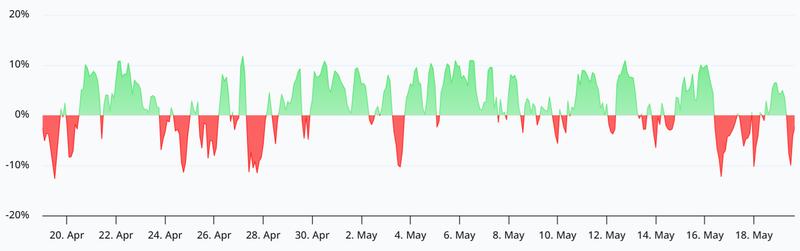
On Tuesday, the SOL perpetual futures funding rate reached -3%, representing a significant drop from Saturday's +8%. Under neutral market conditions, this metric typically remains around +9% to compensate for capital costs and exchange-related risks. Since Saturday, when SOL's price fell beneath $90, demand for bullish leverage positions has been virtually nonexistent.
Solana's DEX activity has dropped 56% since January
A decline in activity across Solana's decentralized exchanges (DEXs) has led to diminished ecosystem revenue and lower demand for SOL. While this decreased interest in decentralized applications (DApps) wasn't unique to Solana, escalating competition represents a significant challenge, as market participants worry that memecoin demand may have permanently subsided.
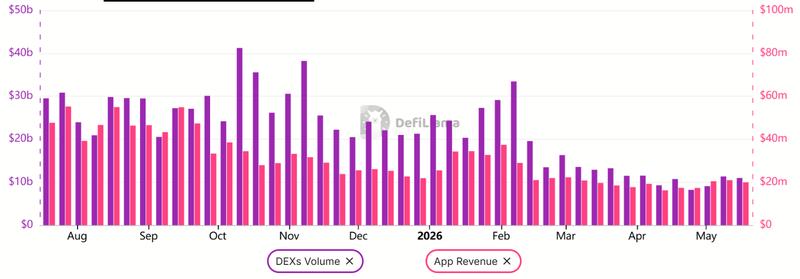
Weekly DApp revenue on Solana has stabilized around $20 million, a decrease from the $35 million average recorded in January. This pattern closely reflects the network's DEX activity trajectory, which currently registers at $11 billion weekly, compared to the $25 billion average seen in January. The leading DApps on Solana over the past 30 days by revenue are Pump, Axiom Pro, Phantom, and Jupiter, which together hold a combined market share of 65%.
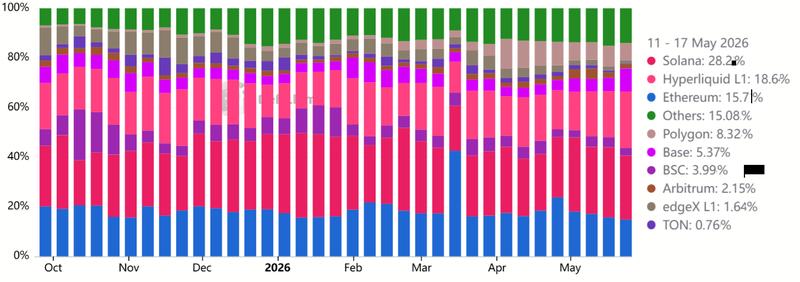
Despite facing growing competition, Solana maintained its position as the leading blockchain for DApp revenue. Hyperliquid has emerged as a direct competitor due to its perpetual contracts dominance, providing a high-throughput solution with essential trading features integrated directly into its consensus layer. Meanwhile, Base, an Ethereum layer-2 network, provided seamless integration with the Coinbase ecosystem.
When measuring total value locked (TVL), Solana claimed the second position with $5.9 billion, ahead of BNB Chain at $5.5 billion and Base at $4.5 billion. DEX platforms and staking DApps such as Jupiter, Kamino, Sanctum, and Raydium dominate Solana's TVL. However, no blockchain currently challenges Ethereum's $43.2 billion TVL, which depends heavily on collateralized lending and liquid staking protocols.
Potential spoofing activity on Solana network DApps
While Solana's presence in the DApp sector is undeniably significant, the network's minimal transaction fees create an ideal environment for maximal extractable value (MEV) botting and artificially inflated activity levels.
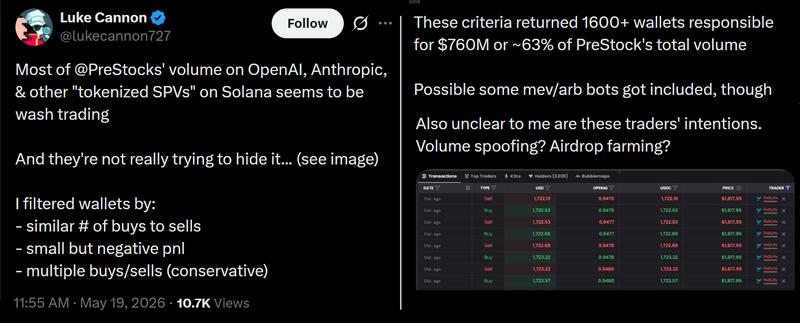
According to X user lukecannon727, approximately 1,600 addresses were allegedly responsible for almost 63% of trading volumes on PreStocks, a synthetic asset trading platform operating on the Solana network. The analysis revealed that these entities exhibited balanced trading patterns, high execution frequency, and minimal net losses. While these characteristics are strongly consistent with arbitrage activity, they could also signal volume spoofing.
The recent weakness in SOL's price can be partly explained by the broader decrease in DApp demand and heightened competition, particularly from Hyperliquid and Base. Any potential bull run appears highly contingent on a resurgence in DEX activity, especially within memecoin trading. However, at this time, there is no clear indication that SOL should revisit the $78 level last observed in early April.