National trust banks now eligible to issue payment stablecoins under expanded CFTC criteria
In alignment with the GENIUS stablecoin framework regulations, the Commodity Futures Trading Commission (CFTC) has updated a prior staff letter to broaden eligibility requirements.

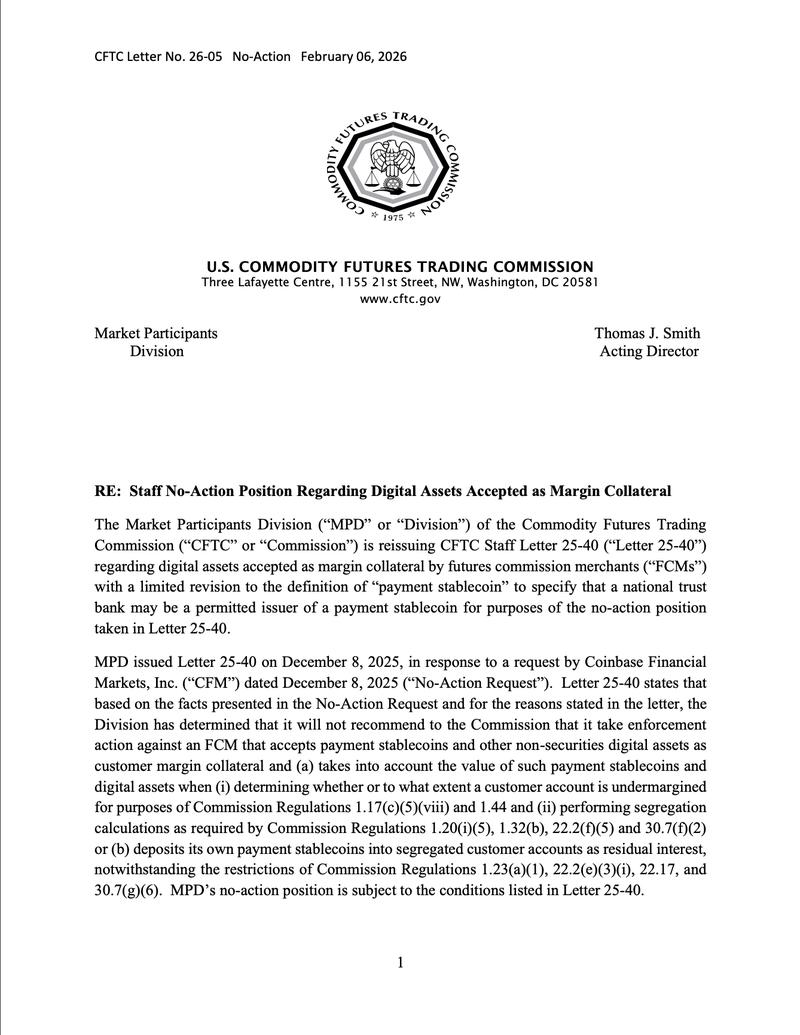
On Friday, the Commodity Futures Trading Commission (CFTC), a financial regulatory body in the United States, reissued a staff letter broadening the eligibility requirements for entities that can issue payment stablecoins, now including national trust banks as qualified issuers of these fiat-backed digital tokens.
Through this revision, the CFTC updated Staff Letter 25-40, originally published on December 8, 2025, to incorporate national trust banks—financial entities authorized to operate across all 50 states in the United States.
Unlike traditional retail banking institutions, National Trust Banks do not typically offer conventional banking products such as loans or consumer checking accounts. Rather, they specialize in providing custodial services, serving as executors representing clients, and delivering asset management solutions. According to the CFTC letter:
"The [Market Participants] Division did not intend to exclude national trust banks as issuers of payment stablecoins for purposes of Letter 25-40. Therefore, the division is reissuing the content of Letter 25-40, with an expanded definition of payment stablecoin."
This updated letter mirrors the evolving regulatory environment in the United States concerning stablecoins following US President Donald Trump's signing of the GENIUS stablecoin bill into law in July 2025.
The Guiding and Establishing National Innovation for US Stablecoins (GENIUS) Act represents a comprehensive regulatory structure for US dollar stablecoins, which are blockchain-based tokens pegged to the value of the dollar.
The Federal Deposit Insurance Corporation outlines a plan for banks to issue stablecoins
During December 2025, the Federal Deposit Insurance Corporation (FDIC), a regulatory agency overseeing US banking institutions, put forward a framework establishing how commercial banks would be permitted to issue stablecoins.
Under this proposal, banks would be authorized to issue these digital tokens through a subsidiary entity that would operate under the supervision of the FDIC, which would evaluate whether both the parent banking institution and its subsidiary meet the GENIUS Act requirements governing stablecoin issuance.
Among these requirements are redemption policy standards, adequate backing collateral for stablecoins in forms such as cash deposits and short-term government securities, along with evaluations of both the bank and subsidiary's comprehensive financial stability.
According to the GENIUS Act, only overcollateralized stablecoins, which maintain 1:1 backing with fiat currency deposits or short-term government securities, such as US Treasury Bills, receive regulatory recognition.
Algorithmic stablecoins and synthetic dollars, which depend on software algorithms to preserve their dollar pegs or utilize complex market trading strategies, were not included within the regulatory framework.