Moody's Reports Major US Banks Anticipate Gradual-Then-Rapid Digital Finance Evolution
According to Moody's, leading American financial institutions foresee a gradual-then-accelerated shift toward tokenized financial systems driven by blockchain technology, digital currencies, and tokenized assets gaining momentum in financial markets.
Leading American banking institutions and intermediaries operating in financial markets anticipate that the transformation toward a digitized financial ecosystem will begin at a measured pace before reaching a critical threshold that triggers rapid acceleration, credit rating agency Moody's Ratings has reported.
The agency released a report on Tuesday revealing that through discussions conducted with American banks and various financial market intermediaries, the majority characterized the transformation as unavoidable and concurred it would follow a "slow, then fast" pattern, with tokenization volumes expanding and spreading across additional market participants, asset classes and applications.
"Throughout our discussions, industry leaders commonly held the belief that comprehensive asset tokenization is inevitable; the primary unknowns revolve around the timeline and order of implementation," Moody's stated.
"In the near term, progress is expected to remain gradual and focused on those simpler segments, such as funds and short-term instruments, running alongside traditional processes. But beyond that, many believe a tipping point will eventually be reached where broader adoption accelerates rapidly."
The tokenization movement has emerged as among the primary catalysts for institutional engagement with blockchain technology and cryptocurrency, with expectations pointing toward substantial expansion in the coming years. ARK Invest, managed by Cathie Wood, forecasts that digital assets could expand into a $28 trillion market by 2030, propelled by key drivers including Bitcoin, decentralized finance, stablecoins and tokenized RWAs.
Traditional Finance Institutions Building Infrastructure
According to Moody's assessment, present-day tokenization activity remains at minimal levels, with primary applications concentrated in cryptocurrency trading, retail cross-border payments and certain institutional scenarios. Nevertheless, conventional financial institutions are proactively laying groundwork in anticipation of an adoption surge.
The tokenized real-world asset market has expanded by over 420% since the beginning of 2025 and stands at a valuation of $31.6 billion as of Thursday, based on data from analytics platform RWA.xyz.
"Nearly every large banking institution and significant financial market intermediary has created specialized digital-asset divisions or innovation departments and is engaging in industry pilot programs to evaluate new infrastructure," Moody's reported.
"These efforts are strategic: firms want to be ready to serve clients with digital asset and digital money capabilities if adoption takes off, so they are not caught flat-footed by a sudden shift in market demand."
During January, Morgan Stanley appointed seasoned executive Amy Oldenburg to oversee the investment bank's newly formed crypto division just weeks following its announcement of intentions to introduce three crypto exchange-traded funds and a crypto wallet.
Moody's Outlines Three Potential Financial System Scenarios
In a separate analysis released on Monday, Moody's outlined three potential trajectories for the financial system, contingent upon tokenization's advancement rate.
Under the "steady growth" base case, which the agency characterized as most probable, the financial infrastructure will predominantly remain unchanged; tokenization would achieve scale within specific assets like stablecoins and tokenized deposits, while existing asset managers, banking institutions and infrastructure providers maintain their central positions.
Alternatively, under a low-growth scenario, where regulatory obstacles, unsettled legal issues and limited end-user demand have constrained adoption, asset tokenization and digital money would remain restricted to limited use cases with minimal alterations to the financial infrastructure.
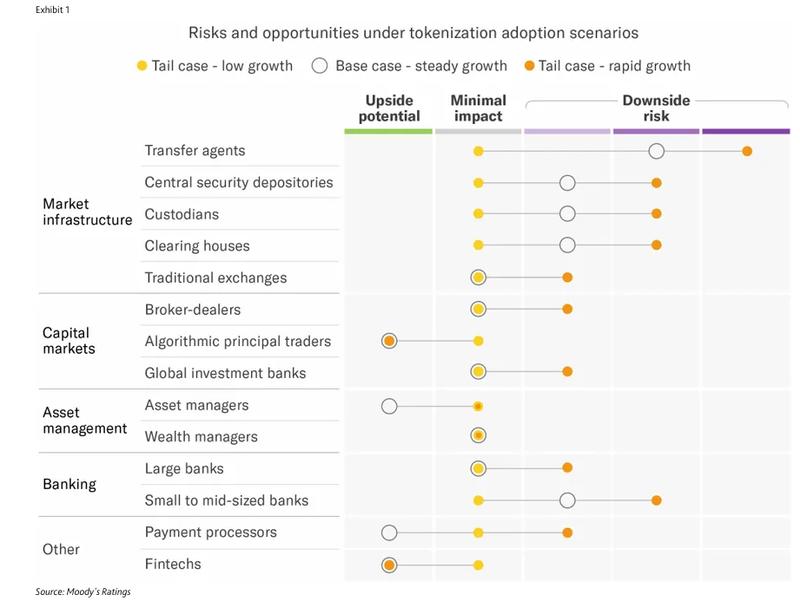
The scenario with greatest disruptive potential would materialize if tokenization experiences accelerated growth and assets including stablecoins achieve widespread acceptance as an onchain settlement mechanism.
"Certain incumbent institutions would encounter increased pressure. For instance, payment processing companies and elements of the traditional market infrastructure, such as correspondent banks may experience revenue losses tied to settlement delays and fragmented infrastructure, and smaller to medium-sized banking institutions could witness declining deposit balances," Moody's indicated.
Jordi Visser, a macro investor and former hedge fund manager, stated on Saturday that the "tokenization reality" will commence this year, with tokenized assets driving agentic AI payments.
In related developments, the International Monetary Fund, an international financial institution, stated in April that tokenization possesses the capacity to eliminate friction and enhance transparency within finance but also cautioned it carries the potential to generate challenges concerning financial stability.