Michael Saylor's Bitcoin messaging lacks transparency, requires improvement to win over market: Standard Chartered
The British banking giant identifies unclear messaging from the world's largest corporate Bitcoin holder as creating short-term uncertainty for cryptocurrency markets.

Michael Saylor, the founder and chairman of Strategy, once more utilized social media platforms this past Sunday to deliver his most recent communication to the investment community, as one financial analyst suggests his messaging requires enhanced transparency to assist Bitcoin in recovering its upward trajectory.
Saylor's Sunday communication read "Orange dots tell only part of the story," accompanying a graphic sourced from Saylortracker.com, mirroring earlier social media communications that have historically preceded announcements regarding Strategy's Bitcoin (BTC) acquisitions, which are usually made public the following day after his social media activity.
Over the past several weeks, the company holding the world's largest digital asset treasury and functioning as a significant BTC stakeholder has shifted from its historically maintained "never sell Bitcoin" philosophy toward an openness to liquidate portions of the leading cryptocurrency when necessary to finance dividend distributions for its STRC preferred stock shareholders and to replenish its liquid capital position. In the first part of this month, Strategy liquidated Bitcoin valued at $216 million, bringing its aggregate holdings down to 843,775 tokens, as documented in a July 6 submission to the US Securities and Exchange Commission.
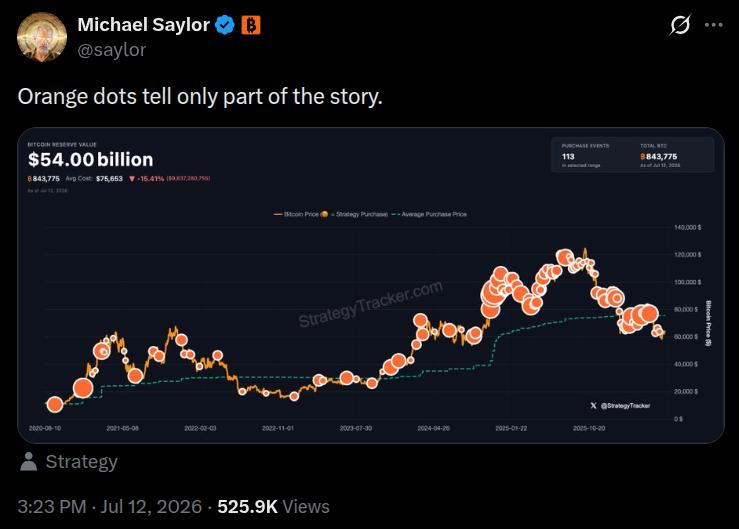
Just days before that transaction, Strategy introduced a capital allocation framework permitting Bitcoin liquidations to finance dividend payments, elevated the yearly dividend yield on its STRC preferred stock to 12%, and revealed that its US dollar cash reserve had expanded to $2.55 billion.
Geoff Kendrick, who serves as Standard Charter's global head of digital assets research, maintains that Strategy's recent operational decisions — combined with Saylor's communication approach surrounding these moves — "are muddying the waters for BTC near-term."
"We think effective communication of MSTR's new strategy (using BTC to back STRC) is key to reassuring markets that wholesale selling is unlikely; this should in turn support BTC prices," Kendrick wrote in a note to clients on Friday. "Indeed, if this signalling proves effective, it should remove the need for MSTR to actually sell any BTC by supporting STRC's price," he said.
StanChart sees inconsistencies in "never sell" approach
According to Kendrick's analysis, Strategy's historically maintained "never sell" philosophy created constraints on how the corporation could leverage its position as the industry's largest digital asset treasury holder.
"The problem with the 'never sell' approach is that it limits what MSTR's BTC holdings can do — or, perhaps more importantly, what they are perceived to be doing," the StanChart analyst said. "MSTR has started to shift its communication strategy on this in recent months. It has sold BTC twice and recently announced a BTC monetization program."
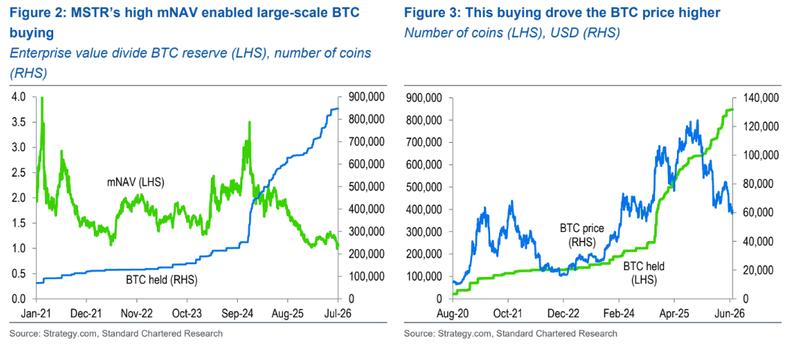
Nevertheless, Kendrick anticipates that Strategy's "market signaling" will demonstrate enhancement in the coming period. His expectation is that this will provide clearer visibility into Bitcoin's trajectory, for which StanChart continues to uphold its $100,000 price target by year-end.
Shares struggle from year low ahead of earnings report
Market participants who embraced the Strategy investment thesis have experienced considerable turbulence over the preceding 12 months. The STRC preferred shares were structured to maintain a $100 price point per unit. Those holding these securities witnessed that par valuation decline significantly last month, reaching the weakest level since the preferred stock's market debut one year prior.
The common stock shares, which trade under the MSTR ticker symbol, have experienced a decline exceeding 70% of their market capitalization since July 2025, settling at $94.64 per share when Friday's trading session concluded, representing a significant drop from the 52-week peak of $457.22.
The company is scheduled to publish its second-quarter financial results on July 30, with the analyst community's consensus projection standing at $4.28 per share, based on Yahoo Finance data. The company's reported earnings have underperformed analyst expectations in six out of the most recent eight quarterly reporting periods, according to Fintel.io data, which includes a 33.76% negative surprise in the first quarter of 2026.