Meta's WhatsApp claims Kremlin blocking service to promote state-controlled messaging platform
Meta-owned messaging platform WhatsApp alleges that Russian authorities are restricting access for its user base in order to drive adoption of a government-controlled communications alternative.

The popular messaging platform WhatsApp, which operates under the ownership of Meta, the social media conglomerate, has leveled accusations against Russian authorities, claiming they are working to restrict access for millions of users within the country as part of an effort to direct them toward a state-controlled messaging alternative.
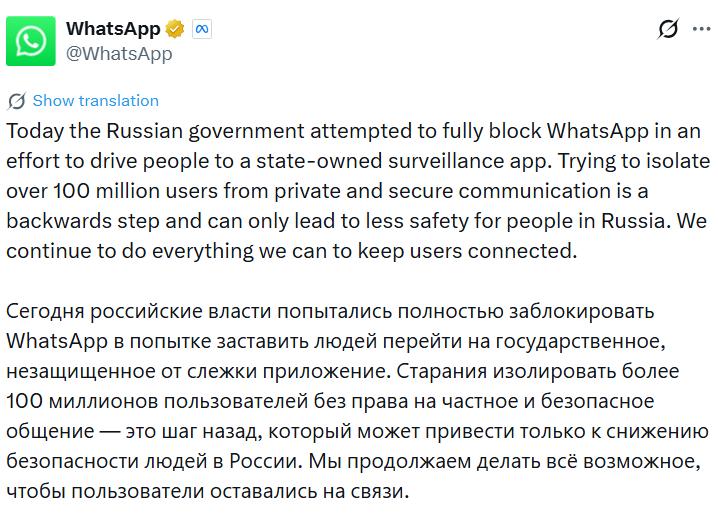
"Attempting to cut off more than 100 million users from secure and private communication represents a regressive move that will only result in diminished safety for individuals throughout Russia. We remain committed to taking every possible action to maintain connectivity for our users," the company stated via a post on the X platform this past Wednesday.
The government-supported messaging service Max made its debut in March 2025, developed and released by VK, a Russian technology company, positioning itself as a domestically-produced substitute for messaging applications owned by foreign entities such as WhatsApp and Telegram.
Russian authorities have subsequently engaged in aggressive promotional campaigns for the platform, implementing regulations that mandate its pre-installation on every smartphone distributed for sale within Russian borders, with enforcement beginning on Sept. 1.
According to data compiled by search engine optimization company Backlinko, Russia maintains the position of fourth-largest monthly active user base for WhatsApp globally, accounting for 72 million users, positioned behind only Indonesia, Brazil and India in terms of total users.
Moscow-based media outlets report WhatsApp has become unreachable
On Wednesday, Gazeta.ru, an internet-based news publication headquartered in Moscow, published reports indicating that WhatsApp's web domain had been subjected to a comprehensive block, rendering it completely inaccessible to users unless they employ a VPN or comparable circumvention technology.
The news organization additionally reported, referencing statements from TASS, the government-controlled news agency, that Dmitry Peskov, who serves as presidential press secretary, declared that restoring WhatsApp access within Russian territory would necessitate that the messaging platform comply with Russian legal requirements and demonstrate openness to participating in negotiations.
During the previous year, Moscow initiated partial restrictions on certain calling features within both WhatsApp and Telegram, with officials alleging that these platforms had refused to provide information to law enforcement authorities and had not complied with requirements to maintain data belonging to Russian users on servers located within the country's borders.
During January, Andrey Svintsov, serving as a deputy within the State Duma, which functions as the lower legislative chamber of Russia's national parliament, informed TASS that the nation's telecommunications regulatory body would implement comprehensive measures designed to entirely block WhatsApp access before the conclusion of 2026.
Additional nations implementing controls on messaging platforms
Multiple other nations have allegedly employed restrictions on communication technologies during periods of political conflict and social unrest.
During December, Bobi Wine, a Ugandan political figure who leads opposition movements, urged his followers and supporters to install Bitchat, the decentralized peer-to-peer messaging application created by Jack Dorsey, while simultaneously alleging that government authorities were preparing to disable communications infrastructure in advance of the upcoming electoral process.
Concurrently, during September, the island nation of Madagascar, located off the African coast, witnessed a dramatic increase in downloads of Bitchat occurring simultaneously with public demonstrations and disruptions to communication services, mirroring a comparable surge in downloads that had occurred during episodes of civil unrest in both Nepal and Indonesia during earlier weeks of that identical month.