Market Turbulence From Tech Selloff and Oil Swings: Can Bitcoin Maintain $60K Support?
As spot Bitcoin ETFs see $1.9 billion in withdrawals and technology equities face downward pressure, Bitcoin's role as a protective asset is being questioned, with the $60,000 level in jeopardy.

Key takeaways:
- Climbing oil prices alongside increasing producer inflation metrics have led market participants to anticipate a more hawkish monetary stance from the US Federal Reserve.
- Significant withdrawals from spot Bitcoin ETFs throughout June indicate the digital asset is presently struggling to serve as a protective hedge against stock market volatility.
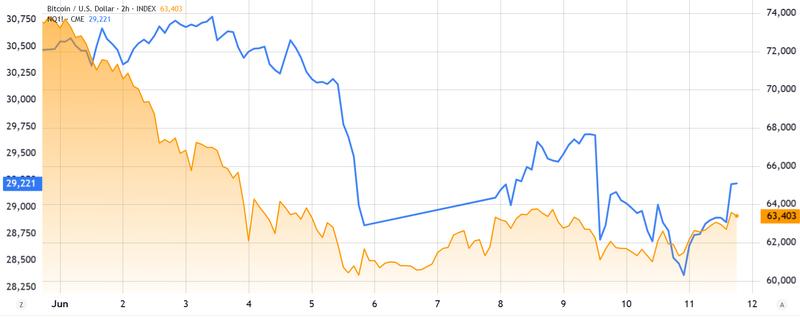
During the seven-day period ending June 10, the Nasdaq 100 Index experienced a 7.5% decline, erasing $2.7 trillion from its total market capitalization. This substantial loss amounts to more than double the entirety of Bitcoin's (BTC) market cap, placing investors on high alert, particularly as inflation figures face upward pressure from elevated oil prices. Market participants are growing concerned that Bitcoin's support level around $60,000 may be vulnerable.
The continuing conflict in Iran has propelled Brent crude oil valuations beyond $90, causing market participants to grow anxious about potential economic deceleration and to factor in expectations for extended tight monetary conditions. Independent of employment market dynamics, discretionary spending capacity typically contracts under such circumstances.
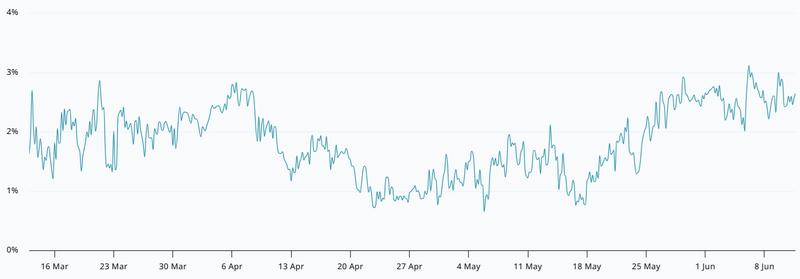
According to Thursday's report from the US Labor Department, the producer price index surged by 6.5% compared to May 2025, reaching its most elevated reading since 2022. Market participants now see 40% probability of the US Fed implementing an interest rate hike by September, a significant increase from the 5% odds projected just one month earlier, based on data from the CME FedWatch Tool.
Companies building AI infrastructure find themselves urgently requiring capital to support their expansion projects, which helps explain the adverse market sentiment. Google (GOOG US) revealed intentions to secure $80 billion in funding, with Oracle (ORCL US) and Super Micro Computer (SMCI US) pursuing similar strategies with $40 billion and $7 billion capital raises, respectively. The Friday launch of SpaceX shares on public markets will probably establish expectations for subsequent IPO activity.
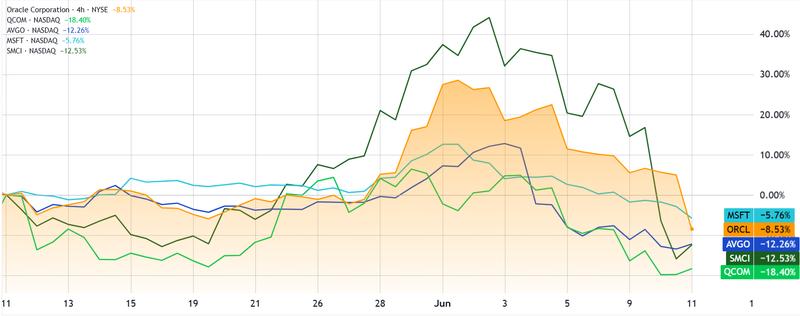
Declaring the AI sector a speculative bubble appears hasty, particularly after SpaceX achieved the distinction of the largest IPO in history with a $1.77 trillion valuation. Furthermore, US equity markets responded favorably following US President Donald Trump's decision to cancel planned military strikes on Iran, referencing revived diplomatic discussions to reestablish access through the Strait of Hormuz.
Strategy accumulation pause amid spot Bitcoin ETF outflows
The downturn in Bitcoin's price occurred simultaneously with Strategy's (MSTR US) announcement to temporarily suspend its Bitcoin acquisition program in order to decrease convertible debt obligations. Consequently, Strategy's cash reserves dropped to a level sufficient for seven months of dividend payments, while its preferred variable Stretch (STRC US) shares moved further away from the $100 threshold that would permit additional equity offerings.
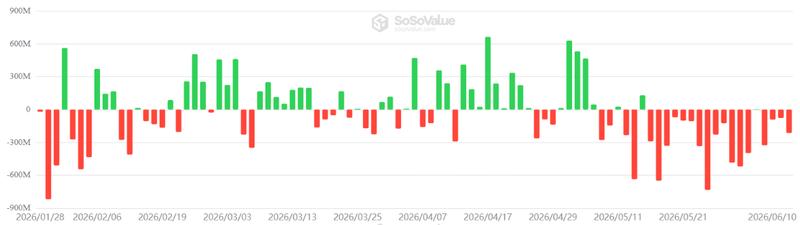
The $1.9 billion in capital withdrawn from spot Bitcoin exchange-traded funds (ETFs) during June strengthened pessimistic market outlook, given that this metric functions as a representation of institutional investor appetite. At present, characterizing Bitcoin as an effective hedge against potential stock market declines appears problematic; the possibility of additional downward movement beneath $60,000 remains a realistic scenario.