Market Experts Dismiss Claims That Jane Street Orchestrates Daily Bitcoin Price Drops at 10 AM
Following Terraform's lawsuit alleging questionable trading methods, cryptocurrency investors point fingers at Jane Street for routine morning Bitcoin declines, though market experts indicate the timing aligns with wider risk asset adjustments.

Digital asset traders have pointed accusations at quantitative trading company Jane Street, claiming the firm applies downward pressure on Bitcoin through systematic daily selloffs coinciding with the opening of United States markets. However, market professionals and available data indicate the alleged pattern lacks consistency, and no individual entity possesses the capability to push Bitcoin into an extended bearish trend.
The allegations gained traction across social media platforms one day following a lawsuit filed by Terraform Labs' court-designated administrator against Jane Street, which accused the firm of insider trading related to deals that intensified the May 2022 collapse of Terra's algorithmic stablecoin network.
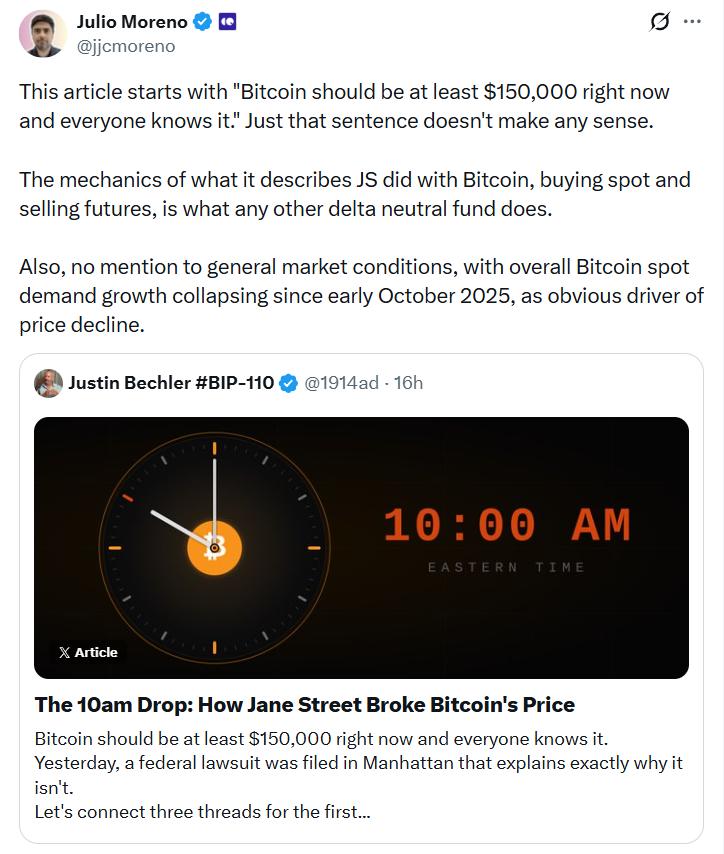
Multiple market observers, including cryptocurrency personality Justin Bechler, have suggested that Jane Street's stake in BlackRock's iShares Bitcoin Trust exchange-traded fund (ETF), identified by the ticker IBIT, might conceal a net short position in Bitcoin through hedging strategies that remain absent from publicly available regulatory documents. According to Bechler's analysis, Jane Street executes coordinated algorithmic Bitcoin sales at precisely 10:00 am Eastern Time each trading day, thereby manipulating the Bitcoin (BTC) price downward to acquire the ETF at reduced valuations.
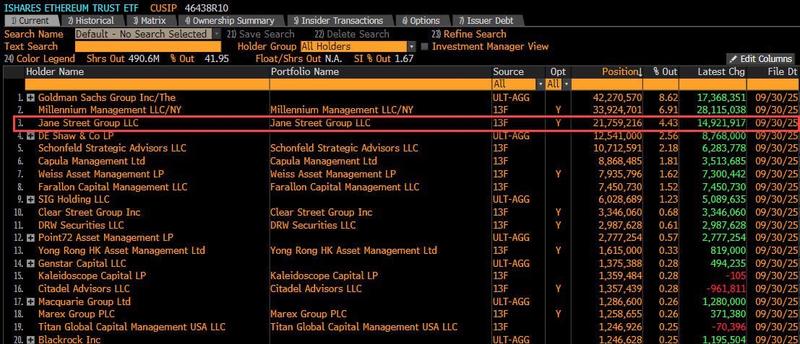
"When Jane Street reports holding $790 million in IBIT shares, the filing tells you nothing about whether those shares are hedged by puts, offset by short futures, or wrapped in a collar that makes the firm's net Bitcoin exposure zero or even negative," wrote Bechler, adding that the "actual position could be a massive short," which looks like a long position that is "invisible" under current disclosure rules.
Julio Moreno, who serves as head of research at CryptoQuant, warned that the trading behavior Bechler outlined is not exclusive to a single organization. According to Moreno, purchasing spot market exposure while simultaneously selling futures contracts represents a standard strategy employed by delta-neutral investment funds aiming to profit from price spreads instead of directional market movements.
The most recent 13-F regulatory filing submitted by Jane Street also revealed holdings in Strategy, alongside substantial investments in Bitcoin mining companies including Bitfarms, Cipher Mining and Hut 8.
Allegations Center on Morning Bitcoin Price Declines
The narrative circulating online revolves around the concept that Bitcoin experiences regular price declines immediately following 10 am ET, a timeframe that coincides with the commencement of United States market trading hours. On Wednesday, onchain data analyst Nonzee published an hourly Bitcoin price chart and asserted that Jane Street has been "manipulating" the cryptocurrency market during this specific window for an extended period of months.
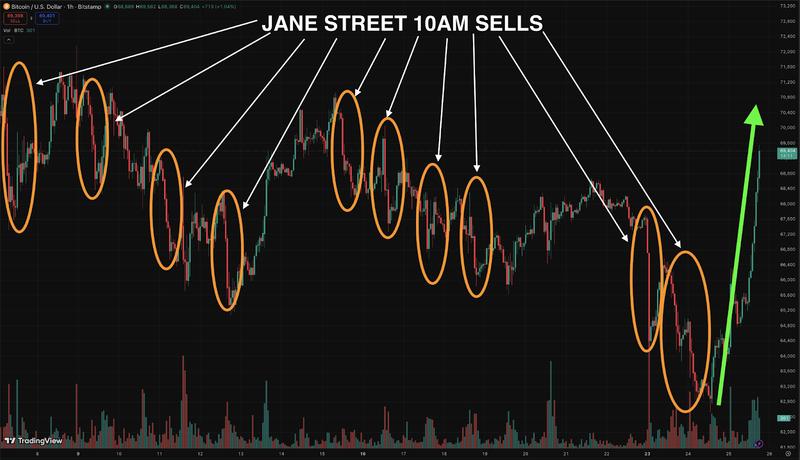
A cryptocurrency market monitoring account known as Whale Factor asserted that Bitcoin has reliably experienced a 2% to 3% decline on a daily basis within minutes of the US market opening, characterizing this as programmatic price manipulation that has persisted since the beginning of November.
"Many traders point to Jane Street's massive $2.5B+ position in BlackRock's IBIT as the likely driver: engineered liquidity sweeps to accumulate spot #ETF's at a discount," said Whale Factor in a Dec. 9 X post.
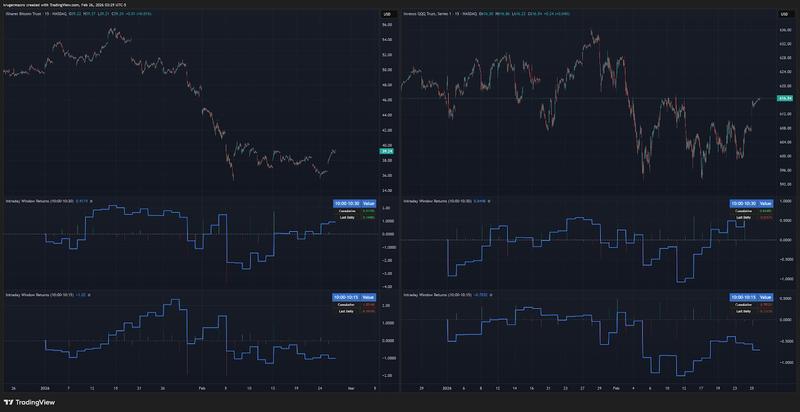
Macroeconomic analyst Alex Krüger challenged this characterization, presenting blockchain information that demonstrated Bitcoin actually achieved aggregate gains of 0.9% during the 10:00 am to 10:30 am ET period since Jan. 1, contradicting claims of a "systemic dump" occurring during these hours.
"Everyone says Bitcoin dumps at 10 AM every day. I pulled the data, and it's not true," wrote Krüger in a Thursday X post, adding that the "10 AM dump" theory is a broad risk-asset repricing that tracks the price performance of the Nasdaq stock index.
Market Analysts Assert Single Entity Cannot Control Bear Market Trajectory
Despite the possibility that specific trading approaches may intensify price swings around the US market opening, certain market participants maintain that it remains improbable for a single organization to control a global marketplace as liquid and decentralized as Bitcoin. "Regardless of whether market manipulation has taken place, Bitcoin's price isn't driven by just one firm, no matter how influential. It isn't a memecoin," said Nick Puckrin, the co-founder and lead market analyst at educational platform Coin Bureau.
"It's understandable that investors with strong conviction in Bitcoin are looking for a villain during a major downturn. But the reality of Bitcoin market dynamics is much more nuanced."
According to Puckrin's assessment, Bitcoin's recent price weakness can be more accurately attributed to a combination of factors including geopolitical instability, worldwide liquidity market conditions and increasing competition for capital allocation from the rapidly expanding artificial intelligence technology sector.