Mark Moss: This Is Bitcoin's Greatest Investment Opportunity Yet
Mark Moss, co-founder of Bitcoin Opportunity Fund, believes that as banks and ETFs expand Bitcoin accessibility, the cryptocurrency will reach a new all-time high in 2027.

According to investor Mark Moss, Wall Street's acceptance of Bitcoin has generated what he describes as the "best buying opportunity ever."
As an advisory partner, Moss co-founded the Bitcoin Opportunity Fund. Additionally, UK-listed Satsuma Technology named him their chief Bitcoin strategist in 2025.
Speaking with Cointelegraph on the most recent Trade Secrets episode, Moss reveals that his initial Bitcoin purchase occurred in 2015 at approximately $300, amid a recovery period following a dramatic drop from $1,000 to $200.
Reflecting on those earlier purchases, Moss remembers, "It was so risky." By comparison, the current landscape features "consensus from the US government and Wall Street."
"But most people still think it's a scam," he says.
According to Moss, this persistent skepticism creates investment opportunities as Bitcoin begins crossing what he describes as the "chasm" separating early adopters from mainstream investors. The growing accessibility through banks and exchange-traded funds (ETFs) has simplified Bitcoin purchases, while financial advisers may help convince previously hesitant clients to explore cryptocurrency investments.
Moss calls bottom but Bitcoin keeps falling
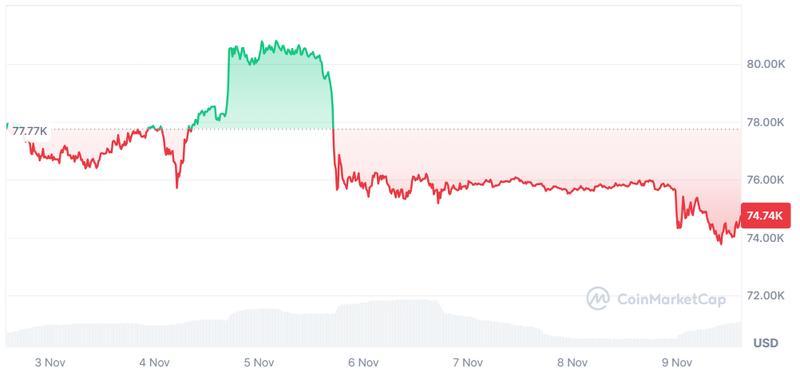
Following the Democrats' midterm election victory in the US Congress, Bitcoin momentarily surged past $80,000, only to surrender those advances when tech stocks experienced a selloff. Bitcoin dropped to $74,762 by Friday, marking its weakest performance since August, and continues struggling at press time.
Notwithstanding the recent selloff, Moss highlights the market's response to the $6.3 billion Binance security breach as evidence that selling pressure was diminishing.
"The price didn't really drop," he says.
Following the breach, Bitcoin declined to $76,320 and subsequently slipped to $74,762 on Friday, wiping out its gains from the post-election period. It dropped even further to approximately $73,500 late Sunday, reaching its weakest point since August, following Nvidia's board announcement that it would investigate allegations regarding CEO Jensen Huang being targeted in a foreign intelligence operation.
During election week, US spot Bitcoin ETF flows experienced dramatic fluctuations. On Wednesday, these funds attracted roughly $75 million, then experienced outflows of $430 million on Thursday.
Nevertheless, historical patterns favor long-term holders. According to Moss, Bitcoin has averaged approximately 53% gains during the 12 months following previous US midterm elections, citing data extending back to 2014. His analysis encompasses three completed election cycles. He anticipates Bitcoin establishing a new all-time high in 2027.
Moss backs Strategy but would keep his Bitcoin
When it comes to Bitcoin treasury companies, Moss believes Strategy (MSTR) is the top choice, though he maintains that direct Bitcoin ownership remains the superior option. Strategy initiated its Bitcoin acquisition strategy in 2020 and subsequently integrated these purchases as a fundamental component of its operations. The company has financed its acquisitions through stock and debt offerings, providing investors with an avenue to gain Bitcoin exposure via a publicly traded entity.
As of Nov. 2, Strategy possessed 849,327 BTC, representing more than 4% of Bitcoin's total maximum supply.
"I don't think there's another publicly traded company that will outperform Strategy over the next ten years," Moss says.
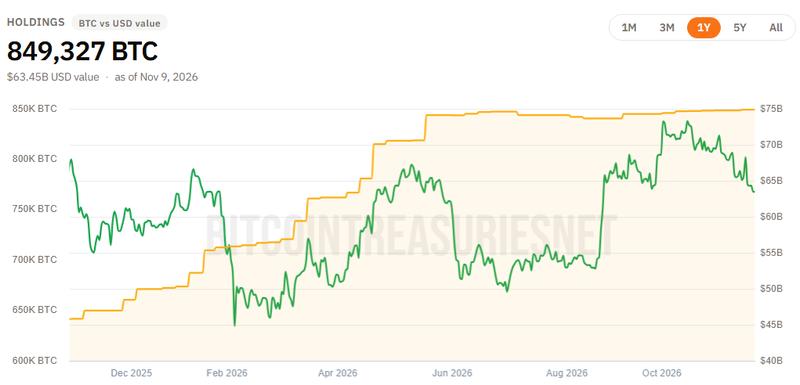
When a Bitcoin treasury company's shares rise alongside the cryptocurrency's price appreciation, leverage can enable those shares to deliver superior performance compared to holding the underlying cryptocurrency directly.
Despite Strategy's potential to outperform, Moss states he wouldn't exchange his Bitcoin holdings for the company's shares.
Prior to acquiring his first Bitcoin, Moss earned his income purchasing foreclosed homes, renovating them and reselling them for profit. His career progressed into property development, followed by building and eventually selling a medical equipment enterprise. He indicates he invested the sale proceeds into Southern California real estate holdings.
Following the 2008 market collapse, he experienced the loss of his entire investment.
"The reward of being right is not worth the risk of getting it wrong," he says.
Despite his optimistic view on Strategy, Moss emphasizes he would retain his Bitcoin holdings and allocate only a modest portion of his portfolio toward pursuing enhanced returns through treasury stocks.
A journey of $1 million Bitcoin starts with small allocations
Under Moss's framework, Bitcoin could potentially reach $1 million under specific conditions, particularly when it begins competing with stocks, bonds, gold and real estate for a significant portion of investor capital. His model calculates the current value of these asset classes, forecasts expansion as the worldwide money supply increases, and determines a Bitcoin valuation based on the market share it could capture.
Financial advisers may facilitate this capital influx through individual client portfolios, recommending they reallocate several percentage points from stocks or bonds into Bitcoin. This projection relies on a substantial number of clients implementing such changes, creating a situation where numerous small allocations collectively become significant.
The framework also presumes Bitcoin maintains its security and decentralized nature. When questioned about potential obstacles to this scenario, Moss identified any failure that would compromise either characteristic.
According to Moss, $1 million represents a realistic target by 2030... although long-term holders may need to exercise patience until 2032.