Major US Dispute Resolution Provider Introduces Legal Framework for AI Agent Transactions
With the rise of AI-driven autonomous transactions, "we need to know there's a clear answer to what happens if something goes wrong," stated Mance Harmon, co-founder of Hedera.

A collaboration between the American Arbitration Association and an extensive alliance of technology, cryptocurrency, and corporate entities has unveiled the Legal Context Protocol, establishing an open framework intended to integrate legal oversight into transactions conducted by agentic artificial intelligence.
On Wednesday, the non-profit American Arbitration Association (AAA) revealed LCP in partnership with Integra Ledger, with the goal of tackling legal challenges that may emerge throughout agent-to-agent commercial exchanges.
The legal infrastructure that has supported e-commerce over the last 20 years… like click-throughs and terms of service — none of that translates... when agents are negotiating with other agents. There had to be some understanding about how legal context attaches to agentic transactions.
Bridget McCormack, president and CEO of AAA
This innovative protocol emerges at a time when corporate entities and financial service providers are exploring opportunities to deploy agentic AI within commercial operations. According to Gartner's projections, the agentic payment economy is expected to achieve $15 trillion in expenditure by 2028.
The primary objective of LCP is to ensure legal terms, authorization, and mechanisms for dispute resolution become "discoverable and verifiable" as AI agents conduct transactions representing individuals and corporate entities, according to AAA's explanation.
LCP, which operates independently of blockchain technology, works in conjunction with current payment and identity frameworks, including x402 and Machine Payments Protocol, by providing clarity on the terms under which transactions take place, the governing legal jurisdiction, and the available recourse options.
Payment infrastructure is actively being built for AI agents. The legal layer — what was agreed, under what terms, and how disputes will be resolved — is not.
David Fisher, CEO of Integra Ledger
We need to know there's a clear answer to what happens if something goes wrong.
Mance Harmon, co-founder of Hedera
Established in 1926, the AAA stands as the world's largest private entity offering alternative dispute resolution services. The organization has formed a partnership with Integra Ledger, a company specializing in open protocols and middleware solutions that provide AI agents with verifiable identity credentials.
The protocol's founding contributors encompass a diverse group of technology and cryptocurrency companies, featuring Google, IBM, Circle, Wayfair, the Stellar Development Foundation, Ava Labs, Cardano, Hedera, Crossmint, the Aptos Foundation, Sei Labs and Mysten Labs, the original contributor to Sui.
Huge predictions for agentic AI market growth
The narrative surrounding agentic AI payments has gained significant traction in 2026, accompanied by diverse forecasts regarding the pace and scale of its expansion in the coming years.
Digital Applied projected in March that the agentic AI marketplace will experience growth exceeding 30-fold throughout the decade, expanding from its current value of $7.6 billion to reach $236 billion by 2034. Research from McKinsey suggests even more ambitious global projections, estimating figures as elevated as $5 trillion by 2030.
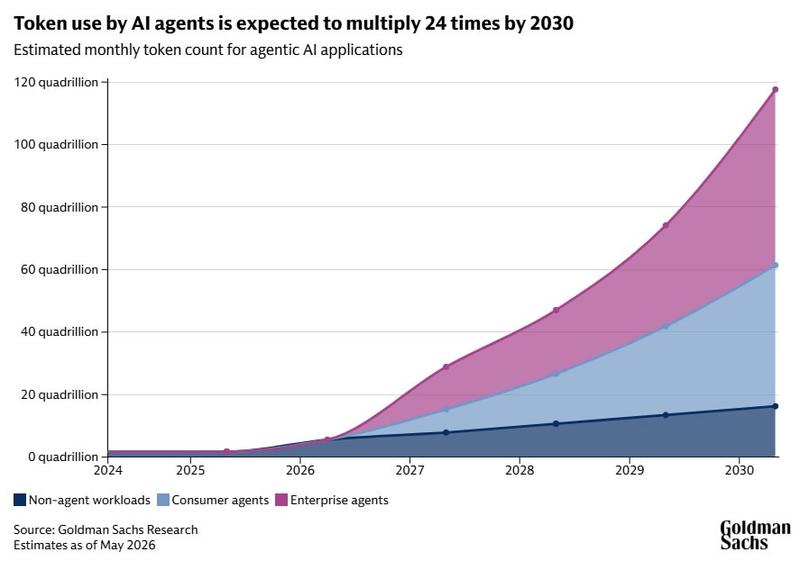
Goldman Sachs researchers forecasted in May that agentic AI is poised to generate a "24-fold increase in token consumption by 2030" driven by widespread adoption among consumers and business enterprises.