Major Trader Takes $70M Bearish Position on Crypto and Tech Stocks: Time for Bitcoin Investors to Panic?
While a highly profitable Hyperliquid trader has placed short-term bearish wagers, the expanding balance sheet of the US Federal Reserve combined with increasing inflationary pressures provide long-term tailwinds for Bitcoin.


Key takeaways:
- A profitable Hyperliquid trader has initiated a $70 million short position, though market data indicates this appears to be a technical strategy.
- Climbing oil prices combined with Federal Reserve liquidity expansion may undermine US Treasury values, strengthening Bitcoin's position as a limited-supply macroeconomic asset.
Bitcoin dips under $80,000 following Hyperliquid trader's bearish turn on cryptocurrency
Bitcoin (BTC) struggled to maintain its upward trajectory on Wednesday, falling back beneath the key psychological threshold of $80,000. Market participants became increasingly concerned as stubbornly elevated oil prices continued exerting pressure on both inflation metrics and consumer expenditure levels. A notable Hyperliquid trader boasting $42 million in cumulative trading gains reversed course to adopt a bearish stance, prompting market observers to wonder whether the latest price surge is running out of steam.
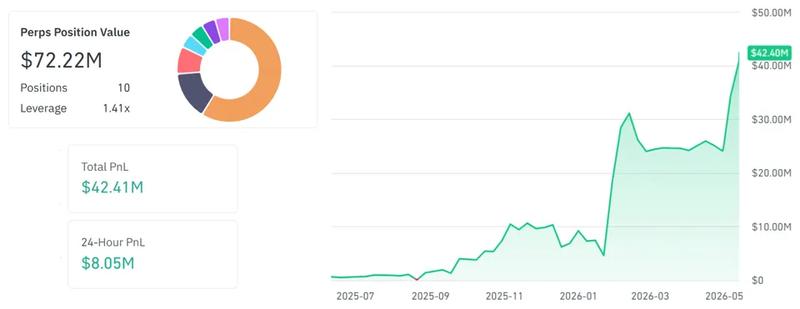
The prominent Hyperliquid trader operating from address 0x8def…992dae has recently established a $70 million short position spanning multiple cryptocurrencies and synthetic instruments representing shares of leading technology companies. Data from the Hyperdash trading and analytics platform identifies this address as belonging to Loracle, a pioneering developer within the Hyperliquid ecosystem. This particular account started placing more substantial wagers beginning in September 2025.
Notably, the bulk of this trader's historical gains have come from bullish positions, including multiple profitable transactions executed during the past month. A long trade involving Bitcoin, Zcash (ZEC), and Toncoin (TON) was liquidated on Monday, delivering a $9.2 million profit after being held for merely two weeks. On Thursday, this same trader realized a $3 million gain on bullish synthetic instruments pegged to crude oil prices following a nine-day holding period.
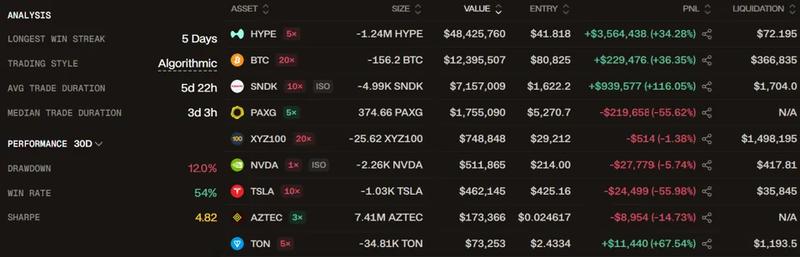
During the previous seven days, this trader switched to a bearish outlook by building up a substantial $49 million short position targeting HYPE. These wagers anticipating price declines were subsequently extended to encompass a $12.5 million short on Bitcoin, in addition to $8 million allocated to synthetic instruments following chipmaker Sandisk (SNDK US) and the Nasdaq-100 Index.
What's driving the trader's short positions in BTC, HYPE, and technology equities?
This pessimistic market view receives additional confirmation through a $1.7 million long position held in a gold-backed stablecoin. Nevertheless, transaction pattern analysis from app.trade.xyz indicates an algorithmic approach to trading, with holdings generally maintained for under seven days. These observations imply the trader is responding to near-term technical signals rather than identifying a fundamental deterioration in risk-seeking assets.
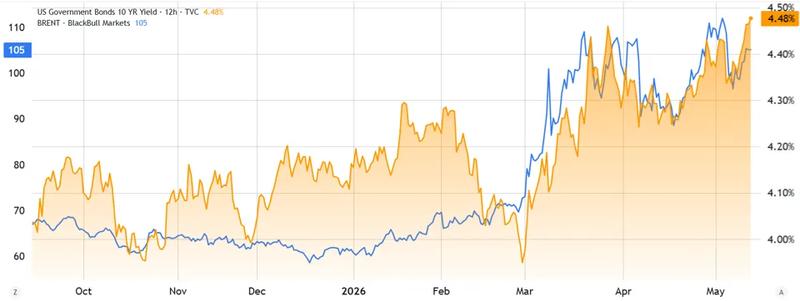
The continuing military conflict in Iran has driven Brent crude oil valuations beyond the $100 mark. This price surge probably compels the US Federal Reserve to enlarge its balance sheet as yields on US Treasury securities climb uncontrollably. With mounting US fiscal budget challenges, market participants face growing incentives to find refuge in assets with limited supply, particularly because elevated inflation expectations diminish the attractiveness of fixed-income securities.
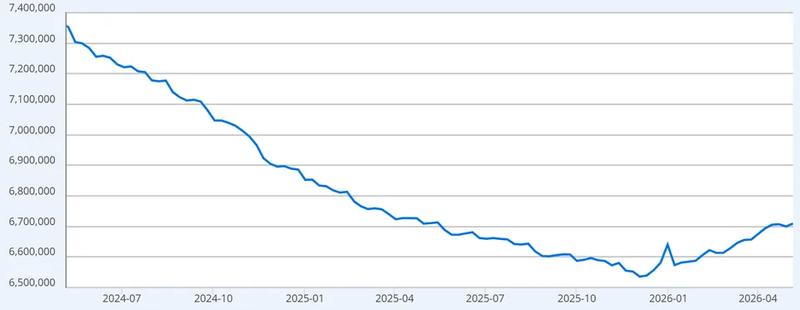
The US Fed has started purchasing bonds and mortgage-backed securities to alleviate strain on banking institutions. Although injecting liquidity addresses immediate market tensions, this interference drives inflation to increase more rapidly. This solution, despite its effectiveness, constrains opportunities for expansionary monetary measures, since the Fed possesses reduced flexibility to lower interest rates meaningfully.
Regardless of whether Bitcoin and technology stocks experience initial negative reactions to indicators of an economy running too hot, market participants will probably ultimately abandon fixed-income holdings as the growth of the monetary base becomes unmistakable. Reduced appetite for US Treasuries reflects declining confidence in monetary policy management, which functions as a beneficial catalyst for Bitcoin throughout the medium-term horizon.
In the final analysis, there exists minimal justification to be concerned about this Hyperliquid trader's pessimistic positions, even when considering the individual's impressive performance history.