Major Protocol Upgrades Set to Transform Blockchain Networks in 2026
Beyond Ethereum's Glamsterdam and Solana's Alpenglow implementations, cryptocurrency's defining moments in 2026 center on protocol-level enhancements and Bitcoin's proposed post-quantum security modifications, marking some of the industry's most critical technical advances in recent memory.
Price chart analysis continues to dominate the focus of most cryptocurrency market participants. Yet throughout 2026, an increasing portion of industry attention has redirected toward strengthening the underlying fundamentals of blockchain protocols themselves.
Major networks including Ethereum, Solana and Avalanche are gearing up to deploy some of their most substantial protocol-level improvements in recent years, while the Base network from Coinbase implemented its Beryl hard fork this past Friday with the goal of optimizing network operations through a native token standard and reduced withdrawal timeframes.
Bitcoin's technical evolution, in contrast, continues to face gridlock, as core developers remain locked in contentious discussions surrounding covenant-related proposals and quantum computing-resistant upgrade pathways.
Tim Sun, who serves as a senior researcher at HashKey Group, the Hong Kong-based digital asset management firm, shared with Cointelegraph that historically, protocol upgrades have concentrated on incorporating new features, increasing speed and expanding throughput capabilities.
Yet in 2026, he observed that the focus has pivoted toward dependability, predictable governance frameworks, and enterprise-grade infrastructure capable of supporting financial applications at massive scale.
The following are the five most significant blockchain network upgrades worth monitoring throughout the latter half of 2026.
Ethereum: Glamsterdam
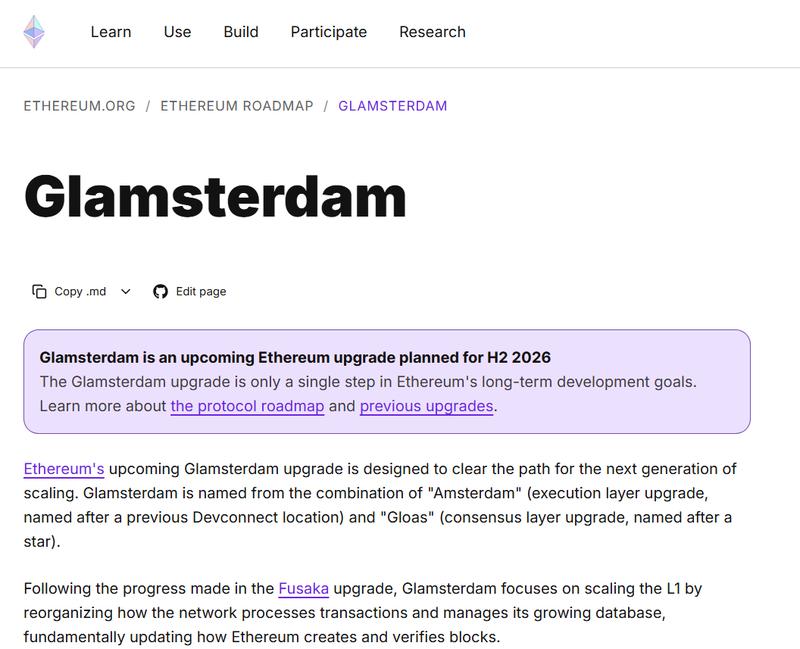
Glamsterdam represents arguably this year's most impactful upgrade, and testing is already underway across development networks. Based on Ethereum's publicly available roadmap, Glamsterdam aims to enhance scalability, strengthen the layer-1 foundation, and improve network usability, with mainnet deployment anticipated during the second half of 2026.
Sun explained that the upgrade should enhance processing speeds by enabling simultaneous processing of more transactions, increase capacity allowing Ethereum to manage more data at elevated throughput levels, and minimize database bloat. These modifications should position the chain more favorably for stablecoin settlement and real-world asset applications, he noted.
Holly Atkinson, serving as chief product and technology officer at 1inch, shared with Cointelegraph that many industry participants regard Glamsterdam as Ethereum's most meaningful upgrade since The Merge was completed in September 2022, when the blockchain transitioned from proof-of-work to proof-of-stake consensus.
She explained that enshrined proposer-builder separation (ePBS) represents a critical modification since most validators continue relying on a limited number of specialized builders and relays, concentrating authority over transaction sequencing.
This configuration magnifies maximal extractable value (MEV), censorship potential and centralization vulnerabilities, she noted. ePBS is engineered to integrate block building and proposing directly into the protocol while enhancing transparency and accountability of the entire process.
Pavan Kaur serves as a Solana Foundation judge and established RuleSpark, a compliance engine designed for digital asset marketing. She conveyed to Cointelegraph that ePBS should be understood as a single component within Ethereum's comprehensive roadmap and doesn't completely eliminate MEV or fully resolve builder centralization challenges.
Tactics such as sandwich attacks may consequently shift location rather than vanish entirely.
Solana: Alpenglow
Solana's most substantial transformation this year comes through Alpenglow, a consensus-layer upgrade that fundamentally restructures the network's foundational protocol. Alpenglow has been characterized by numerous observers, including Solana ecosystem lead David Liang, as the blockchain's "most significant consensus upgrade yet."
Following overwhelming approval through a governance process completed in September 2025, Alpenglow continues under active development with deployment expected alongside the Agave 4.1 validator client release later in 2026.
Arun Krishnakumar, serving as vice president of institutional capital at enterprise software firm R3, conveyed to Cointelegraph that Alpenglow will serve as a substantial catalyst that will strengthen the 'internet capital markets' concept even more powerfully.
Fundamentally, Alpenglow is engineered to dramatically accelerate the speed at which the network achieves finality. Rather than depending on Solana's current TowerBFT-based consensus mechanism, it introduces a redesigned architecture constructed around a novel voting component designated Votor.
The tangible outcome is a significant decrease in confirmation times, with finality targeted at approximately 100-150 milliseconds under optimal conditions, contrasted with roughly 12.8 seconds currently.
In addition to velocity improvements, the upgrade also eliminates onchain vote transactions, which presently constitute a substantial percentage of network activity. By optimizing validator communication and agreement mechanisms on chain state, Alpenglow is intended to render Solana simultaneously lighter and more efficient when operating under load.
Hadley Stern, board director at DeFi Development Corp, conveyed to Cointelegraph that eliminating onchain vote transactions constitutes the "real story" for institutional allocators since it "cleans up validator economics and gives you honest telemetry, which matters when you're underwriting SOL as a treasury asset."
He indicated that a network capable of migrating its consensus layer as seamlessly as planned demonstrates the type of "governed adaptability legacy financial infrastructure can't match."
Base: Beryl
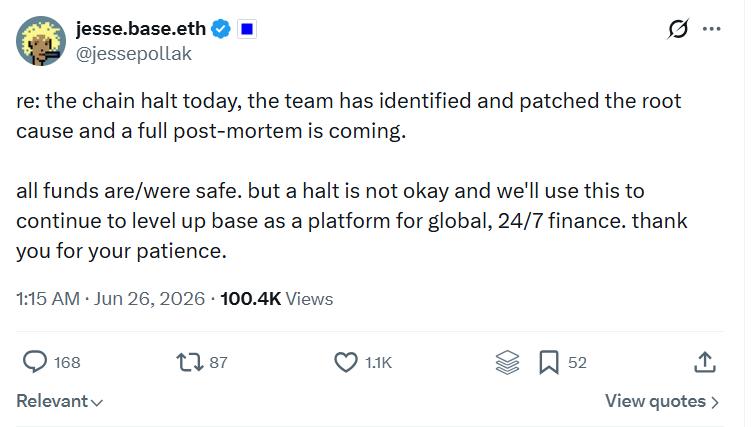
Base's Beryl hard fork activated on Friday, following a brief sequencer-related interruption, when block production halted for approximately two hours after an invalid block triggered a temporary consensus failure.
Base co-founder Jesse Pollak stated that user funds remained unaffected throughout the incident. Though he emphasized that "all funds are safe," he acknowledged that "a halt is not okay" and indicated that insights gained from the episode will be applied to further reinforce Base as a platform for "global, 24/7 finance."
According to documentation published by Base, Beryl implements a collection of modifications designed to enhance the network's performance and minimize friction at operational boundaries. These encompass the B20 native token standard, a reduction of withdrawal finality from seven days to five, and integration with Reth V2, anticipated to decrease node storage requirements while enhancing execution efficiency.
Sun indicated that Base has been progressing toward a more consolidated "stack" methodology, providing greater control over network construction and upgrade processes, and enabling changes to deploy more rapidly than under the previous Optimism Superchain framework.
The compromise, he explained, is that liquidity, which previously flowed more seamlessly across the broader Superchain ecosystem, may experience increased fragmentation, even while Base strengthens its integration with Coinbase's extensive user base.
Avalanche: Octane
Avalanche's upcoming evolution is characterized less by a singular branded hard fork than by a comprehensive initiative to enhance performance while attracting institutions and tokenized asset issuers.
Sun conveyed to Cointelegraph that Avalanche's recent Etna hard fork substituted the previous subnet architecture with sovereign Avalanche L1s, slashing the expense of launching a dedicated blockchain by over 99% and positioning the network as more appealing to institutional participants.
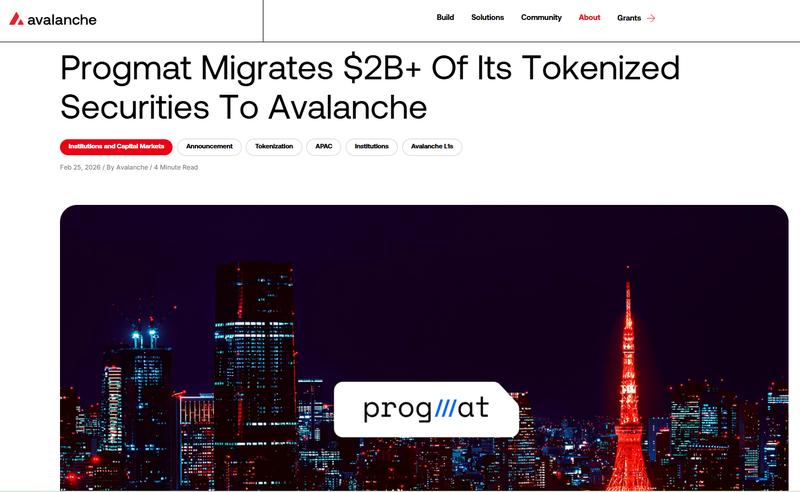
It has already demonstrated success in this domain. Sun referenced Progmat, which he indicated represents approximately 63% of Japan's national security token market, having migrated over $2 billion in tokenized assets to a dedicated Avalanche L1, alongside the Avalanche Payments Collective supported by institutions including Franklin Templeton, VanEck and WisdomTree.
Atkinson indicated that Avalanche is additionally advancing two upgrades designed to transform its C-Chain into one of the fastest Ethereum Virtual Machine (EVM) environments available.
She characterized Streaming Asynchronous Execution as a mechanism to decouple transaction execution from consensus enabling the chain to operate more continuously and calibrate capacity more closely to typical demand. For end users, she explained, the tangible result should manifest as elevated throughput and reduced, more stable fees during intervals of intensive activity.
Bitcoin: OP_CAT
Bitcoin stands as the exception in this landscape because its most significant developments in 2026 are not scheduled upgrades but rather a continuation of impassioned debates regarding whether the protocol should evolve to become more programmable and how urgently it requires hardening against quantum computing threats.
Bitcoin has not implemented a major soft fork since Taproot in 2020, which enhanced Bitcoin's scripting capabilities to enable more flexible transactions and strengthen privacy features.
Subsequently, dialogue surrounding covenant-related proposals including OP_CAT, CheckTemplateVerify (CTV) and Lightning-focused concepts like LNHANCE has grown more intense. None of these modifications has established a consensus path toward activation.
Researchers have simultaneously been deliberating BIP-360 and associated proposals as methodologies to facilitate easier migration of coins into quantum-resistant spending paths, should the quantum computing threat materialize into reality.
Atkinson characterized Bitcoin as the unpredictable element among the group. She indicated that covenant proposals could enable safer storage solutions and more sophisticated scripting capabilities, yet the topic remains controversial and subject to extensive debate.
Sun stated that those proposals could enhance self-custody security, fee management mechanisms and protocols such as Lightning and Ark, while providing institutions with more programmable custody logic operating directly on the L1.
Bitcoin development operates at an infamously deliberate pace, and any protocol modification undergoes scrutiny from every conceivable angle. There exists widespread agreement that no covenant opcode is positioned for activation this year, and achieving consensus on proposals like OP_CAT or CTV remains considerably distant.
Regarding the post-quantum dimension, BIP-360's authors project that a complete migration to quantum-resistant addresses and signatures would require years even under optimistic scenarios. It appears improbable at this juncture that a quantum-resistance upgrade will be implemented before 2026 concludes.