Legal & General Migrates £50 Billion in Liquidity Funds to Blockchain Through Calastone Platform
Legal & General Asset Management, headquartered in London, joins the growing list of major asset managers utilizing blockchain technology for fund distribution and trading infrastructure.

Legal & General Asset Management, operating out of London, has launched tokenized versions of its liquidity funds via Calastone's distributed ledger technology network, providing investors with the capability to access and move fund shares through digital channels as a substitute for conventional settlement processes.
Based on an announcement released Wednesday, these tokenized share classes feature restricted access controls, permitting approved participants to purchase, maintain ownership of, and move them within a compliant regulatory framework, with conventional share classes continuing to be offered via established distribution pathways.
These investment vehicles, available in US dollars, euros and British pound sterling, oversee assets exceeding £50 billion and are structured to preserve capital while offering same-day liquidity access. Their investment strategy focuses on high-grade, short-duration money market securities, which include government bonds, deposits held at banks and corporate debt instruments.
The network operated by Calastone, which is part of SS&C Technologies, delivers the foundational framework for generating tokens, directing orders, consolidating trades, performing reconciliation tasks and executing settlement on blockchain rails, all while connecting with current transfer agent and fund administration platforms.
The tokenized iterations of these funds will launch initially on Ethereum alongside other networks compatible with the Ethereum Virtual Machine.
According to company information, Legal & General Asset Management oversees approximately £1.2 trillion worth of assets spanning both public and private market sectors, while Calastone reports that its network links together more than 4,500 financial institutions on a worldwide basis.
This development arrives as United Kingdom regulatory authorities advance toward implementing a more comprehensive crypto regulatory structure, with the Financial Conduct Authority currently seeking input on regulations that would address matters including custody services and trading operations in anticipation of a regulatory framework scheduled for 2027 implementation.
Tokenized money market funds grow as asset managers expand distribution
The tokenized money market fund sector is experiencing expansion as institutional asset managers broaden their reach through blockchain infrastructure and alternative trading frameworks.
Data from RWA.xyz indicates that tokenized products backed by US Treasury securities, encompassing money market funds, have expanded to exceed $13 billion as of the current reporting period, representing an increase from approximately $8.9 billion recorded at the beginning of this year.
At the forefront is BlackRock's USD Institutional Digital Liquidity Fund (BUIDL) managing roughly $2.47 billion in total assets, with Franklin Templeton's OnChain US Government Money Fund coming in second at about $993 million and WisdomTree's Government Money Market Digital Fund holding approximately $864 million.
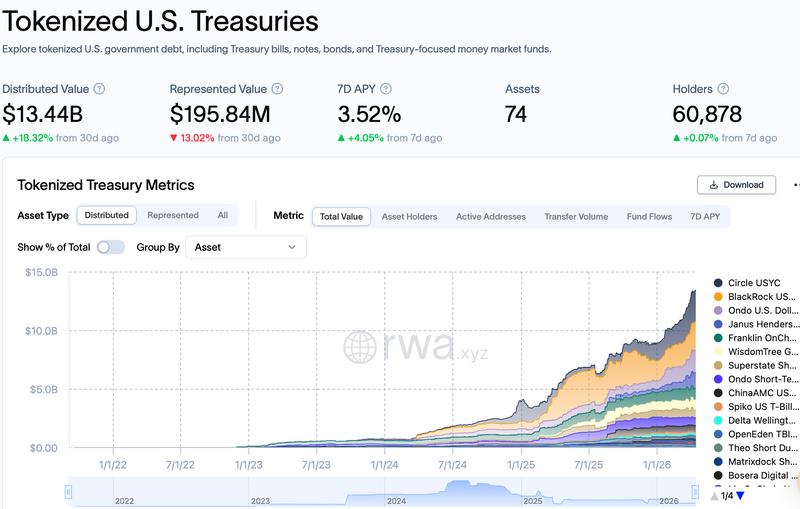
During recent months, institutional asset managers have broadened the availability of these investment products throughout various blockchain networks and diverse trading structures.
During November, Franklin Templeton connected its Benji platform with the Canton Network, broadening access to its tokenized money market fund within an institutional-grade blockchain ecosystem, while BlackRock brought BUIDL to the Solana (SOL) blockchain during March.
During February, WisdomTree activated around-the-clock trading capabilities and instantaneous settlement functionality for its tokenized money market fund while operating within a regulated compliance structure.
Nevertheless, alongside the expansion of these investment products, additional complexities emerge. The Bank for International Settlements has issued warnings that disparities between instantaneous token transfer capabilities and the comparatively slower settlement processes for underlying assets have the potential to generate liquidity pressures and systemic contagion vulnerabilities.