JPMorgan files for blockchain-based money market fund targeting stablecoin reserve management
The banking giant has submitted regulatory filings for the "OnChain Liquidity-Token Money Market Fund," designed to allow stablecoin companies to deposit reserves and generate yields on their holdings.


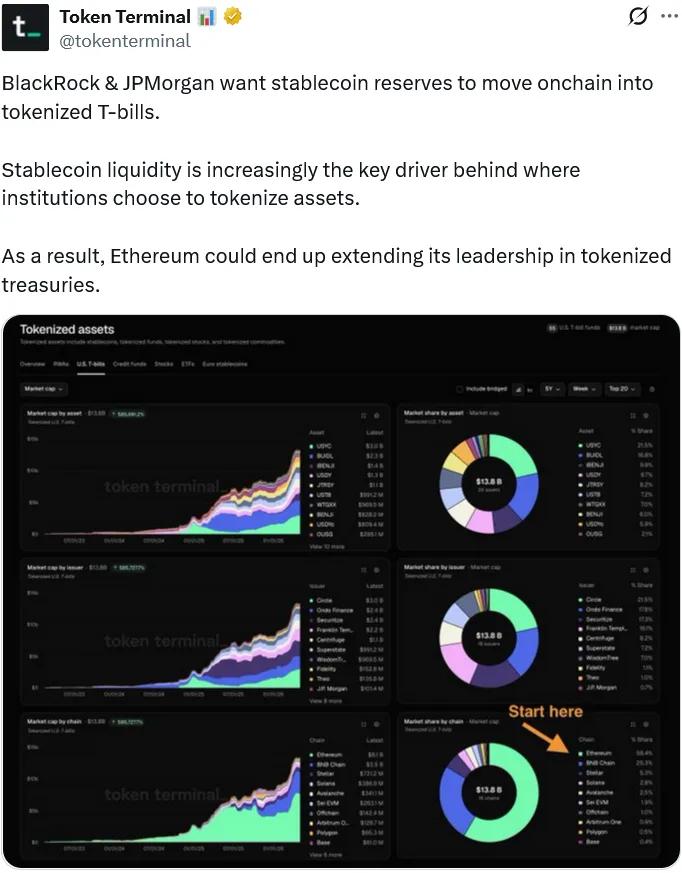
JPMorgan has submitted documentation to introduce a tokenized money market fund built on Ethereum, creating an opportunity for stablecoin companies to store the reserves that support their digital currencies in a regulated, cash-equivalent product that generates yields.
According to documentation filed Tuesday with the US Securities and Exchange Commission, the "OnChain Liquidity-Token Money Market Fund," which carries the ticker JLTXX, will allocate capital into US Treasury bills along with overnight repurchase agreements backed by US Treasurys or cash. The fund is designed to meet requirements outlined in the GENIUS Act, legislation focused on stablecoins that received presidential signature in July.
The fund imposes a $1 million minimum entry requirement for participants, and features a 0.16% yearly fee following waivers. JPMorgan's blockchain division, Kinexys Digital Assets, will oversee management of the fund. According to the investment bank's statements, the filing gains effectiveness on Wednesday, although the institution has not revealed a specific launch timeline for the fund.
The concept of blockchain-based tokenization has garnered increasing attention from Wall Street leadership in recent months, with many executives viewing the technology as providing superior operational efficiency for trade execution and settlement compared to legacy infrastructure.
Data from RWA.xyz indicates that more than $32.2 billion in real-world assets, not counting stablecoins, has been tokenized onchain at present. The tokenization phenomenon has touched nearly every significant asset category, spanning commodities, equities, fixed income securities and property.
Eric Balchunas, an analyst at Bloomberg, characterized JPMorgan's JLTXX as a "big deal" due to the fact that the 0.16% fee represents a competitive rate for a money market fund maintaining a stable asset value.
JPMorgan's blockchain use cases
The introduction of JLTXX arrives after JPMorgan's initial tokenized offering, My OnChain Net Yield Fund, known as MONY, which debuted in December and operates on Ethereum as well. MONY maintains positions in short-term debt securities engineered to provide returns exceeding traditional bank deposit rates, with both interest and dividends accumulating on a daily basis.
The regulatory filing for JLTXX also emerges following a pilot transaction that JPMorgan took part in last week, during which the first tokenized US Treasury fund transferred from the US through XRP Ledger and interbank infrastructure to one of JPMorgan's Singapore bank accounts within seconds.
In April, Morgan Stanley introduced the Stablecoin Reserves Portfolio, which provides stablecoin issuers with the ability to place reserves supporting their fiat-pegged tokens into one of the bank's money market funds while generating interest.
However, the International Monetary Fund raised several concerns about tokenization in a report in April, contending that tokenization transfers risk from the banking system to shared ledgers and smart contract code, creating greater difficulty for intervention during "stress events."
The IMF further noted that absent legal clarity regarding ownership records and settlement finality, tokenized markets face the danger of becoming "fragmented and peripheral."
Multiple industry pundits, including "Shark Tank" investor Kevin O'Leary, have stated that crypto market structure legislation — such as the CLARITY Act — is necessary to resolve these issues.