Is 'Uptober' Dead? Bitcoin's Traditional Seasonal Trends Face Growing Skepticism
After declining 7.3% in October 2026, marking its second consecutive yearly drop during what was historically a strong month, Bitcoin's seasonal patterns are being questioned by market analysts.

The cryptocurrency's consecutive October declines have sparked intense scrutiny of the so-called "Uptober" phenomenon, with market experts now weighing whether seasonal patterns still hold relevance in the face of institutional market forces and macroeconomic dynamics.
According to data from CoinGlass, Bitcoin experienced a 7.3% drop throughout October 2026, marking the second consecutive year of October losses after approximately 4% fell in the previous year.
These downturns contradicted October's long-standing bullish track record, which had previously given rise to the popular "Uptober" moniker. During the recent period, market participants adopted more ominous terminology such as "Black October" and "Hacktober," particularly following numerous cryptocurrency security breaches, most notably the unprecedented $6.3 billion Binance hack.
Bitcoin's seasonal trends shift as monthly volatility declines
Historically speaking, October has delivered Bitcoin's strongest median return at 15.4%, recording positive performance in 10 out of 13 years leading up to 2025, as reported by Andrew Yang, a researcher with crypto analytics platform Kaiko.
Meanwhile, September's long-held bearish reputation appears to be fading. Bitcoin has registered positive returns every September starting from 2023, potentially indicating that traders are accumulating positions in anticipation of the traditional October surge, Yang explained in his conversation with Cointelegraph.
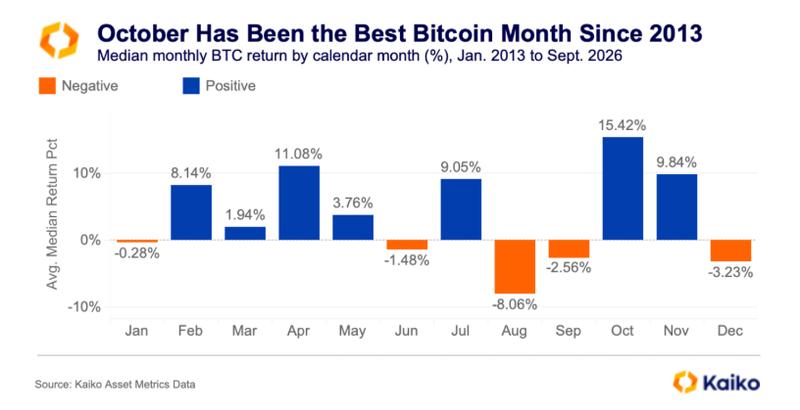
The compression of Bitcoin's price volatility might also be contributing to less distinct seasonal patterns, according to Yang. The cryptocurrency's average monthly price movement has contracted from 14% during the 2013-2016 period to 9.6% beginning in 2024, which reduces the potential magnitude of seasonal price surges, he noted.
Are institutions rewriting Bitcoin's calendar?
Market analysts have also highlighted institutional capital and wider economic factors as increasingly dominant forces influencing Bitcoin's valuation.
According to Justin d'Anethan, head of research at Arctic Digital, exchange-traded fund (ETF) activity and corporate Bitcoin acquisitions now play a crucial role, with these investment choices being determined primarily by liquidity conditions, interest rate environments and institutional mandates rather than historical seasonal trading patterns.
During October, US spot Bitcoin ETFs experienced net outflows totaling $515 million, while spot Ether ETFs witnessed unprecedented monthly redemptions of $1.61 billion.
While Yang acknowledged that spot Bitcoin ETFs, which gained approval in January 2024, haven't been trading long enough for definitive conclusions, he emphasized that Bitcoin "increasingly trades like a macro asset, driven more by economic data and institutional flows than by the calendar."
Two October losses don't settle the question
Even with back-to-back October declines now on record, market analysts urged caution before completely dismissing the Uptober phenomenon.
According to Julio Moreno, head of research at CryptoQuant, October's performance has typically been stronger throughout Bitcoin bull cycles and weaker during bear markets, suggesting that the overarching market phase represents a critical consideration when evaluating monthly returns.
Price performance depends more on spot demand dynamics than cyclical patterns, and demand doesn't care about the calendar.
Julio Moreno, CryptoQuant
Markus Levin, co-founder of XYO, suggested that market participants might be front-running anticipated seasonal movements. "When enough people expect a rally in October, the rally gets priced in before the month arrives," he said.
"Uptober has historical validity but, like other seasonality metrics, it can also fail at times," said Arctic Digital's d'Anethan.