Iran military operations trigger Bitcoin mining decline, Robinhood shares plunge 16%: March market analysis
Five-year US Treasury bond yields climb 4%, weighing on Bitcoin's performance, which concluded the month near its opening levels.

Throughout March, the Bitcoin network's computational power declined by 6% following joint military strikes by the United States and Israel on Iranian targets, revealing the substantial scale of Iran's cryptocurrency mining operations.
The Bitcoin market, in the meantime, continues to display underwhelming performance. The 4% increase in US Treasury bond yields has intensified downward pressure, with market participants gravitating toward safer investment options during this period of geopolitical instability.
Diminished interest in cryptocurrency transactions has created challenges for Robinhood. The brokerage firm's shares have fallen 16% during the month, prompting executives to unveil a share repurchase initiative.
Transactions on prediction market platforms reached unprecedented levels, showing an increase exceeding 2,800% compared to the previous year's corresponding period.
March's key metrics include:
Bitcoin struggles to gain traction as 4% Treasury yields weigh on valuation
Five-year US Treasury bond yields have climbed to 4% during March, creating headwinds for Bitcoin's price performance. Despite experiencing moderate gains during the middle of the month, the cryptocurrency concluded March trading near its starting point of approximately $67,000.
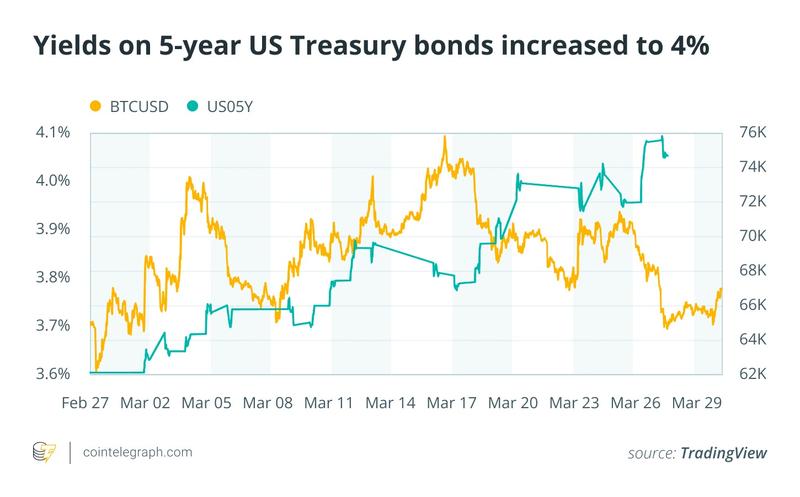
According to a Cointelegraph analysis, concerns about a protracted military confrontation involving the US and Israel against Iran have prompted investors to reduce exposure to risky assets. Bond sell-offs, coupled with yields reaching a nine-month peak of 4%, indicate that market participants are accumulating cash reserves.
Network computational power drops nearly 6% following US-Israel military action in Iran
On Feb. 28, joint forces from the United States and Israel initiated a special military operation in Iran designated "Operation Epic Fury." Four weeks following the operation's launch, Bitcoin (BTC) network hashrate has declined by almost 6%.
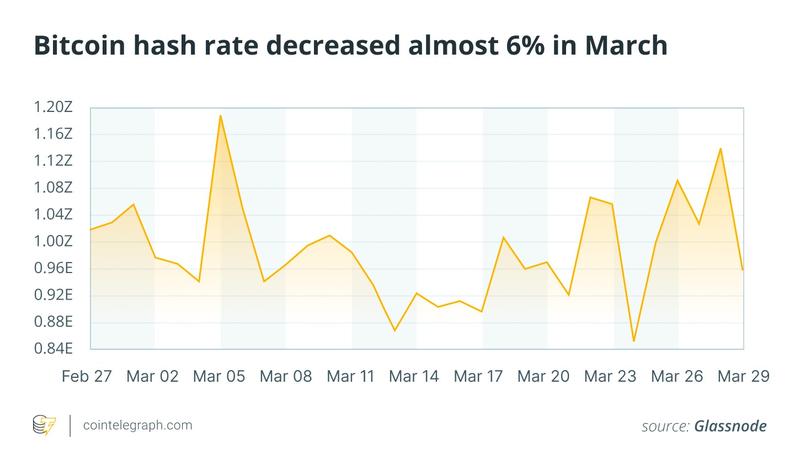
In a recent interview, Bloomberg's crypto and digital assets strategist Dushyant Shahrawat explained that Iran ranks among the planet's most significant Bitcoin mining nations, contributing approximately 6-8% of worldwide hashrate, with 70% of these operations controlled by military entities.
Consequently, damage to the nation's power grid infrastructure and the reallocation of military resources toward defensive operations have substantially impaired Iran's Bitcoin mining capacity.
Betting platform transactions surpass 192 million mark
Transaction volumes on betting platforms such as Polymarket and Kalshi exceeded 192 million during March. This figure marks a 24% rise from the preceding month and represents a 2,880% surge when compared to March of last year, based on Dune analytics data.
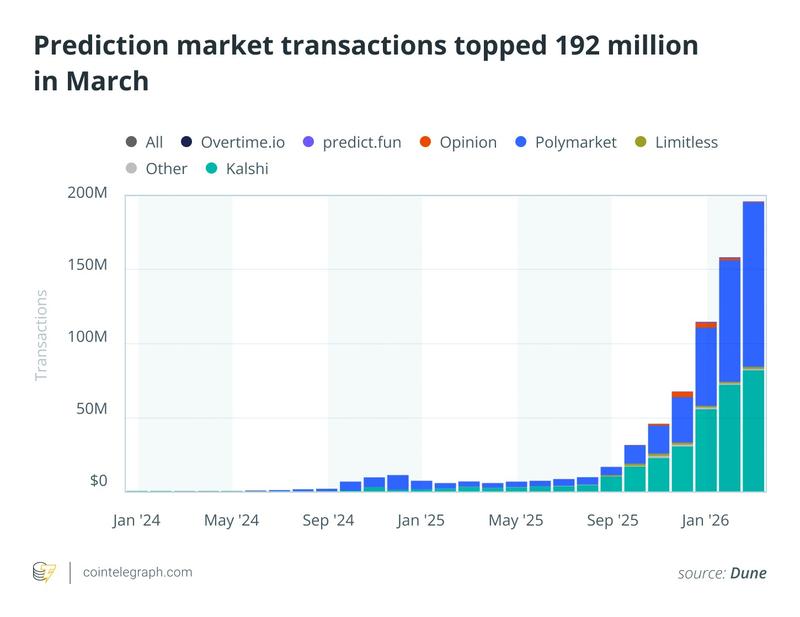
While prediction markets continue gaining traction, they encounter opposition from state-level regulators in the United States who characterize them as gambling operations. Legal actions have been initiated against these platforms in at least 11 states.
On March 20, Nevada's Carson City District Court Judge Jason Woodbury affirmed a regulatory decision to impose a temporary prohibition on prediction market platform Kalshi within the state.
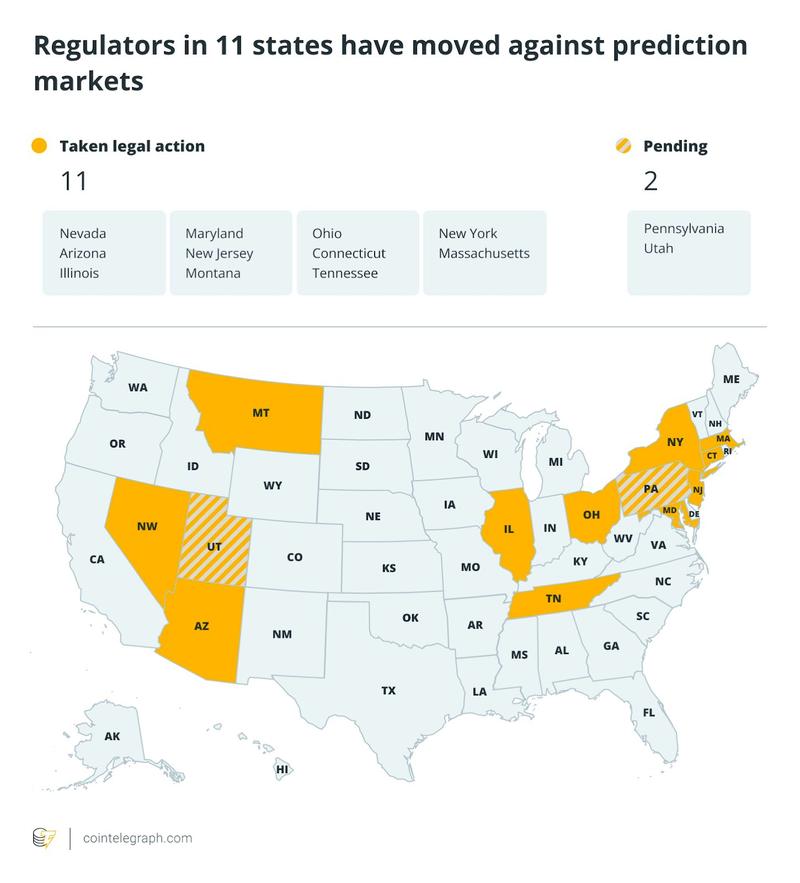
Authorities in Arizona have filed criminal complaints against Kalshi, accusing the platform of "running an illegal gambling operation and taking bets on Arizona elections, both of which violate Arizona law."
Additional states including Utah and Pennsylvania are actively evaluating legislation that would place prediction markets under state gambling or gaming regulatory frameworks. Kalshi maintains its position that federal oversight through the Commodity Futures Exchange Commission (CFTC) represents its sole regulatory authority.
Euro-backed stablecoins dominate 85% of alternative currency market
Stablecoins pegged to the euro have become the predominant choice for investors seeking alternatives to dollar-backed digital assets. Approximately 85% of non-dollar stablecoin transaction volumes involve euro-denominated tokens, based on a March analysis from Dune.
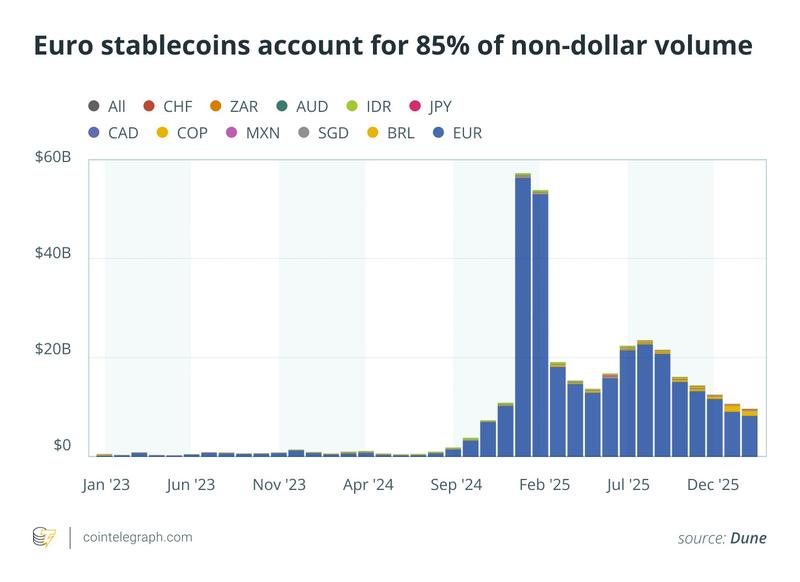
Although euro-pegged coins originally constituted roughly 50-70% of the non-dollar marketplace, they experienced substantial expansion beginning in 2024. Currently they comprise 85% of aggregate transferred volume. Euro-denominated stablecoins also lead in terms of user engagement, with participation rates climbing above 78%.
Dune credits this growth to enhanced institutional trust in stablecoins, driven predominantly by the Markets in Crypto-Assets regulatory framework (MiCA).
Trading platform Robinhood experiences 16% share price decline
Shares of Robinhood have depreciated more than 16% throughout March, declining from approximately $80 to $66 at the time of publication.
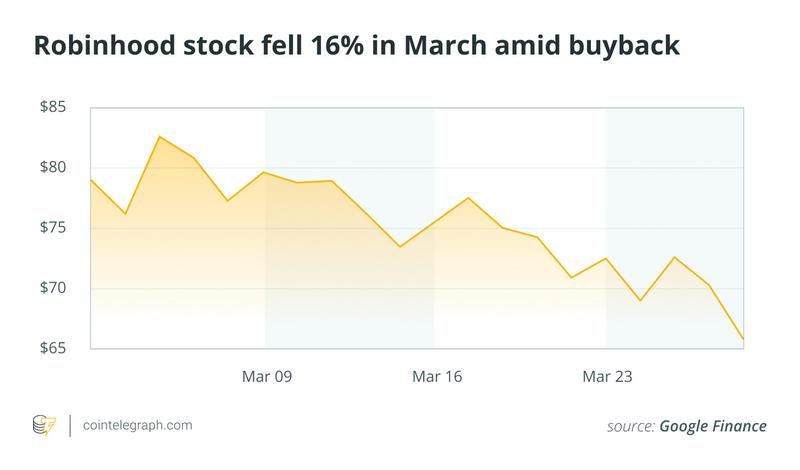
The equity and cryptocurrency trading platform's valuation has faced persistent challenges in recent periods. During the past six months, shares have plummeted more than 50%. Regulatory ambiguity surrounding emerging business lines including prediction markets and social trading, combined with plummeting cryptocurrency transaction revenues, present significant structural headwinds for the organization.
Cryptocurrency trading revenue allegedly fell 38% on a year-over-year basis as of Q4 2025. Volumes on crypto applications declined 58%.
In response to these challenges, Robinhood authorized a $1.5 billion share repurchase program in March, scheduled for implementation across the following three years.
Strategy's Bitcoin investment portfolio shows 11% unrealized loss
Against the backdrop of muted price movement this month, Strategy's Bitcoin holdings currently reflect an 11% paper loss. The company's average acquisition cost for Bitcoin stands at $75,669. At the time of publication, Bitcoin trades near $67,800.
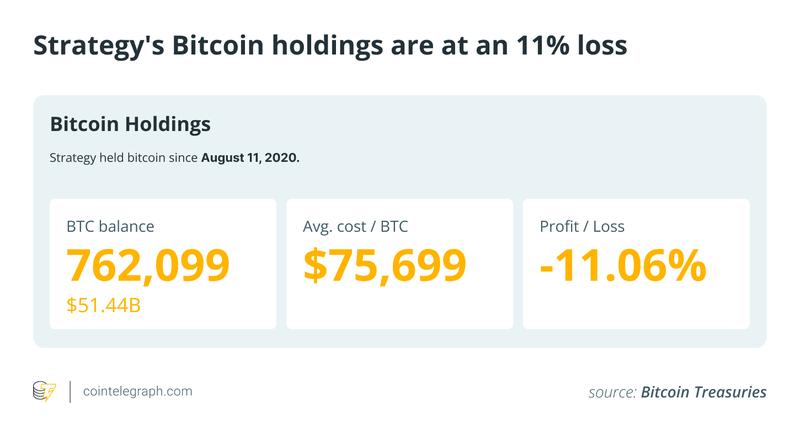
Nevertheless, the enterprise has maintained its consistent Bitcoin acquisition strategy. Two purchases occurred this month: 17,994 Bitcoin acquired on March 9 and an additional 22,337 Bitcoin purchased on March 16, totaling approximately $2.7 billion at current valuations.
The software enterprise has funded the majority of its Bitcoin acquisitions through high-yield equity offerings, such as Stretch (STRC). This approach enables the organization to accumulate Bitcoin without diminishing the value of its MSTR common stock.
Company chairman and Bitcoin advocate Michael Saylor recently disclosed that 80% of STRC purchasers are individual retail investors. "Retail investors prefer low-volatility, high-yield digital credit," he stated.