Iran Conflict Sees Bitcoin Recovery, Yet Safe-Haven Status Remains Disputed
While Bitcoin outperforms gold amid Iran tensions, its reliance on liquidity trends continues to cast doubt on claims of safe-haven characteristics.
In the months preceding the outbreak of conflict with Iran, Bitcoin remained trapped in sideways price action even as gold surged to unprecedented highs.
During that period, gold maintained its reputation as the preferred safe-haven asset; concerns about inflation persisted and global tensions escalated, yet Bitcoin (BTC) couldn't demonstrate it deserved comparable status.
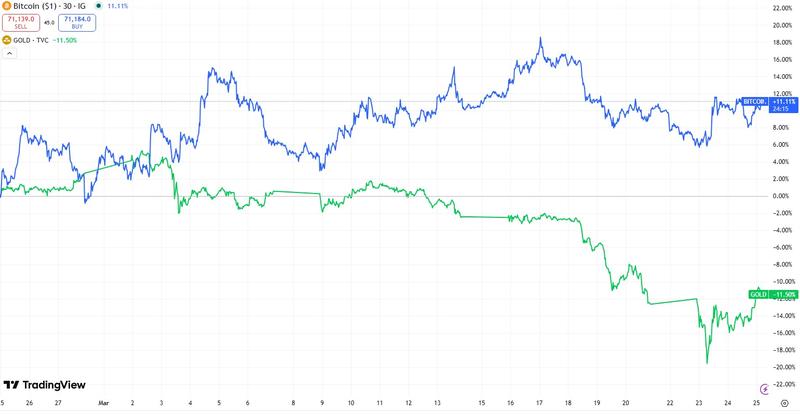
Roughly one month following the initial military operations launched by the US and Israel against Iran on Feb. 28, this perspective faces scrutiny. Bitcoin dropped initially to $63,176 when news of the strikes emerged but has subsequently climbed approximately 12% to reach $71,012, according to Wednesday's figures.
In contrast, gold has suffered under the pressure of climbing oil prices and mounting inflation anxieties, declining 11% during the previous week, representing its most significant weekly decline since 1983.
Despite this, Jonatan Randin, a senior market analyst at PrimeXBT, emphasized that Bitcoin's trading behavior continues to mirror that of risk assets instead of safe havens. The cryptocurrency experiences sell-offs in tandem with equity markets when geopolitical turbulence strikes.
"Its movement remains confined to a range and demonstrates fragility within an overarching downward trend. These characteristics don't align with safe haven assets," he said.
Bitcoin price movement "dominated" by liquidity conditions
Throughout recent years, Bitcoin has demonstrated responsiveness to international developments, encompassing geopolitical upheavals and social media commentary from powerful personalities like US President Donald Trump. Such price movements typically prove fleeting.
Matthew Pinnock, co-founder of decentralized finance project Altura, explained to Cointelegraph that global liquidity stands as the primary force behind Bitcoin's valuation, with macroeconomic factors overshadowing volatility triggered by news headlines.
"BTC functions as a high-beta liquidity asset, meaning that restrictive financial conditions, including elevated real yields, a robust dollar and diminished [exchange-traded fund] inflows, curtail marginal capital availability and create downward price pressure," he said.
Research conducted in September 2024 and compiled by Sam Callahan of treasury company OranjeBTC revealed that Bitcoin's price exhibited a 0.94 correlation with global liquidity spanning May 2013 through July 2024.
Callahan's research additionally demonstrated Bitcoin traveled in the same trajectory as global M2 during 83% of 12-month intervals, surpassing gold, which recorded 68.1%. Following Bitcoin most closely in directional correlation was the S&P 500 index, representing large-cap US equities and frequently referenced as a benchmark for risk-oriented assets.
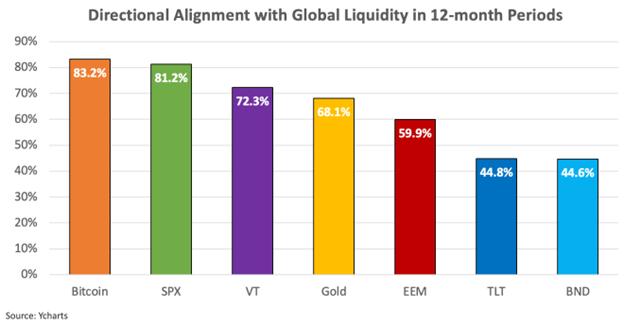
Randin noted that more contemporary data revealed a comparable trend, referencing the increase in global liquidity throughout the third quarter of 2025, coinciding with Bitcoin's achievement of a fresh all-time high.
This divergence underscores a fundamental challenge within Bitcoin's safe haven thesis. Although it has delivered superior performance relative to gold across specific timeframes since hostilities commenced, its responsiveness to liquidity dynamics indicates it reacts more intensely to financial tightening than to geopolitical turbulence directly. This reality undermines the notion of Bitcoin functioning as "digital gold," especially in contexts where inflation and interest rates shift simultaneously.
Rising oil prices challenge Bitcoin's inflation protection story
Short-term inflation expectations have influenced market sentiment since the conflict's inception, propelled by escalating oil valuations and supply chain disruptions resulting from the shutdown of the Strait of Hormuz, among the world's most critical shipping passages.
Randin explained that heightened inflation worries connected to geopolitical disturbances typically disadvantage Bitcoin over brief periods, as elevated oil costs contribute to inflation projections, diminish the probability of interest rate reductions and maintain high real yields. This sequence of developments constricts financial conditions and dampens risk tolerance, constraining demand for assets such as Bitcoin.
From this perspective, Bitcoin doesn't respond to inflation directly, but rather to the monetary policy reaction that ensues, said Randin.
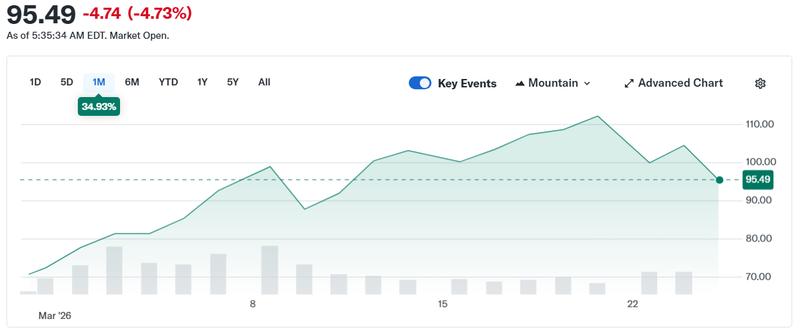
The Iranian conflict propelled oil valuations beyond $110 as the Federal Reserve elevated its 2026 personal consumption expenditures inflation projection to 2.7% and communicated a more measured approach to policy easing.
"Bitcoin might be more accurately characterized as a protection against long-term monetary debasement instead of a near-term inflation safeguard, and this represents an essential difference," Randin said.
"It demonstrates sensitivity to money supply expansion across extended multi-year periods, not to consumer price index releases. Within the timeframe of an oil shock stemming from war, it continues to exhibit the characteristics of the risk asset that it fundamentally is."
Bitcoin recovers during Iran tensions yet maintains risk asset characteristics
Bitcoin's conduct throughout the Iran conflict continues to correspond with risk asset behavior. Every instance of escalation has prompted selloffs, liquidation sequences and strengthened correlation with equity markets, even though Bitcoin has demonstrated greater resilience than conventional assets across particular intervals.
"However, it's essential to consider the broader context. Bitcoin arrived at this conflict already experiencing a technical bear market, declining more than 40% from its October peaks and significantly ahead of equities in incorporating worsening conditions," Randin said.
Therefore, while it has demonstrated relative stability since the strikes commenced, exceeding the performance of the S&P 500, gold and silver across specific intervals, it hasn't delivered any substantial directional momentum.
A fundamental transformation would necessitate a definitive departure from this established pattern, and such indicators have not yet materialized.
Onchain metrics reveal a contrasting underlying trend. Persistent accumulation, decreasing exchange reserves and expanding holdings among major wallet addresses indicate positioning is developing, even though price movement hasn't captured it.
Nevertheless, this positioning remains limited by macroeconomic circumstances.
"Currently, inflation propelled by an increase in oil valuations stemming from geopolitical considerations is driving yields upward and maintaining central bank hawkishness, which restricts liquidity. This generates a 'bad inflation' environment where BTC declines together with other risk assets," Pinnock said.
"The inflation protection argument fails because Bitcoin demonstrates greater sensitivity to monetary expansion than to inflation in isolation, and presently, conditions are restrictive rather than stimulative," he added.
Unless liquidity environments become more accommodative and Bitcoin demonstrates decoupling from equities throughout periods of market stress, its classification as a safe haven asset remains unsubstantiated.