Insider Trading Fears Mount as White House Issues Warning Following Suspicious Iran-Related Trading Activity
White House personnel received warnings about misusing classified information following questionable oil futures trading linked to Iran policy decisions and increased examination of prediction market activities, Reuters reports.

According to Reuters, White House personnel received a warning about the improper utilization of privileged information for placing wagers in futures markets, following questionable oil trading activity that occurred prior to President Donald Trump's Iran-related announcement on March 23, which attracted significant attention.
On Thursday, Reuters disclosed that the internal email from the White House was dispatched on March 24, one day following Trump's directive to postpone attacks on Iran's energy infrastructure for five days.
The cautionary message came after approximately $500 million in wagers on Brent and West Texas Intermediate crude futures were executed during a sixty-second window just prior to Trump's March 23 statement, based on Reuters' analysis of exchange data. Following the policy announcement, oil prices experienced a decline of approximately 15%.
This incident has amplified examination of the possibility that government officials or traders with political connections might generate profits from confidential information related to policy or military decisions. The situation has also strengthened the broader effort underway in Washington to establish stricter regulations governing prediction-market wagering.
Federal officials, including members of congress, executive personnel and judicial officers are prohibited from utilizing non-public information obtained through their positions to engage in trading of commodity, futures or options markets under the STOCK Act amendment incorporated into the Commodity Exchange Act (CEA). This amendment became law through signature on April 4, 2012.
Cointelegraph has reached out to the White House seeking to obtain a copy of the internal communication.
Lawmakers respond to prediction market insider trading concerns
Prediction markets have also come under increased scrutiny from lawmakers, as strategically timed wagers connected to political and military developments have generated comparable concerns regarding the abuse of insider knowledge. Traders on Polymarket generated profits of approximately $1 million through accurate predictions regarding the timing of US military action against Iran.
Addressing these concerns, on March 25, Congressman Adrian Smith and Congresswoman Nikki Budzinski put forward the Preventing Real-time Exploitation and Deceptive Insider Congressional Trading Act (PREDICT Act), a bipartisan legislative proposal designed to prohibit members of Congress and federal officials from engaging in prediction market trading.
A day later, on March 26, lawmakers Todd Young, Elissa Slotkin, John Curtis and Adam Schiff presented the bipartisan Public Integrity in Financial Prediction Markets Act of 2026, legislation intended to restrict insider trading in prediction markets by government officials.
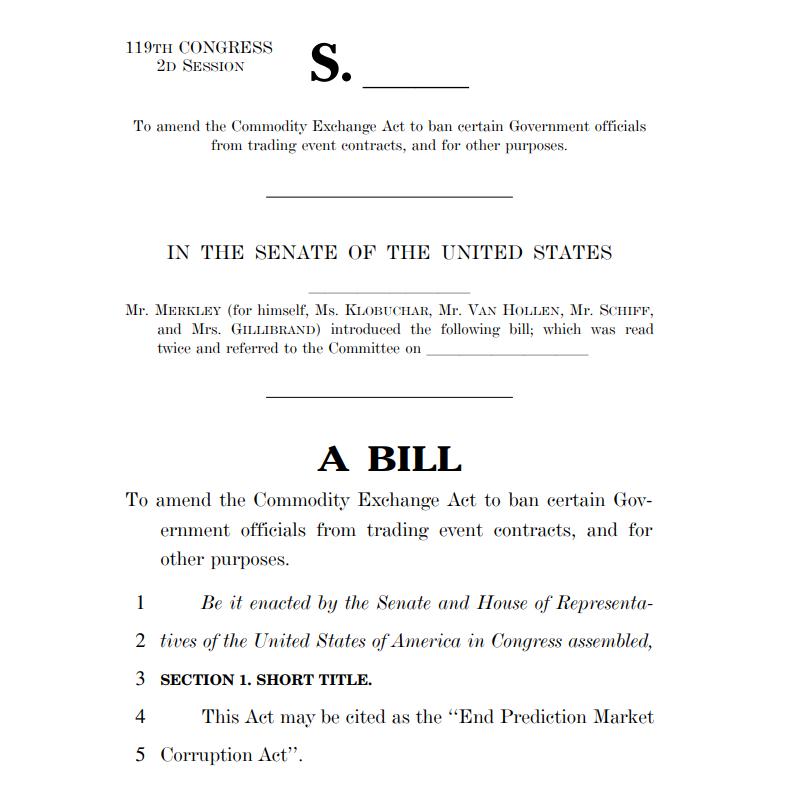
That same day, the End Prediction Market Corruption Act was introduced by Senator Jeff Merkley, proposing to prohibit event contract trading by government officials possessing "material non-public information," a category that encompasses the president, vice president and congressional members.