Indiana Approves Legislation Protecting Cryptocurrency Rights and Prohibiting Targeted Taxation
Governor Mike Braun will receive Indiana's HB 1042 after it successfully passed both legislative chambers, preventing discriminatory taxation on digital assets and enabling cryptocurrency investments in state retirement funds.

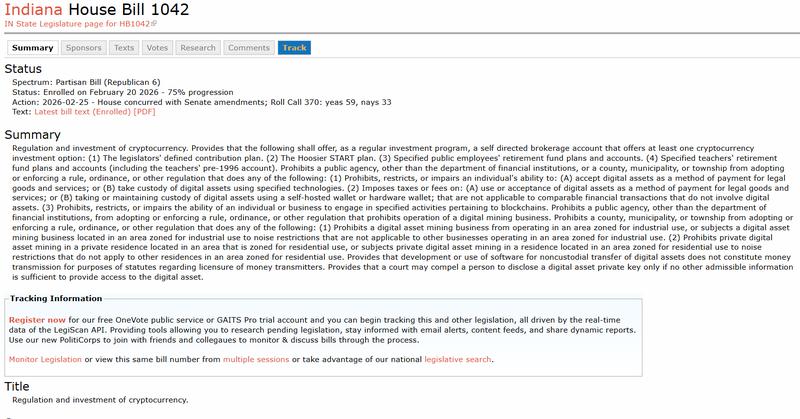
Legislators in Indiana have successfully advanced legislation to Governor Mike Braun's desk that would broaden legal safeguards for individuals using digital currencies and mandate that specific state-administered retirement and savings programs provide a self-directed brokerage alternative featuring no fewer than one cryptocurrency investment opportunity.
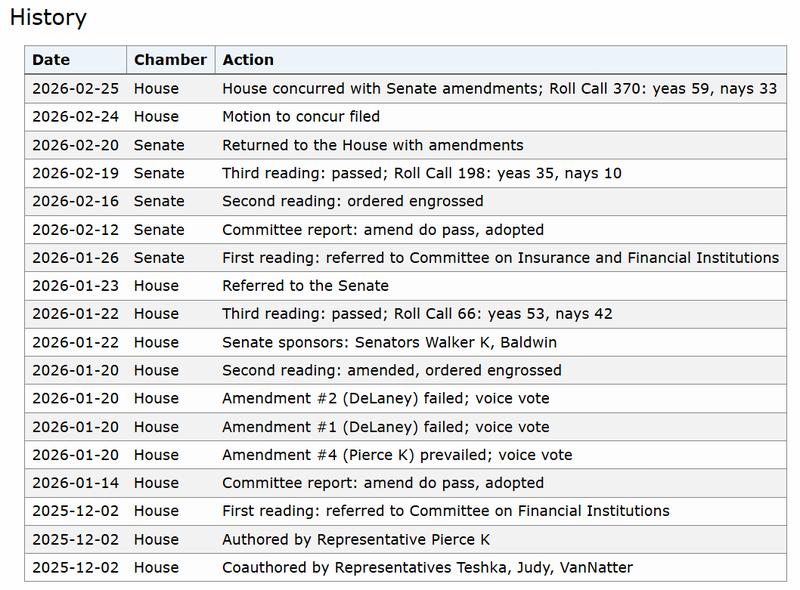
Legislative measure House Bill 1042 (HB1042) addressing "regulation and investment of cryptocurrency" received approval from the state legislature this past Wednesday, securing 59 affirmative votes while 33 lawmakers voted in opposition, based on information provided by Legiscan.
The legislative measure aims to safeguard the rights of Bitcoin (BTC) and cryptocurrency investors, prohibit discriminatory taxation targeting crypto assets, and create opportunities for digital asset investments within state-administered retirement programs.
The legislation now awaits Governor Mike Braun's approval through signature. Upon enactment, the majority of its provisions would become operative on July 1, 2026, whereas the mandate concerning self-directed brokerage options in retirement plans would be implemented at a subsequent date.
Several American states have previously enacted legislation protecting cryptocurrency investors, with Oklahoma implementing such measures in November 2024 and Kentucky following suit in March 2025.
Pennsylvania advanced its House Bill 2481 (HB2481) focusing on crypto investor protection rights during October 2024 with substantial support across party lines, though the measure remains unsigned and has not yet become law.
What distinguishes Indiana's cryptocurrency rights legislation from comparable measures in other states is its unique provision mandating self-directed brokerage account availability to enable cryptocurrency holdings within retirement investment plans.
Retirement plans add crypto option
The legislation will enable residents of Indiana to incorporate Bitcoin and other digital assets within their retirement investment portfolios for the very first time.
Should the governor sign the measure into law, it would mandate that designated state retirement and savings programs provide self-directed brokerage account options including a minimum of one cryptocurrency investment choice no later than July 1, 2027.
The requirement would apply to the defined contribution plan for state legislators, the Hoosier START plan, designated retirement funds for public employees, and specific retirement fund plans available to teachers, along with additional programs.
Additionally, the legislation incorporates several other significant provisions designed to shield cryptocurrency investors' rights against potential future enforcement actions by regulators.
State rules limited on crypto
The Indiana bill would place limitations on state and local government entities, preventing them from implementing or enforcing regulations that would ban legitimate cryptocurrency transactions, self-custody practices, or mining activities, with exceptions as outlined in the bill.
According to the proposed legislation, government agencies at the public level, with the exception of the Department of Financial Institutions, would be barred from establishing rules that restrict individuals' capacity to receive digital asset payments for lawful products and services, maintain custody over their cryptocurrency assets, or levy taxes and charges specifically targeting crypto transactions and self-custodied digital holdings.
Additionally, the bill prevents the implementation of rules that would ban cryptocurrency mining activities conducted by commercial enterprises or private individuals.