Hungary Plans to Abolish Cryptocurrency Trading Restrictions Following EU Investigation
Following EU examination and widespread platform withdrawals, Hungary plans to eliminate 2025 cryptocurrency regulations that mandated authorized validation for digital asset conversions and criminalized non-compliance.

The Hungarian government plans to eliminate criminal penalties associated with cryptocurrency trading, abandoning regulations that threatened imprisonment for specific crypto-to-fiat and crypto-to-crypto exchanges, as confirmed by Tisza administration representative Anita Köböl.
During a Thursday media briefing, Köböl announced that Hungary would dismantle regulations implemented the previous year which mandated authorized validation for cryptocurrency conversions and imposed criminal sanctions for non-compliance. According to her statement, these restrictions led to diminished cryptocurrency trading volumes throughout Hungary.
This was an unnecessary piece of legislation. It made practical operation impossible and frightened the market participants. The criminal consequences also negatively impacted several hundred thousand people.
Anita Köböl, Tisza government spokesperson
According to Köböl, the regulatory framework additionally caused multiple digital currency platforms, including Revolut, to discontinue cryptocurrency offerings within Hungarian territory. She further noted that the legislation had initiated a European Union investigation examining whether Hungary's regulatory measures aligned with the bloc's established guidelines.
This policy reversal represents a significant departure for Hungary following its 2025 cryptocurrency regulatory structure that established a stringent authorization mechanism for digital assets, subjecting both users and platform operators to potential criminal prosecution.

Hungary's 2025 crypto rules threatened traders with prison time
The restrictive measures originated from a comprehensive legislative framework enacted in 2025 that modified Hungary's Criminal Code alongside its Act VII of 2024 concerning the cryptocurrency market, commonly referred to as the Crypto Act.
According to the modifications that became operational on July 1, 2025, cryptocurrency exchanges could only be executed with a compliance certificate provided by an authorized crypto asset conversion validation service provider.
Exchanges conducted without such certification were classified as "unauthorised crypto-transactions," with associated asset movements considered void and incapable of generating legal consequences.
The regulatory structure additionally introduced a novel category of organization, designated as a crypto conversion validation service provider, which necessitated licensing from Hungary's Supervisory Authority of Regulated Activities.
These authorized organizations were responsible for examining the source of cryptocurrency assets, confirming wallet or device ownership, evaluating user credentials and cross-referencing transactions with external information repositories before providing compliance certificates.
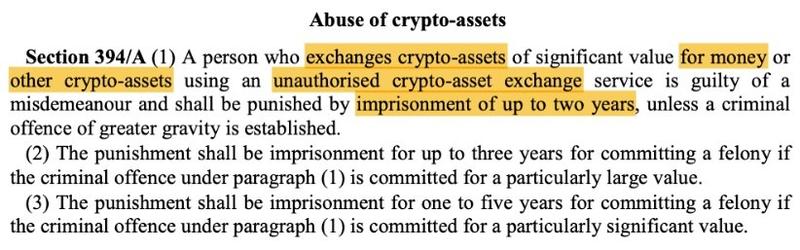
Private citizens or organizations conducting cryptocurrency exchanges valued between 5 million Hungarian forint and 50 million forint (approximately $16,000 to $160,000) via an unauthorized exchange platform faced potential imprisonment of up to two years.
Criminal sanctions escalated to five years for exchanges valued between 50 million forint and 500 million forint, and reached up to eight years for exchanges exceeding 500 million forint.
The cryptocurrency policy reversal follows Hungary's April 12 parliamentary election, which concluded the 16-year tenure of veteran nationalist Prime Minister Viktor Orban and elevated Peter Magyar's pro-European Tisza Party to government authority, with the incoming administration working to reduce friction following prolonged disputes between Hungary and the EU.
With additional reporting from Zoltan Vardai