How the SEC's tokenized stock regulations create market winners and losers
A five-year window for tokenized equities has been established by the SEC, though not all platforms and products meet the criteria. Which players among Uniswap, Robinhood, Coinbase, and Kraken will emerge victorious?

Robinhood's chief executive Vlad Tenev declared that "Tokenization is coming to America" following the SEC's announcement of its Innovation Exemption last week — a development that appears to have been favorably received by the markets.
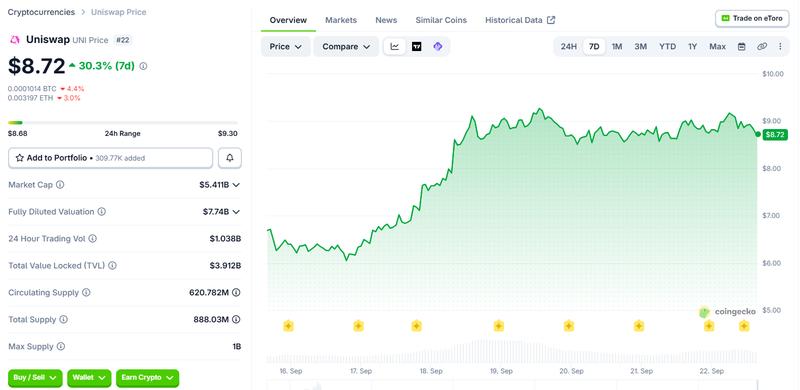
Both BTC and ETH experienced increases exceeding 10%, while Uniswap's UNI token — a protocol that appears positioned to become a major destination for tokenized equity trading — saw gains surpassing 30% in the subsequent days.
Although the Securities and Exchange Commission has officially authorized tokenized equities in America, the majority of current stock tokens don't comply with the newly established regulations.
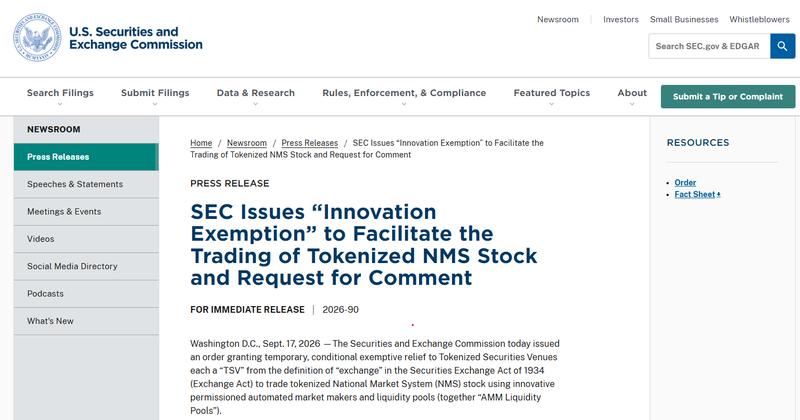
The commission's recently introduced five-year Innovation Exemption establishes a framework allowing specific venues to facilitate trading of tokenized National Market System (NMS) equities onchain without the requirement of registering as a securities exchange, and permits third parties to tokenize equities — though only when specific conditions are satisfied.
Tokens are required to provide holders with identical "rights and privileges" as the underlying equities, and trading platforms must implement permissioned access for users and liquidity pools.
There's significant variation among tokenized stocks. A token may resemble a share and mirror the valuation of a share while failing to deliver the shareholder rights associated with a share. The new regulations classify such instruments as synthetic stocks, which are deemed non-compliant.
"Not everything we do will fit, and that's fine. What matters is that the SEC acted instead of waiting on Congress to finish the job."
The SEC's tokenization lane is narrow
The Sept. 17 order from the SEC provides certain platforms with temporary exemption from exchange registration requirements when facilitating trades of tokenized NMS equities via permissioned AMM liquidity pools.
Put differently, the regulatory body has created an avenue for onchain equity trading, though it's relatively narrow in scope, and the characteristics of the token become equally critical as the platform itself.
For qualification purposes, a tokenized equity must grant holders identical dividend payments and voting privileges as the underlying security.
Although a third party has the ability to tokenize an equity without affiliation with the issuing company, the issuer retains the authority to reject the token prior to its trading commencement.
This provision eliminates synthetic exposure instruments, which represents negative news for Robinhood's Stock Tokens and Kraken's xStocks as they currently exist.
Commissioner Hester Peirce emphasized that the exemption applies to one specific model instead of encompassing every conceivable method of trading tokenized securities, though she noted the SEC remains receptive to alternative models beyond the TSV framework.
The products closest to the SEC's model
The stock tokens offered by Coinbase align reasonably well with the requirements.
On Sept. 14, chief executive Brian Armstrong stated the company had "set the standard" through its tokenized equities, emphasizing they are neither synthetic nor debt instruments, but rather "real fully-backed securities, redeemable for the underlying shares, with dividends integrated," and voting privileges "coming soon."
That said, Coinbase's present tokenized equity product serves non-US customers exclusively, and its exchange infrastructure operates on a central limit order book foundation. The SEC's exemption framework is constructed around TSVs offering permissioned AMM liquidity pools. Nevertheless, Coinbase's operation of the Base network provides it with alternative pathways in this context.
In June, Ondo introduced tokenized US securities, where the underlying equities are maintained in traditional custody while the token serves as the investor's onchain entitlement representation.
The company also completed the acquisition of Oasis Pro, which encompasses an SEC-registered broker-dealer, ATS and transfer agent, featuring infrastructure spanning both traditional and onchain market segments.
According to Curley, the SEC's exemption supports "exactly the model we've already proven out: custodial, entitlement-based, with real shareholder rights and corporate actions passing through to the holder." Nevertheless, he cautions, "we're not assuming anything clears automatically."
Coinbase and Ondo both possess components of the infrastructure the SEC appears to be seeking. Neither organization can presume its current configuration qualifies without modifications, though they potentially face less reconstruction than competitors.
Uniswap's permissioned pools could open the door
The SEC exemption has been specifically structured around permissioned AMM liquidity pools, a development that appears favorable for Uniswap.
In July, the protocol unveiled Permissioned Pools for v4, enabling regulated assets to be traded via AMMs with compliance enforcement implemented directly onchain.
Although this doesn't transform Uniswap into a TSV per se, its v4 infrastructure could serve as a foundation for operators constructing one, given that Permissioned Pools enable issuers to regulate who can engage in trading or supply liquidity, aligning with the SEC's stipulations.
Permissioned access mandates Know Your Customer (KYC) verification, maintenance of records, public disclosures and transaction transparency.
Should this infrastructure be integrated with the shareholder rights and regulatory framework necessary for US securities trading, Uniswap could possess a system capable of adaptation to the SEC's model.
Robinhood has the users, but not the right product
Approximately 200 stock tokens are currently trading on Robinhood Chain, which Tenev has characterized as one-to-one backed with full DeFi composability.
However, Jaewon Kim, the head of research at Four Pillars, observed that the SEC's order eliminates synthetic exposure, thereby disqualifying products such as Stock Tokens and Kraken's xStocks.
The Stock Tokens from Robinhood constitute tokenized debt securities issued through Robinhood Assets (Jersey) Limited. This structure means they deliver economic exposure to the underlying equities while failing to grant holders legal or beneficial rights. Additionally, they lack registration under US securities laws and remain unavailable to US persons.
Nevertheless, although Robinhood's current offering doesn't conform to the SEC's regulations, its distribution capabilities and blockchain infrastructure could provide substantial competitive advantages should it successfully adapt its model to satisfy the new stipulations.
Kraken's xStocks maintain full backing by underlying equities, yet they similarly fail to provide holders with equivalent rights as traditional shares. Simply having backing by shares proves insufficient for qualification under this exemption.
Five years to prove tokenized stocks are actually better
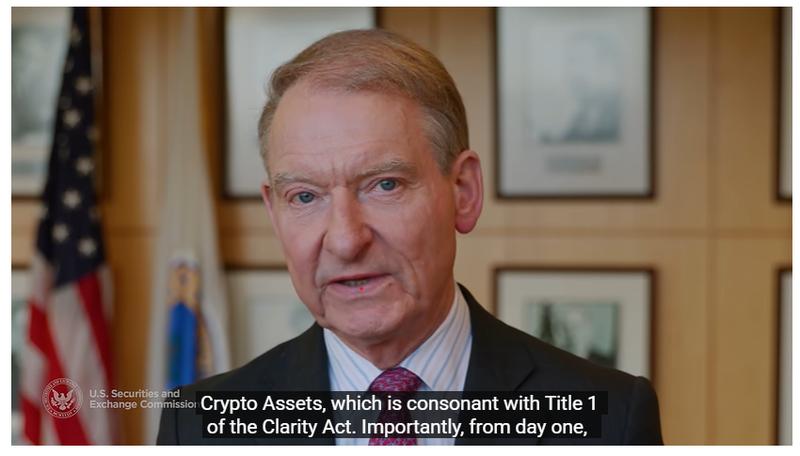
The SEC characterizes the exemption as temporary in nature, with chairman Paul Atkins indicating the five-year duration will enable the market to "develop" as the commission "evaluates future rulemaking."
Beyond determining which company establishes the first compliant platform, the genuine challenge lies in whether tokenized equities will achieve mainstream adoption initially.
As Curley articulates, investors require an outcome that's "faster, cheaper, or more useful than a conventional brokerage position." Concerns have already emerged regarding whether the fragmented liquidity across stock tokens will deliver competitive pricing or satisfactory user experience.
The exemption has the potential to facilitate 24/7 trading capabilities, fractional ownership opportunities, accelerated settlement processes, onchain composability and shareholder rights preservation. Ultimately, however, these benefits hold significance only if investors demonstrate genuine interest.