How Recovering $2.85B from Binance Thieves Makes the Case for UK Stablecoin Freeze Regulations
The recent Binance breach demonstrated the effectiveness of stablecoin freezing mechanisms. Britain should now establish mandatory freeze protocols as a prerequisite for coin listings.

Opinion by Lissele Pratt, co-founder, Capitalixe
Over the past weekend, the Federal Bureau of Investigation announced that North Korea stood behind the $6.3 billion Binance breach, which industry experts are describing as the most significant theft in cryptocurrency history.
Although I've encountered extensive coverage regarding the magnitude of this criminal operation, considerably less attention has been paid to the aspects that actually functioned as intended.
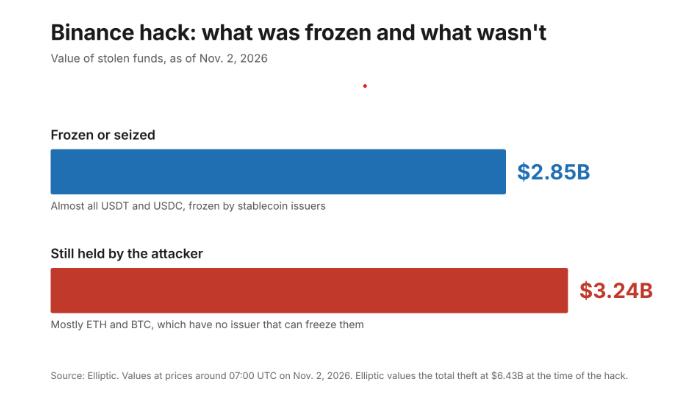
The reality is that despite the criminals successfully stealing $6.3 billion, they have been unable to retain a substantial portion of these proceeds. Authorities and stablecoin issuers have managed to freeze $2.85 billion of the stolen assets.
The explanation for this outcome relates directly to the composition of the stolen funds. Of that frozen $2.85 billion, an overwhelming 94% consisted of stablecoins.
Although this breach represented catastrophic news from every angle, it provided clear evidence that centralized oversight, frequently condemned by cryptocurrency traditionalists, may in fact represent one of our most powerful weapons in the fight against digital asset crime.
The key difference is that, unlike alternative cryptocurrencies, stablecoins possess the unique characteristic of being freezable by the companies that issue them, providing theft victims with a genuine opportunity to prevent stolen funds from reaching criminal hands.
This situation does, nevertheless, present a troubling dilemma. When private corporations possess the authority to freeze assets worth billions of dollars, who determines the circumstances under which they should exercise this power?
The United Kingdom currently finds itself in a position to answer precisely that question.
The rush to dispose of stablecoins
To truly understand the significance of the freeze capability, one need only examine the actions taken by the criminals during the initial sixty minutes following their heist.
The hackers obviously recognized that they faced an extremely narrow time frame to transfer the stablecoins before intervention could occur. Consequently, they acted with extreme urgency.
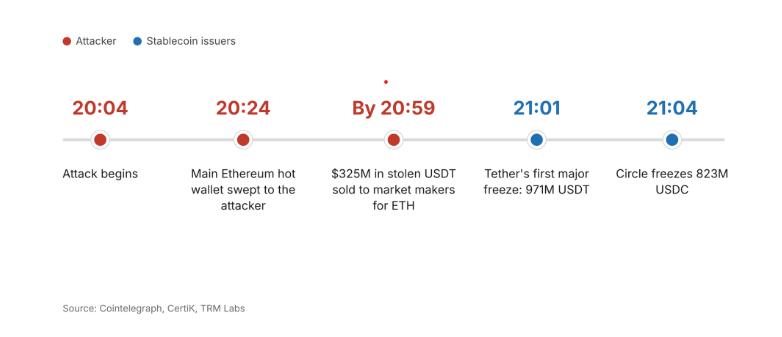
Within less than sixty minutes from the moment the breach commenced, they had successfully exchanged $325 million in stolen USDT (the stablecoin issued by Tether) for Ether. Their strategy centered on converting an asset vulnerable to freezing into one that possessed immunity from such interventions.
Fortunately, the companies issuing stablecoins responded with remarkable speed, with Tether implementing its first significant freeze merely 37 minutes after the stolen assets arrived in the hackers' primary wallet, and Circle responding three minutes after that, preventing any USDC movement.
Had Tether and Circle not stepped in when they did, substantially more of the stolen funds would likely have escaped beyond their capacity to recover.
Standardized rules remain absent
The freezing mechanism, credit where it's due, proved largely effective primarily because a small number of corporations chose, on the spot, to deploy it.
The challenge lies in the fact that no universally accepted framework currently exists that defines when freezing funds becomes justified or establishes how rapidly the intervention must occur, and we're starting to witness the ramifications of this regulatory vacuum.
As an example, Circle currently faces a proposed class action lawsuit from Drift Protocol investors alleging the company failed to freeze approximately $230 million in stolen USDC following the April security breach. The plaintiffs contend that Circle possessed the capability to halt the funds' movement but failed to respond with adequate speed.
At the same time, Tether faces legal action in New York from two business owners claiming the company froze several million dollars of their holdings months before any seizure warrant was issued. It bears mentioning that Tether has issued a response to this lawsuit, dismissing these claims as without merit.
Given my professional experience in payments and banking, I routinely observe traditional financial institutions freezing funds and customer accounts. This raises the question: if conventional banks can take these actions regularly, what justification exists for preventing stablecoin issuers from doing the same?
My position isn't opposition to their freeze authority. However, banks don't operate with arbitrary discretion when freezing customer assets. A legal justification typically underlies their actions, along with established procedures for customers to contest these decisions.
Stablecoin issuers currently wield equivalent authority while facing pressure to respond more rapidly and navigate international jurisdictional boundaries. The time has arrived for them to operate within an established framework.
The UK has the opportunity to solve this problem
A complication exists, however, when considering stablecoin issuer regulation. Tether and Circle, representing two of the industry's dominant issuers, maintain their operations outside the UK, meaning British regulatory authorities cannot unilaterally dictate their operational procedures.
What British authorities do possess jurisdiction over, though, is determining which stablecoins UK consumers can access for purchase, and they've already initiated this process.
Last June, the Financial Conduct Authority (FCA) released its cryptoassets regulatory framework. This framework requires UK-based trading platforms to conduct comprehensive due diligence and make public a disclosure document prior to listing any cryptocurrency, including stablecoins issued by overseas entities. The regulations become effective on 25 October 2027.
The Bank of England plans to complete its Code of Practice governing systemic stablecoin issuers before the current year ends. This code applies to stablecoins that have achieved sufficient widespread adoption in payments to affect UK financial system stability.
Neither regulatory framework currently establishes the explicit responsibilities surrounding the freezing of stolen assets that I consider essential. However, both frameworks remain under development, presenting the UK with an ideal window to close this gap immediately, instead of attempting to add new requirements to completed regulations later.
Two prerequisites for obtaining UK listing approval
Here's my proposed solution that I'm confident would prove effective. Prior to any stablecoin receiving authorization for sale on a UK-based platform, the issuing company should be required to satisfy two specific conditions.
The first requirement is maintaining accessibility and preparedness for immediate action. Tether and Circle demonstrated exactly this capability last week, though the affected party was the planet's largest cryptocurrency exchange. A smaller UK-based platform deserves identical responsiveness.
My work involves collaboration with numerous smaller cryptocurrency enterprises that lack Binance's industry prominence or established communication channels with Tether. Within the existing system, these organizations face the highest probability of experiencing delays in receiving assistance.
The second requirement involves establishing a transparent timeline governing subsequent actions. When an issuer implements a freeze on funds, that issuer should be obligated to inform the National Crime Agency within the same twenty-four-hour period. The freeze should then automatically expire unless a judicial order has been secured to maintain the wallet in frozen status.
Neither of these proposals represents a particularly radical position. They would provide law enforcement agencies with an opportunity to take action when theft occurs while simultaneously protecting individuals from experiencing indefinite asset freezing without proper legal authorization.
The Binance security breach has demonstrated conclusively that stablecoins possess the capability to provide cryptocurrency crime victims with an opportunity to intercept stolen funds before they disappear permanently. This capability shouldn't remain an exclusive benefit available only to the world's largest cryptocurrency exchanges.