How AI Infrastructure Turned Crypto Companies Into Wall Street Darlings
The recent stock rally at Galaxy Digital reveals an emerging pattern: Wall Street is increasingly rewarding cryptocurrency companies for their AI infrastructure capabilities rather than their digital asset portfolios.

From tokens to power: The AI revolution reshaping crypto company valuations
Historically, cryptocurrency companies have been evaluated based on conventional metrics including trading volumes, digital asset portfolios, mining revenues and total assets under management.
Market participants traditionally assessed these organizations based on their Bitcoin exposure, Ethereum holdings and their connection to the expanding blockchain ecosystem.
This perspective is now undergoing a transformation.
During June 2026, Galaxy Digital's stock experienced a significant rally as market participants concentrated on an alternative aspect of the company's operations: infrastructure for artificial intelligence. This surge highlighted an emerging trend within public markets. Several cryptocurrency enterprises are discovering that their control over power resources, real estate and data center facilities may be more valuable to Wall Street than their conventional cryptocurrency business lines.
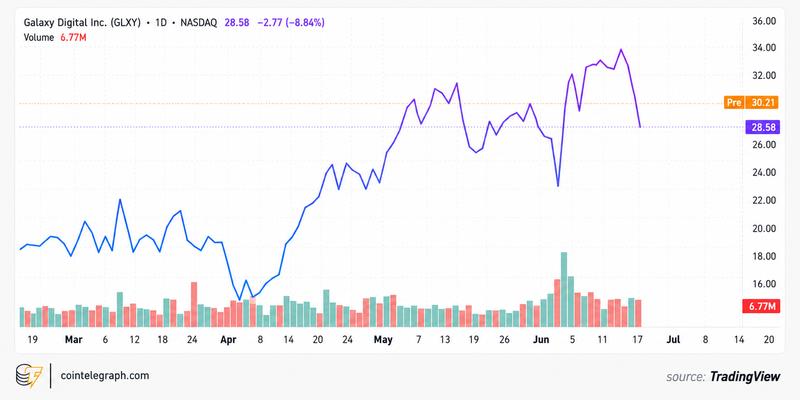
This development signals a broader transformation across financial markets. With artificial intelligence demand accelerating, the infrastructure required to power AI models has emerged as among the most sought-after resources globally. In certain instances, cryptocurrency companies already possess precisely the assets that artificial intelligence enterprises are pursuing.
Galaxy Digital's unexpected rally surprises crypto market participants
Galaxy Digital has established itself as a prominent digital asset player, operating diverse businesses spanning trading operations, asset management services, venture capital investments and blockchain infrastructure development.
However, the catalyst behind its latest stock appreciation was unrelated to Bitcoin valuations, exchange-traded fund capital flows or broader cryptocurrency market activity.
Rather, market participants directed their attention toward the company's Helios facility located in Texas. This location represents a substantial data center development targeted at artificial intelligence applications and high-performance computing operations.
Statements from Galaxy Digital's leadership team indicated that Helios might ultimately represent a significant portion of the organization's overall valuation. Market analysts seemed to concur. Rather than evaluating Galaxy Digital exclusively as a cryptocurrency enterprise, investors started analyzing it as an artificial intelligence infrastructure provider.
The stock movement demonstrated a distinct shift in investor valuation methodology for certain crypto enterprises. An organization established on digital asset foundations unexpectedly captured market interest for its potential contribution to the artificial intelligence industry.
Did you know? Bitcoin miners previously competed primarily for inexpensive electricity. Today AI companies are vying for the identical resource. Across numerous regions, power access has surpassed the value of access to graphics processing units (GPUs) themselves. Various utilities have documented waiting periods extending multiple years for substantial AI data center developments requesting grid access.
The surging value of AI infrastructure explained
Artificial intelligence's explosive expansion has generated a novel constraint. The primary obstacle is no longer solely developing more sophisticated AI models. It also involves obtaining sufficient computing power to train and operate them.
Contemporary AI platforms require extensive GPU arrays, specialized networking infrastructure, sophisticated cooling mechanisms and enormous electricity supplies. Constructing the facilities that accommodate this equipment now ranks among the technology industry's most capital-intensive undertakings.
Consequently, investors are directing increased attention toward organizations that supply this fundamental infrastructure, beyond merely those developing AI applications.
Data centers have transformed into critical enablers of AI expansion.
This clarifies the robust investor enthusiasm for infrastructure-oriented enterprises. Organizations that maintain power supply control, grid connectivity and substantial computing facilities possess assets that are challenging and costly to replicate.
For Wall Street, these characteristics frequently indicate sustained revenue generation potential and more predictable financial performance.
The strategic positioning of certain crypto companies
Certain cryptocurrency enterprises maintain advantageous positions because they already possess infrastructure requirements that align with the AI industry's needs.
Initially, cryptocurrency operations and artificial intelligence appear as entirely distinct sectors. Nevertheless, both rely upon one critical resource: enormous computing capability.
Throughout their evolution, Bitcoin mining facilities and other cryptocurrency infrastructure operations made substantial investments in locations designed for elevated power consumption. They obtained appropriate land parcels, negotiated power procurement contracts, deployed sophisticated cooling infrastructure and established direct electrical grid connections.
These identical resources are currently attracting attention from artificial intelligence organizations.
While an AI data center differs from a cryptocurrency mining facility, the two share multiple fundamental requirements, encompassing significant electricity consumption, expansive physical locations and adequate space for specialized hardware. This convergence has generated an unanticipated opportunity.
In certain situations, AI operators can collaborate with established facilities initially constructed for cryptocurrency purposes. This approach enables them to circumvent the expense and timeline associated with constructing entirely new locations.
Consequently, certain crypto enterprises now control valuable assets within the expanding AI infrastructure marketplace.
Galaxy Digital's evolving approach centered on Helios
Galaxy Digital's Helios campus demonstrates how infrastructure initially connected to Bitcoin mining can be repurposed toward AI computing applications. Following the acquisition of this location from Argo Blockchain in 2022, Galaxy Digital commenced transitioning Helios toward high-performance computing and AI data center capabilities.
This approach received additional validation when AI cloud services provider CoreWeave established agreements associated with the location. These arrangements indicated that prominent AI enterprises recognized strategic worth in the infrastructure.
Extended AI infrastructure contracts can generate consistent revenue flows that are more predictable than income derived from cryptocurrency trading activities. Rather than depending on volatile market fluctuations, organizations can establish cash flow through multi-year commitments.
This degree of predictability appeals to public market participants.
Did you know? Training and operating sophisticated AI models demands substantial computing resources. This requirement is compelling developers to conduct global searches for regions with plentiful and dependable energy sources.
The emergence of crypto-AI hybrid enterprises
Galaxy Digital's Helios approach represents more than an exceptional instance. Throughout portions of North America, numerous crypto mining and digital infrastructure organizations have begun exploring opportunities in AI hosting, cloud computing services and high-performance data center management.
This indicates a broader transformation in how financial markets categorize these operations. Historically, cryptocurrency companies were frequently perceived as high-risk ventures closely correlated with digital asset valuations.
Currently, certain investors are distinguishing infrastructure assets from direct cryptocurrency exposure.
An organization controlling substantial megawatts of power availability may attract a distinct valuation methodology compared to one primarily dependent on trading income. This has spawned a novel business category: the crypto-AI hybrid entity.
These organizations maintain digital asset activities, while increasing proportions of their valuation derive from infrastructure capable of supporting multiple industries.
Wall Street's preference for AI-derived revenue streams
The market's inclination becomes more apparent when examining the financial characteristics of both sectors. Cryptocurrency revenues frequently demonstrate significant temporal volatility.
Trading activity fluctuates with prevailing market psychology. Asset management compensation varies with cryptocurrency valuations. Mining profitability shifts according to network difficulty parameters and token valuations. Comparatively, AI infrastructure revenue can resemble income from conventional utility or commercial real estate operations.
Organizations execute multi-year agreements. Revenue becomes more forecastable. Financial projections become less complicated to develop. Institutional capital allocators typically assign premium value to this consistency.
An extended lease arrangement with an AI customer frequently carries reduced perceived risk compared to dependence on future cryptocurrency market dynamics. Therefore, enterprises connected to AI infrastructure can justify elevated valuation multiples.
This doesn't indicate investors have abandoned cryptocurrency. Rather, they may perceive AI infrastructure as a more dependable foundation for future revenue generation.
Is the market experiencing excessive optimism?
Despite prevailing enthusiasm, legitimate concerns warrant consideration. The AI infrastructure surge has generated considerable excitement, prompting certain analysts to question whether excessive capacity might eventually materialize.
Historical technology cycles provide numerous illustrations of premature overinvestment. Railroad networks, telecommunications systems and early internet infrastructure all experienced phases of surplus development before utilization aligned with available supply.
AI infrastructure might encounter comparable challenges if capacity expansion outpaces demand growth.
Should demand materialize more gradually than anticipated, certain data center initiatives may fail to achieve the utilization rates investors currently project.
Implementation challenges also persist. Transforming facilities originally designed for cryptocurrency applications into AI-capable locations requires substantial capital investment and specialized technical knowledge. Not every organization will execute this conversion successfully.
Investors must accordingly weigh genuine opportunities against the possibility of market overenthusiasm.
Did you know? Organizations constructing AI infrastructure are progressively negotiating energy agreements directly with utility providers, renewable energy developers and even nuclear facility operators to guarantee long-term electricity availability.
Implications for cryptocurrency investors
The consequences extend substantially beyond Galaxy Digital. Investors evaluating cryptocurrency-related equities may require assessment beyond digital asset holdings.
Considerations that previously focused predominantly on cryptocurrency now incorporate infrastructure analysis:
- What power capacity does the organization control?
- Does it maintain ownership of strategically located real estate?
- Can its facilities accommodate AI computing requirements?
- Are prominent technology corporations interested in leasing its infrastructure?
- How diversified are its income sources?
In certain circumstances, these elements may carry equivalent weight to Bitcoin reserves or trading activity levels.
This suggests an evolving valuation framework, where physical infrastructure assets receive greater consideration than digital holdings exclusively.
The emerging paradigm: Power infrastructure outweighs crypto exposure
Galaxy Digital's stock appreciation underscored a definitive market transformation.
Wall Street is attributing substantial value to the infrastructure necessary for powering artificial intelligence systems. Data center facilities, dependable electricity access and computing resources have become strategically critical assets.
Certain cryptocurrency enterprises already maintain control over these resources following years of development for mining and blockchain applications. As artificial intelligence demand intensifies, investors may increasingly view these assets as more valuable than traditional cryptocurrency business operations.
For organizations like Galaxy Digital, future prospects may no longer hinge exclusively on Bitcoin performance, trading operations or asset management activities. The principal value driver could prove more tangible: access to electrical power, real estate and the computing infrastructure essential for supporting the forthcoming artificial intelligence wave.