Gulf Investors Maintain AI, Crypto Positions While Purchasing Technology Downturn
Investors in the UAE continue accumulating AI and technology assets during market decline, sustaining positions in semiconductors, software, and cryptocurrency while regional tensions test the Gulf's aspirations as a worldwide technology center.

Investors based in the United Arab Emirates are embracing the artificial intelligence market correction instead of withdrawing from it, even as regional tensions put the Gulf's vision of becoming a worldwide center for AI and digital assets to the test.
Fresh data from eToro provided to Cointelegraph on Wednesday reveals that UAE-based users increased their positions in software and AI infrastructure companies whose stock valuations dropped substantially during the opening quarter, indicating they leveraged the market decline to "buy the dip" instead of executing broad risk reduction strategies.
This investment behavior indicates UAE investors are maintaining commitment to long-term AI and digital-infrastructure narratives even while the conflict introduces additional risks for data centers, logistics operations, and cross-border technology expansion projects throughout the Gulf. A report published on April 13 by Deutsche Bank indicated the disruption is more probable to intensify rather than prevent demand for AI, cybersecurity, and sovereign digital infrastructure throughout the region.
According to Josh Gilbert, market analyst at eToro, who spoke with Cointelegraph, UAE investors demonstrated greater selectivity regarding where they allocated risk during Q1, with investor conduct motivated by long-term narratives rather than a risk-averse approach.
Gilbert stated the most definitive indicator emerged across AI infrastructure and software stocks, highlighting ServiceNow (+125%), Super Micro Computer (+65%), Adobe (+54%) and Oracle (+38%), all of which experienced substantial increases notwithstanding market headwinds.
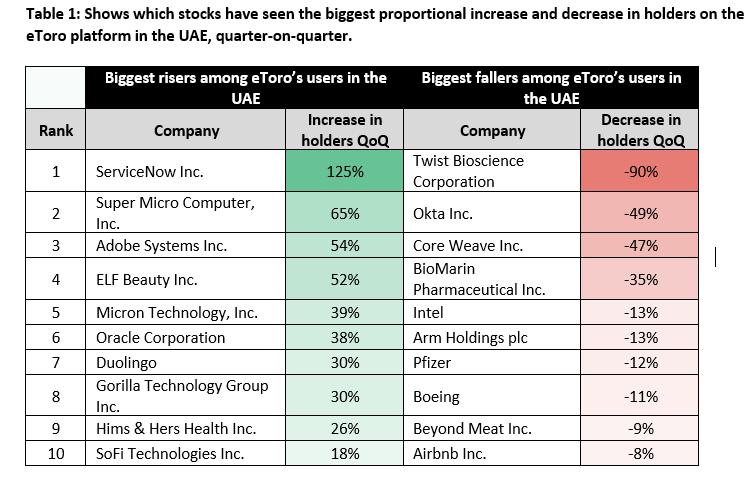
Regarding the crypto sector, Gilbert noted that Strategy Inc. continued as the eighth-most-held stock, demonstrating persistent exposure to crypto-linked equity instruments.
War puts Gulf AI ambitions under pressure
This durability emerges while the US-Israeli conflict with Iran has revealed new vulnerabilities for Gulf technology infrastructure. Deutsche Bank referenced reported attacks on Amazon Web Services data centers located in the UAE and Bahrain and intimidations directed at the planned 1GW Stargate campus in Abu Dhabi.
According to Gilbert, the conflict has been generating volatility, accompanied by dramatic oil price fluctuations that can eventually impact tech valuations. Preserving core positions in diversified mega-cap tech while repositioning within the sector indicates a more sophisticated, risk-conscious strategy, Gilbert explained.
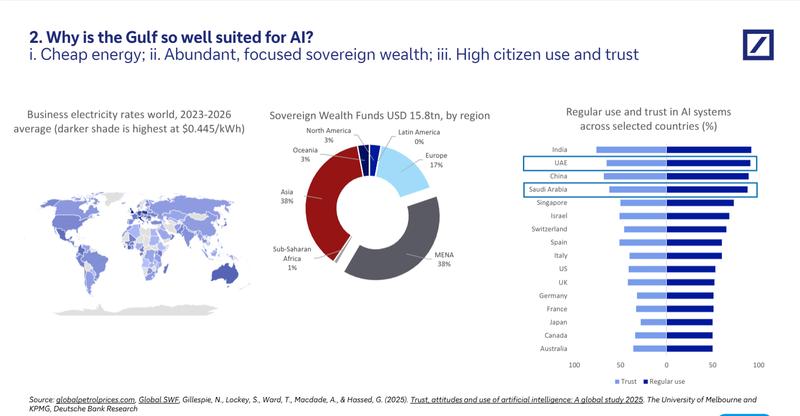
Deutsche also emphasized that the Gulf region, and the UAE specifically, is improbable to withdraw from the AI competition. The area enjoys advantages from inexpensive energy, an exceptionally concentrated pipeline of data center initiatives, and sovereign wealth funds that manage approximately $5 trillion globally in 2025, with Abu Dhabi entities among the most assertive supporters of global AI transactions, according to the report.
Crypto companies stay open as conflict remains
At the operational level in Dubai, cryptocurrency industry participants report the conflict has decelerated but not stopped the city's ambitions as a hub. Ben El-Baz, managing director of HashKey MENA, informed Cointelegraph that business operations continued "broadly functional," facilitated by cloud-based trading and custody platforms less reliant on a physical presence, although remote work arrangements and travel complications were unavoidable.
Additional companies, including Binance, also maintained normal business operations, notwithstanding contrary reports. A Binance spokesperson informed Cointelegraph employees received the option of temporary relocation as a precautionary step, but the "vast majority" elected to stay, while significant conferences such as Token2049 were postponed.
Ento Capital, a Dubai-based investment firm, states the conflict is "refining" instead of derailing the GCC narrative. Hayssam El Masri, senior executive officer, told Cointelegraph that investors have transitioned from "confidence-driven to risk aware," but are typically not withdrawing from the region. Battle-tested resilience and continuing investment in AI, cloud and crypto infrastructure may eventually reinforce the GCC's long-term positioning, El Masri stated.
Regulators bet clear rules will anchor capital
Dubai's Virtual Assets Regulatory Authority (VARA) has persisted in implementing its activity-based framework throughout the disruption, including comprehensive guidance on token issuance and formal regulations for crypto derivatives.
Sean McHugh, VARA's head of market assurance, informed Cointelegraph that during periods of stress, credible market participants do not pursue "the lightest-touch jurisdiction, they look for the clearest one," stating that Dubai's combination of transparent licensing, visible supervision and active enforcement is designed to convince institutions to regard the emirate as a strategic base instead of an opportunistic punt.